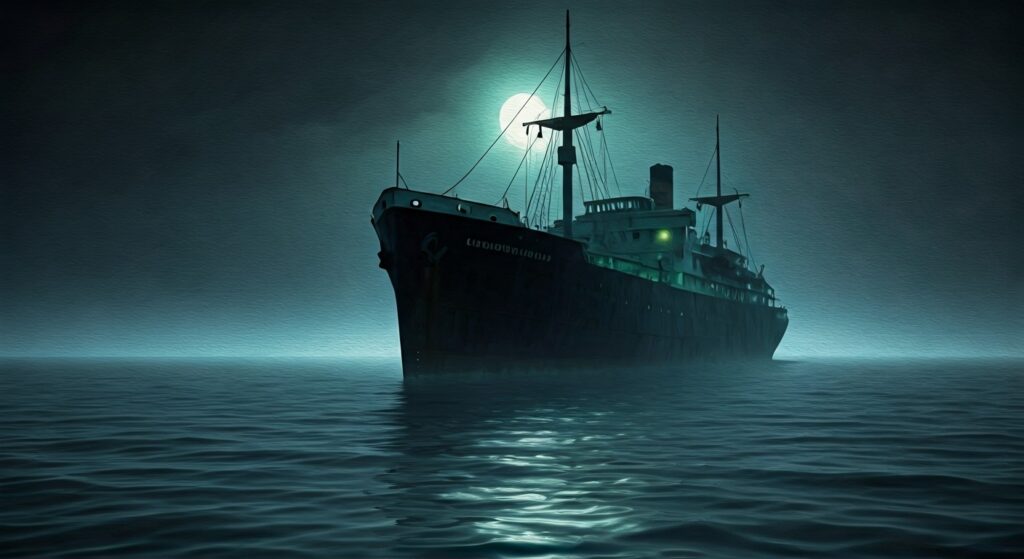
The year was 1947—or perhaps 1948. Records from the post-war era are notoriously slippery, but the terror of what transpired in the deep, murky waters of the Strait of Malacca remains absolute. Several vessels, including the American ships City of Baltimore and Silver Star, were navigating the heavily trafficked shipping lane when their radio operators picked up a frantic, disjointed Morse code SOS.
The transmission was utterly grim: “All officers including captain are dead lying in chartroom and bridge. Possibly whole crew dead.”
A chaotic burst of indecipherable dots and dashes followed. Then, a final, bone-chilling sign-off pierced the static: “I die.”
After that, there was only the vast, impenetrable silence of the ocean.
Boarding the Floating Tomb
The crew of the Silver Star quickly triangulated the signal, tracking it to a Dutch freighter known as the SS Ourang Medan—roughly translating to “Man of Medan.”
When the Silver Star pulled alongside the drifting vessel, the deck was eerily still. Hails went unanswered. The captain ordered a boarding party to investigate, but nothing could have prepared the men for the macabre scene awaiting them.
The entire crew was dead.
Bodies were strewn across the decks, the chartroom, and the bridge. But it wasn’t just the sheer scale of the tragedy that terrified the boarding party; it was the posture of the dead. The victims’ eyes were wide open, their faces contorted in expressions of unadulterated agony and terror. Their arms were outstretched, fingers grasping at the air as if trying to fend off an unseen attacker. Even the ship’s dog was found frozen in death, its teeth bared in a mid-snarl.
Yet, as the rescue party frantically searched the ship, they uncovered a deeply baffling detail: there wasn’t a single drop of blood. There were no visible signs of trauma, no bullet wounds, and no blunt force injuries. The ship itself was completely undamaged.
The Evidence Goes Up in Smoke
Determined to uncover the truth, the Silver Star’s captain decided to tow the floating tomb into port where authorities could investigate. The crew secured a tow line and prepared to move out.
But the Ourang Medan had one last terrifying trick up its sleeve.
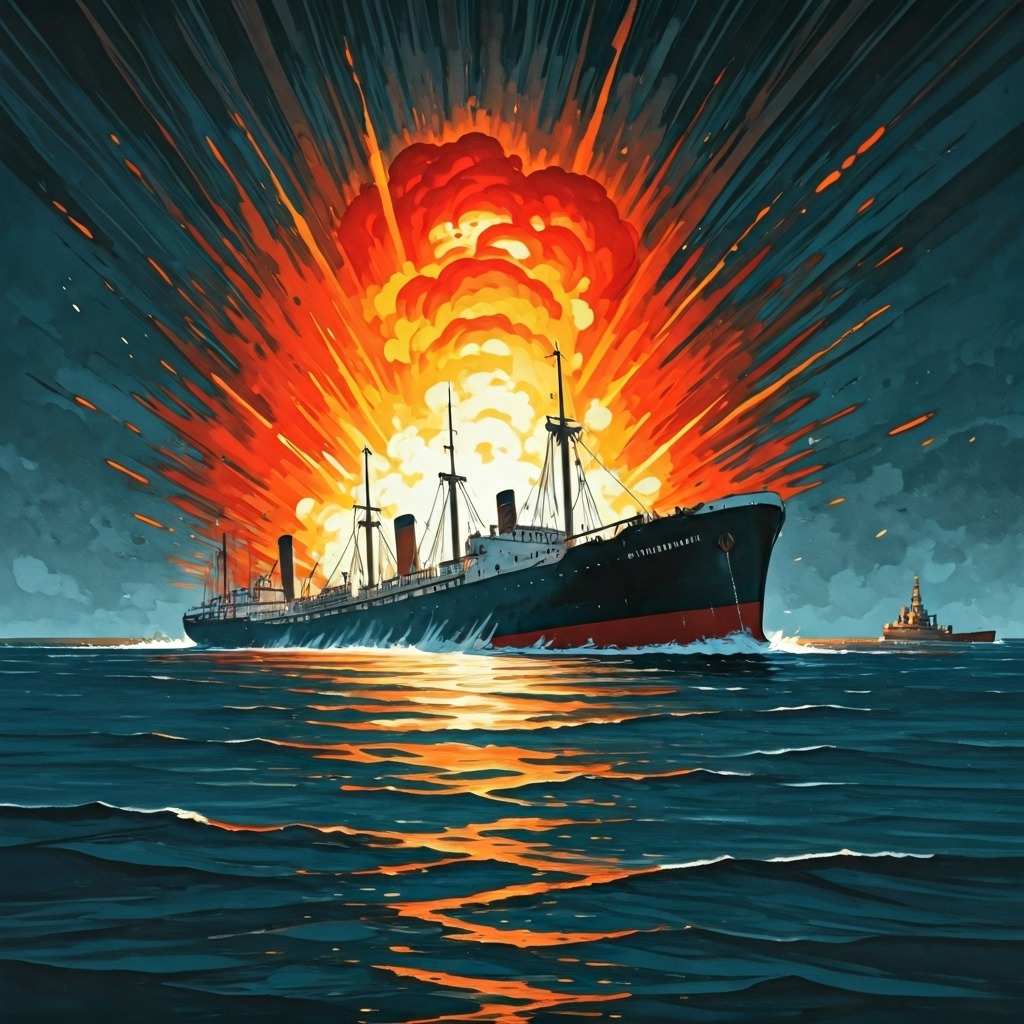
Before they could even get underway, a sudden, violent fire erupted deep within the Ourang Medan’s No. 4 cargo hold. The boarding party was forced to evacuate immediately, scrambling back to the safety of the Silver Star. Moments after they severed the tow line, a massive explosion ripped through the ghost ship. The blast was so powerful it lifted the vessel entirely out of the water before sending it plunging to the bottom of the ocean.
In an instant, all physical evidence of the tragedy was swallowed by the sea.
The Ship That Never Was
When modern historians attempt to verify this chilling tale, they hit a massive brick wall. Extensive searches of official maritime databases, including Lloyd’s Register of Shipping, yield absolutely zero records of a vessel named the SS Ourang Medan.
Skeptics are quick to point out that the earliest known written account of the incident surfaced in 1948, in a series of articles published by the Dutch-Indonesian newspaper De Locomotief. The paper later admitted the tale might have been heavily romanticized fiction.
Case closed? Just an urban legend?
Not quite. The story refused to die, gaining major official traction when it was published in the May 1952 issue of the Proceedings of the Merchant Marine Council by the U.S. Coast Guard. Why would an official U.S. government maritime publication legitimize a random Indonesian ghost story? That single detail keeps the mystery alive, haunting the edges of maritime history.
Covert Cargo or the Unknown?
If the ship did exist, what killed its crew?
The most grounded—yet sinister—theory suggests the Ourang Medan was a black-market smuggler. In the chaotic aftermath of WWII, the world was awash in dangerous, illicit materials. Some researchers believe the ship was secretly transporting potassium cyanide, nitroglycerin, or even leftover nerve agents like Tabun or Sarin, possibly tied to the notorious Japanese biological warfare division, Unit 731. A leak of a deadly nerve gas would perfectly explain the rapid asphyxiation, the lack of physical trauma, and the terrified, wide-eyed expressions of the crew. Furthermore, seawater mixing with a volatile, leaking cargo would easily trigger the sudden fire and massive explosion.
Another highly plausible theory points to carbon monoxide poisoning. A smoldering, undetected fire in the ship’s boiler rooms could have silently flooded the vessel with deadly, odorless gas, killing the crew before eventually igniting the cargo hold.
And then, there are the fringe theories. Some propose encounters with mythical sea creatures, while others point to extraterrestrial phenomena. A crew frozen in terror, reaching up at an unseen force in the sky, before the ship mysteriously self-destructs to hide the evidence? It is a narrative tailor-made for the paranormal.
Whether the SS Ourang Medan was a real vessel carrying a deadly secret, or simply a masterpiece of post-WWII maritime folklore, it perfectly captures our primal fear of the vast, isolated ocean. It serves as a chilling reminder that out there in the deep blue, some secrets stay buried forever.