Every great historical disaster begins with a single, fatal misstep. For England, that misstep occurred on the pitch-black, freezing night of November 25, 1120.
King Henry I had spent years meticulously securing his legacy, resting the entire future of his kingdom on the shoulders of his only legitimate son, 17-year-old William Adelin. William and a glittering entourage of young nobles were set to cross the English Channel from Normandy to England aboard a state-of-the-art vessel known as the White Ship.
But before they set sail, the medieval equivalent of a frat party broke out. The crew and the young aristocrats engaged in heavy, reckless drinking. When they finally pushed off into the dark, the intoxicated oarsmen rowed the ship directly into a submerged rock.
The Party Boat That Broke a Kingdom
The vessel was ripped apart. In the freezing waters of the Channel, almost everyone aboard drowned, including the young heir. In one single, drunken shipwreck, the English succession was obliterated, setting the stage for a period of history so violently unhinged that chroniclers literally thought heaven had abandoned them.
The Ultimate Family Backstab
With his only legitimate son dead, King Henry I panicked. Desperate to secure his bloodline, he did something unprecedented: he named his daughter, Empress Matilda, as his sole heir.
Matilda was fiercely intelligent, a widow of the Holy Roman Emperor, and entirely capable. Henry forced his Anglo-Norman barons to swear oaths of fealty to her—not once, but multiple times. But this was the 12th century. The idea of a female ruler was deeply unpopular, a sentiment only made worse by her second marriage to Geoffrey of Anjou, a traditional rival of the Norman lords.
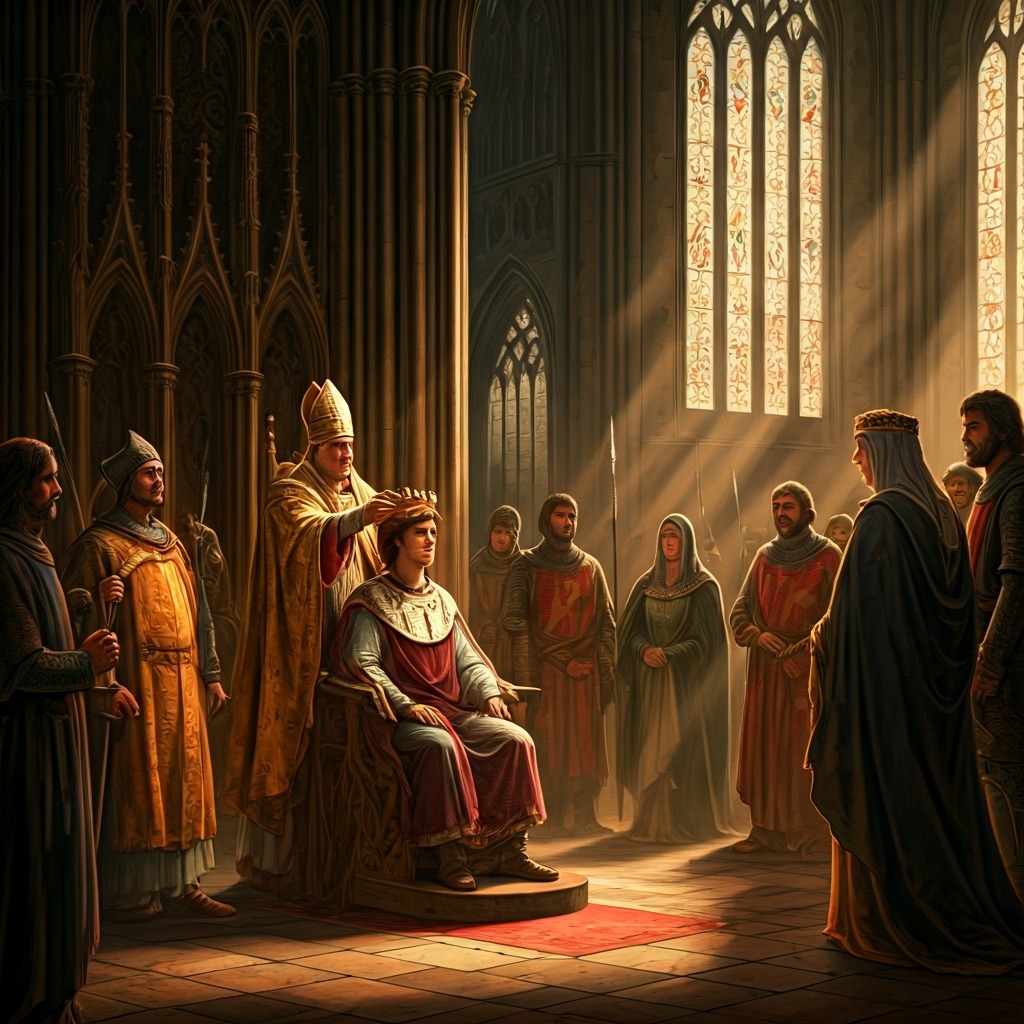
When King Henry I finally died in 1135, those sacred oaths evaporated instantly. Matilda’s own cousin, Stephen of Blois, saw an opening. Moving with terrifying speed, Stephen crossed the Channel, seized the royal treasury at Winchester, and had himself crowned King of England.
Stephen was affable, charming, and most importantly to the misogynistic barons, he was a man. But he had just stolen a crown that didn’t belong to him. And Matilda was not the type of woman to simply walk away.
Check, Mate, and a London Mob
In 1139, Matilda invaded England, backed by her powerful half-brother, Robert, Earl of Gloucester. The realm was instantly plunged into a brutal, grinding civil war known as The Anarchy.
Stephen was a brave warrior, but he lacked the ruthless, Machiavellian edge required of a medieval king. His leniency allowed the barons to run amok, playing both sides for their own gain. Matilda, on the other hand, was determined and unyielding—traits that male chroniclers of the time bitterly criticized as “imperious” and “unfeminine.”
The war became a dizzying, bloody game of chess. In 1141, the tide violently shifted when Stephen was captured at the Battle of Lincoln. Matilda had him in chains. The throne was finally hers.
She marched to London to prepare for her coronation. But victory made her uncompromising. When the Londoners begged for tax concessions, Matilda flatly refused. Enraged, a violent mob formed, chasing her out of the city before the crown could even touch her head. Days later, her chief military commander, Robert, was captured in the Rout of Winchester. Forced into a corner, Matilda had to trade Stephen for Robert, resetting the board and dragging the war back into a bitter stalemate.
Ghosts in the Snow
If there is one moment that defines the sheer grit of Empress Matilda, it happened in the dead of winter in December 1142.
Stephen had managed to trap Matilda inside Oxford Castle. He laid siege to the fortress, determined to starve her into submission. As the weeks dragged on and rations dwindled to nothing, surrender seemed inevitable.
But Matilda refused to yield. Under the cover of a pitch-black night, as a heavy snowstorm battered the castle, Matilda and a few fiercely loyal knights wrapped themselves entirely in white cloaks. Camouflaged against the driving snow, they were lowered by ropes from the towering castle walls. Moving like ghosts, they crept right past Stephen’s freezing sentries, slipped into the night, and walked for miles across the frozen, cracking ice of the River Thames to safety.
It was a daring, cinematic escape that kept her cause—and the war—alive.
When Heaven Closed Its Eyes
While the royals played their deadly game of thrones, the true horror of The Anarchy fell upon the common people.
Because King Stephen couldn’t control his realm, local lords transformed into ruthless “robber barons.” Men like the infamous Geoffrey de Mandeville built unlicensed, illegal fortresses known as “adulterine castles.” From these stone strongholds, they rode out to plunder the countryside, extorting and torturing the peasantry with absolute impunity.
The despair of the era was so profound that a monk writing in the Anglo-Saxon Chronicle recorded that the barons “tortured men with pains untellable.” The devastation was so absolute, the starvation so widespread, that the chronicler penned one of the most chilling lines in medieval history: it was said openly that “Christ and his saints slept.”
An Exhausted Peace and a New Dynasty
The nightmare dragged on for over a decade. It wasn’t until Matilda’s son, Henry FitzEmpress—a brilliant, relentless military commander—took up his mother’s mantle and invaded England in 1153 that the endgame finally began.
By this time, the realm was a burnt-out husk. The barons on both sides were completely exhausted, flatly refusing to fight any more pitched battles. When King Stephen’s own heir, Eustace, suddenly died, the fight completely drained out of the aging king.
Stephen finally agreed to the Treaty of Wallingford. The terms were a bitter compromise: Stephen would remain King of England for the rest of his life, but he had to legally adopt Henry as his son and recognize him as his sole heir.
Stephen died the very next year, in 1154. Matilda’s son ascended the throne as King Henry II, bringing the nightmare of The Anarchy to an end and giving birth to the mighty Plantagenet dynasty—a family that would go on to provide more than enough historical drama to keep the world captivated for centuries.