The streets of 17th-century Edo were bathed in the cold, flickering light of a paper lantern when the shogun’s guards came for the samurai. He was stripped of his rank, his reputation ruined, and his life forfeit.
His crime? He hadn’t plotted a coup against the government. He hadn’t dishonored his lord in combat.
He had abandoned a sick puppy.
History is littered with eccentric tyrants, but Tokugawa Tsunayoshi, the fifth ruler of the Tokugawa shogunate, remains an absolute wildcard. Reigning from 1680 to 1709, Tsunayoshi is remembered by a moniker that sounds more like a comic book villain than a military dictator: the “Inu-Kubo,” or the “Dog Shogun.” The story of how he earned that title is a masterclass in how a single, terrifying obsession can completely upend an empire.
The Monk, the Curse, and the Year of the Dog
To understand the madness, one must look to the shogun’s deepest insecurity. Despite his immense, unquestionable power, Tsunayoshi was missing the one thing a dynasty requires to survive: a male heir.
Desperate for a solution, he turned to a Buddhist monk named Ryuko. The monk delivered a chilling prophecy: Tsunayoshi’s inability to produce an heir was the result of dark karma. In a previous incarnation, the shogun had taken too many lives. To break the curse, Ryuko advised, Tsunayoshi had to show absolute, unwavering compassion to all living creatures. And because Tsunayoshi was born in the Year of the Dog, the canine species required his utmost devotion.
The shogun took this advice to a terrifying extreme.
Beginning in 1687, he unleashed the Shorui Awaremi no Rei, or the Edicts on Compassion for Living Things. These weren’t gentle suggestions to be kind to your pets. They were draconian laws backed by the lethal, unyielding force of the shogunate.
A Capital Offense for Swatting a Mosquito
Almost overnight, the social hierarchy of Edo-period Japan was flipped on its head. Suddenly, animals had more legal protection than the peasants who walked the streets. The edicts protected birds, fish, and even insects, but dogs were elevated to a sacred, untouchable status.
The atmosphere in Edo became one of suffocating paranoia. Imagine walking down the street, knowing that swatting a mosquito that landed on your neck could lead to imprisonment. Citizens and high-ranking samurai alike were exiled, locked up, or executed for harming, neglecting, or killing dogs.
Because culling was strictly banned, Edo’s stray dog population exploded into an absolute menace. Packs of wild dogs roamed the streets, becoming a massive public danger. But no one dared lift a finger against them.
The Canine Metropolis of Edo
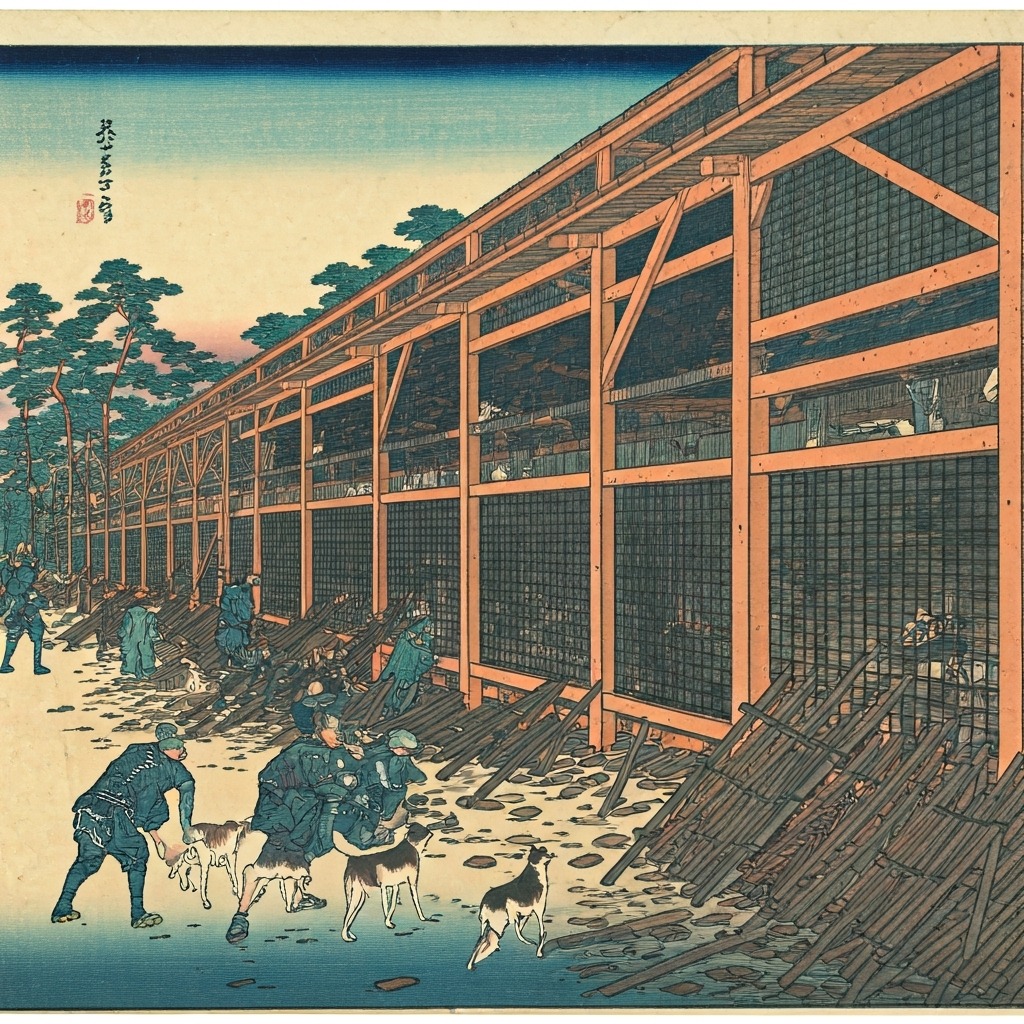
Tsunayoshi’s response to the stray dog crisis was a logistical marvel that still defies belief. To deal with the roaming packs, the shogun ordered the construction of massive, tax-funded dog shelters in the Nakano district of Edo. We aren’t talking about a few wooden pens. These sprawling facilities housed tens of thousands of stray dogs.
The government levied heavy taxes on the populace to fund this canine metropolis. The dogs were fed a daily, highly regulated diet of rice and dried fish—a menu vastly superior to what many human citizens were eating. While the dogs feasted, human commoners suffered through poverty and famine. The resentment brewing in the shadows was palpable, but the fear of the shogun’s blade kept the populace in line.
The Masterstroke of a “Mad” Dictator
For centuries, Tsunayoshi was written off as a madman. But when historians dig into the political realities of 17th-century Japan, a thrilling alternative theory emerges. What if the Dog Shogun wasn’t crazy at all? What if this was a calculated, ruthless political masterstroke?
Beyond his canine obsession, Tsunayoshi was a deeply educated Neo-Confucian scholar. He looked at the samurai class—men who had been bred for centuries to be martial killers—and realized they were a massive liability in a time of peace.
At the time, samurai casually engaged in a horrifying practice called tsujigiri, which translates to “crossroads killing.” If a samurai bought a new katana, he might test its sharpness by slicing down a random, unarmed passerby in the dead of night.
Some modern historians argue the Edicts on Compassion were a Trojan horse. By making the penalty for violence against any living thing so severe, Tsunayoshi was forcing the samurai to put away their swords. He was trying to domesticate a class of killers, transforming them from bloodthirsty warriors into educated, moral bureaucrats who respected the absolute, unquestionable authority of the shogun.
And it worked. His reign coincided with the Genroku era, a golden age of Japanese culture that saw an explosion of kabuki theater, haiku poetry, and ukiyo-e woodblock prints. It was an era of profound artistic beauty, overseen by a man who ruled with a terrifying, iron-clad leash.
The Leash Finally Snaps
Theory and reality are two different things, and the reality for the people of Edo was that no amount of cultural flourishing could make up for the terror of the dog laws.
The Edicts remained overwhelmingly, violently unpopular. When Tsunayoshi finally died in 1709, the illusion shattered. His successor, Tokugawa Ienobu, wasted zero time. He immediately repealed the Edicts on Compassion, and a collective sigh of relief washed over the entire Japanese archipelago. The giant shelters were dismantled, the draconian punishments ended, and the samurai could walk the streets without fear of a stray puppy ending their bloodline.
Yet, the legend of the Dog Shogun remains. Was he a cursed ruler terrified of his own karma, or a brilliant visionary who used puppies to disarm an army of killers? Either way, Tokugawa Tsunayoshi proved that sometimes, the strangest chapters in history are the ones where the bite is just as deadly as the bark.