The morning of February 22, 1803, was bitterly cold along the jagged coastline of Hitachi Province. As local fishermen cast their nets into the frigid, mist-shrouded Pacific, they spotted something impossible bobbing in the surf. It wasn’t a lost fishing boat. It wasn’t a whale. It was a vessel unlike anything they had ever seen—and it was about to become one of the most bizarre, heavily debated maritime mysteries in Japanese history.
The Hollow Ship
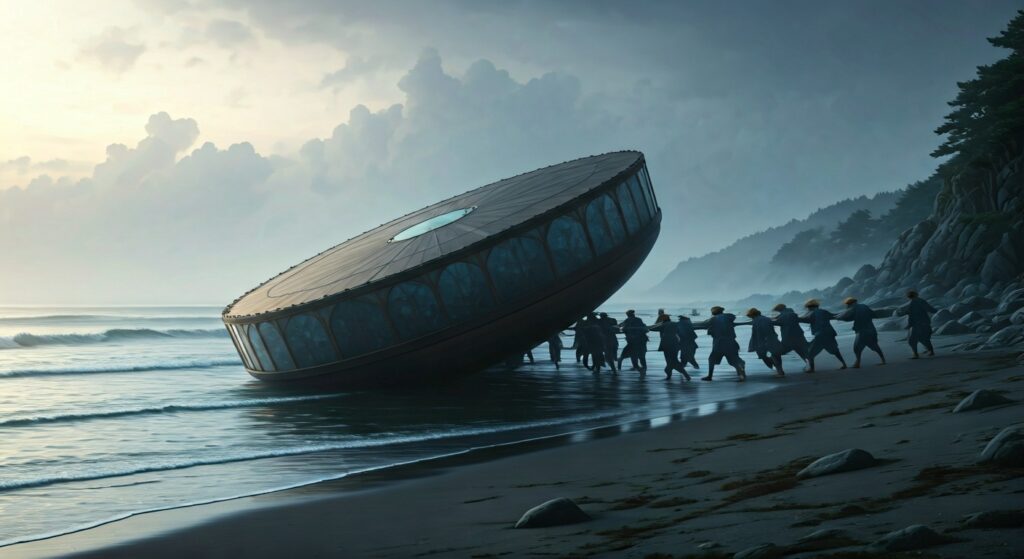
Curiosity overriding their caution, the fishermen rowed out, secured lines to the drifting anomaly, and hauled it onto the sand. They called it the Utsuro-bune—the “hollow ship.”
The craft was an engineering marvel that defied the era. Resembling a flattened spinning top, it measured roughly 3.3 meters high and 5.4 meters wide. The upper half was crafted from a rich, rosewood-like material, fitted with crystal-clear glass windows. To keep the harsh ocean out, the window seams were meticulously sealed with tree sap. The lower half was built for brutal survival, reinforced with heavy metal plates to protect the hull from being shredded by coastal rocks.
But the true shock came when the fishermen peered through the sap-sealed glass. They didn’t find a crew of lost sailors. They found a single, living occupant.
The Girl with the Red Hair
Inside the bizarre craft, the walls were covered in strange, geometric symbols resembling an alien script. Alongside the writing were meager provisions: two bed sheets, a bottle of water, some meat, and a type of kneaded cake.
But all eyes were on the ship’s sole passenger.
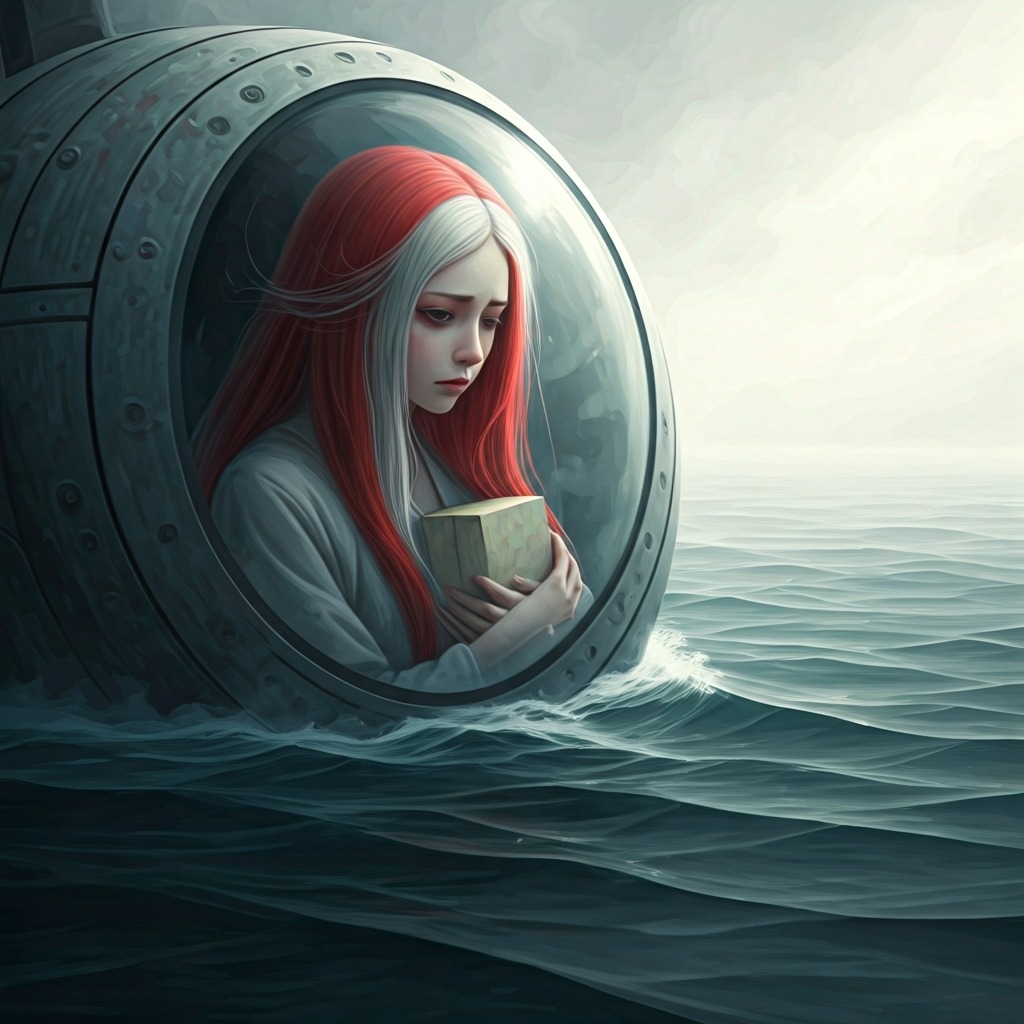
She was a young, exceptionally beautiful woman, estimated to be around twenty years old. Her skin was strikingly pale, and she wore garments crafted from unknown, high-quality fabrics that no local tailor could identify. Most unsettling of all was her hair—vibrant red, extended with long, white, artificial strands.
The fishermen tried to speak to her, but she answered in a melodic, completely incomprehensible language. She was entirely alone, save for one terrifying object.
The Pale Box
In her arms, the woman fiercely clutched a pale, square box, roughly two feet in length. No matter how much the locals pressed her, she refused to let anyone touch it, her panic rising whenever they approached.
Unable to communicate, the village elders were left to guess her origins, and their theory was incredibly grim. They speculated she was a foreign princess exiled from her homeland due to a scandalous, illicit love affair. The pale box she guarded with her life? They believed it contained the severed head of her executed lover.
The Ultimate Betrayal
This is where historical reality crashes into the mystery. At the time, Japan was operating under the strict isolationist policy of Sakoku. Contact with foreigners wasn’t just frowned upon; it was highly restricted and incredibly dangerous. Harboring an undocumented outsider—especially one arriving in a metal-plated, glass-windowed dome—could bring the violent wrath of the Shogunate down upon their entire village.
Faced with this terrifying prospect, the fishermen made a brutal, pragmatic choice. To avoid a deadly political nightmare, they packed the woman and her macabre box back into the Utsuro-bune, pushed it out into the unforgiving Pacific, and let fate decide her destination.
She drifted away into the mist, never to be seen again.
An Enduring Enigma
If this were just an old wives’ tale, it would have faded into obscurity. But the Utsuro-bune incident is remarkably well-documented. It appears in three prominent Edo-period texts, most notably Toen shosetsu (1825) by Kyokutei Bakin. These texts include incredibly detailed, identical illustrations of the woman, the ship, and the bizarre geometric script.
Today, the mystery divides experts into three distinct camps. Modern UFO enthusiasts frequently cite the Utsuro-bune as an early, documented close encounter, pointing to the disc-like shape and unrecognizable script as evidence of an Unidentified Submerged Object (USO). Historians suggest a more grounded reality: she may have been a Russian or British shipwreck survivor whose strange clothes and language were completely alien to isolated Japanese fishermen. Meanwhile, folklorists argue the “exiled princess in a boat” is a recurring motif in local mythology, perhaps a cautionary tale born in an era when the outside world was viewed with deep suspicion.
Whether she was a lost sailor, an extraterrestrial visitor, or a myth spun by fearful fishermen, the woman in the hollow ship remains one of the most captivating enigmas of the Edo period. And the greatest mystery of all still lingers: what was really inside that pale box?