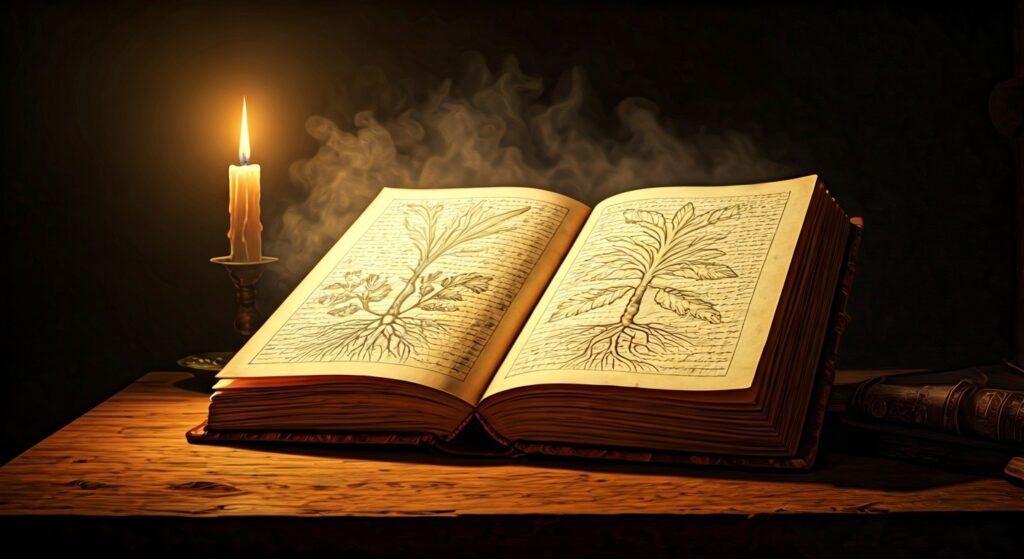
Deep inside a climate-controlled vault at Yale University’s Beinecke Rare Book and Manuscript Library sits a 240-page codex that has humiliated the greatest minds in human history.
Bound in calfskin and cataloged simply as MS 408, it is filled with a flowing, elegant script that no one on Earth can read. Its pages are bursting with bizarre, hallucinatory illustrations: alien plant species, intricate astrological diagrams, and naked women wading through interconnected, organ-like plumbing.
For over a century, elite cryptographers, brilliant linguists, and supercomputers have tried to crack its secrets. Every single one has failed.
This is the Voynich Manuscript—the ultimate historical cold case.
A Ghost in the Parchment
For decades, skeptics dismissed the manuscript as a brilliant modern forgery, likely cooked up by Wilfrid Voynich, the Polish book dealer who “discovered” it in an Italian Jesuit villa in 1912. But modern science tells a far more unsettling story.
In 2009, radiocarbon dating by the University of Arizona tested the manuscript’s vellum pages, definitively anchoring their creation between 1404 and 1438. Further multispectral imaging and ink analysis confirmed that the text and the intricate outlines were applied shortly after the parchment was prepared. This was no 20th-century huckster drawing on blank historical vellum. It is a genuine medieval artifact.
The most chilling detail, however, is the handwriting itself. Written left to right with no obvious punctuation, the script—dubbed “Voynichese”—is fluid and confident. There are no corrections, no hesitations, and no signs of a forger painstakingly copying unfamiliar symbols. Whoever wrote it was completely fluent in a writing system that literally no one else on the planet understands.
Frankenstein Flora and Alchemical Plumbing
If the text is an impenetrable locked door, the illustrations are the terrifying noises echoing from the other side. Based on the artwork, scholars have divided the surreal manuscript into six distinct sections:
- Herbal: Large, highly detailed drawings of plants that do not exist on Earth. Many resemble “Frankenstein” flora, with the roots of one species awkwardly grafted onto the leaves and flowers of another.
- Astronomical and Astrological: Bizarre circular diagrams, suns, moons, and zodiac symbols swarmed by tiny, naked figures.
- Biological: Easily the most unhinged section. It features sprawling, intricate drawings of nude women wading in emerald pools or navigating complex, interconnected tubes that look alarmingly like human organs or bizarre alchemical plumbing.
- Cosmological: Elaborate, multi-page foldouts of mysterious geometric medallions.
- Pharmaceutical: Isolated plant parts and roots drawn alongside ornate, colorful apothecary jars.
- Recipes: Dense pages of text broken into short paragraphs, each marked by a single, star-like flower.
Flipping through its fragile pages feels less like reading a book and more like peering into an alternate dimension.
The Emperor’s Obsession
The manuscript’s known paper trail is just as chaotic as its contents. Tucked inside the cover upon its discovery was a letter dated 1665 from a scientist named Johannes Marcus Marci to the famous Jesuit scholar Athanasius Kircher. The letter claimed the book once belonged to the eccentric Holy Roman Emperor Rudolf II (1552–1612).
Rudolf was the ultimate Renaissance patron of the occult. Convinced the manuscript was the lost work of the legendary 13th-century English philosopher and alchemist Roger Bacon, the Emperor reportedly purchased the book for a staggering 600 gold ducats. After Rudolf’s reign, the codex bounced through the shadows of history, eventually landing in the hands of Georg Baresch, a 17th-century Prague alchemist who spent his entire life thoroughly baffled by it.
The Code That Broke the Codebreakers
You might assume that with the advent of modern computing, cracking Voynichese would be a trivial weekend project. Instead, the manuscript has broken the best in the business. William Friedman, the elite cryptographer who famously cracked Japan’s “PURPLE” cipher during World War II, spent years attacking the manuscript. He came up empty.
The deepest, most maddening mystery lies in the mathematics of the language. Statistical analysis reveals that Voynichese adheres strictly to Zipf’s law—a linguistic rule stating that in any natural human language, the most frequent word occurs twice as often as the second most frequent, three times as often as the third, and so on.
This mathematical signature makes a medieval hoax highly unlikely. Zipf’s law wasn’t even discovered until the 1930s. How could a 15th-century fraudster perfectly fake the subconscious mathematical structure of a real, functioning language?
Today, four major theories keep historians and cryptographers awake at night:
- The Cipher Theory: It is a known language (like Latin or Hebrew) hidden behind an impossibly complex, unbreakable substitution cipher.
- The Unwritten Language Theory: It is a phonetic transcription of an obscure, unwritten natural language, with theories ranging from a lost proto-Romance dialect to Nahuatl.
- The Constructed Language Theory: The author invented their own philosophical language and alphabet entirely from scratch.
- The Elaborate Hoax: Despite the mathematical anomalies, some scholars still argue it could be highly sophisticated gibberish, perhaps generated using a tool like a “Cardan grille” to swindle a wealthy, gullible monarch like Rudolf II.
Whether it is a lost language, an unbreakable cipher, or the most elaborate grift in human history, the Voynich Manuscript remains an unparalleled cultural phenomenon. It sits in the dark at Yale, its strange plants unharvested, its naked bathers frozen in their green tubes, and its text completely silent—waiting for the one person who finally knows how to listen.