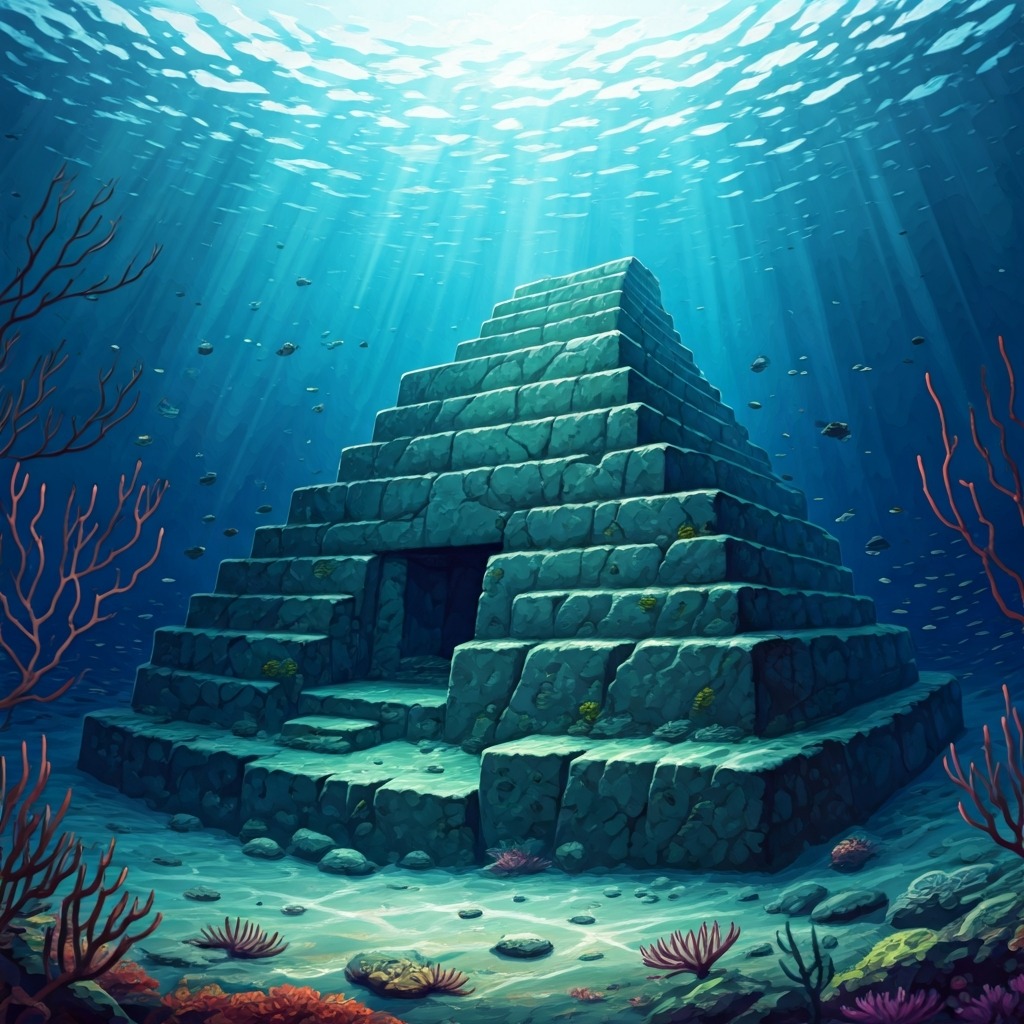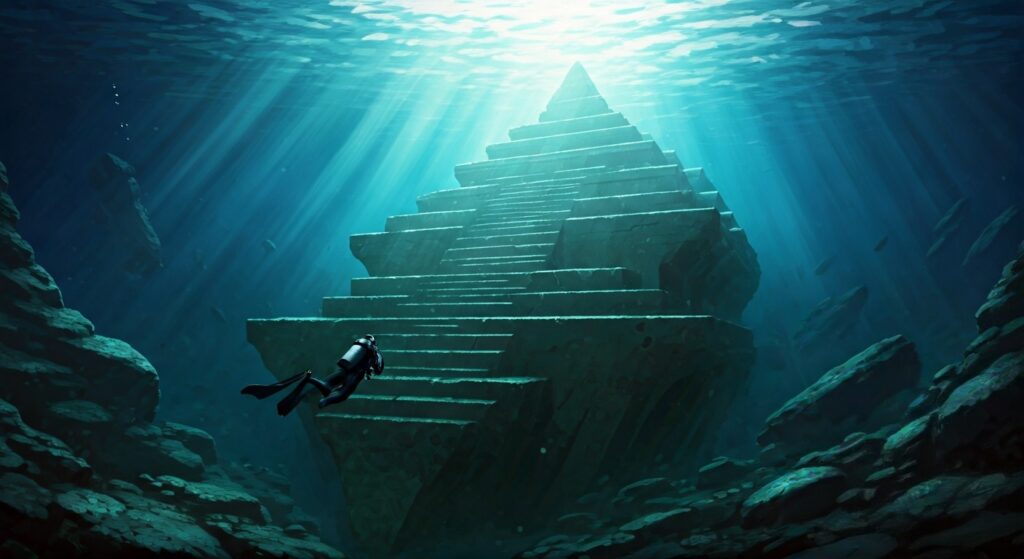
Eighty feet beneath the crashing waves of Japan’s Ryukyu Islands lies a mystery that defies logic. Lurking in the deep blue shadows is a colossal, geometric monolith. Is it the remnants of a forgotten, highly advanced civilization swallowed by the sea? Or is it the greatest architectural illusion Mother Nature ever pulled?
Welcome to the enigma of the Yonaguni Monument.
The Hammerhead Hunter and the Sunken Ziggurat
In 1986, local diver Kihachiro Aratake plunged into the waters off the coast of Yonaguni. He wasn’t looking for lost cities; he was hunting for hammerhead sharks to show tourists. But as the ocean floor suddenly dropped away, the murky depths gave birth to something that stopped his breath.
Looming before him was a colossal stone structure. It didn’t look like a coral reef. It looked like a sunken ziggurat.
Measuring roughly 165 feet long and 65 feet wide, the massive continuous rock mass featured perfectly terraced steps, flat platforms, sharp right angles, and straight edges. It resembled an ancient, labyrinthine arena ripped from a myth. Subsequent dives revealed even more bizarre features: a massive archway, a grand staircase, a retaining wall, and a rock formation eerily resembling a carved turtle. The sheer geometric precision immediately sparked a fierce, decades-long debate.
The Fingerprints of a Lost Continent
Enter Masaaki Kimura, a marine seismologist from the University of the Ryukyus, who has spent over two decades mapping every inch of the site’s eerie contours. To Kimura, the concentration of perfect right angles and flat surfaces in one area completely defies the laws of natural probability.
He argues that the monument is the ruins of a submerged city—possibly a fragment of the mythical lost continent of Mu. Pointing to what he identifies as quarry marks, drainage channels, retaining walls, and even carved faces in the stone, Kimura suggests the site was constructed or heavily modified roughly 2,000 to 10,000 years ago.
The implications are staggering. If Kimura is right, an unknown, highly advanced Ice Age civilization was carving massive stone monoliths long before tectonic activity and rising sea levels swallowed their city whole.
Nature’s Blueprint: The Geologist Strikes Back
But before rewriting the history books, the mainstream scientific community offers a sobering counter-narrative. Led by geologists like Robert Schoch of Boston University, skeptics firmly maintain that the Yonaguni Monument is a bizarre, yet entirely natural, geological phenomenon.
Schoch’s analysis reveals that the monument is composed of medium to very fine sandstones and mudstones of the Lower Miocene Yaeyama Group. These specific sedimentary rocks are highly prone to “jointing”—a natural process where rocks fracture in straight, parallel lines.
Here, the environment plays the role of the master builder. The Ryukyu Island region is highly tectonically active. Frequent earthquakes rattle the area, fracturing the rock along natural fault lines to create perfect right angles and flat “steps.” Powerful ocean currents then sweep through like a giant broom, clearing away the fractured debris and leaving behind clean, terrace-like structures.
Schoch’s evidence is compelling: the “steps” are often far too large for human use, the entire monument is one solid rock mass rather than stacked blocks, and—perhaps most damningly—not a single definitive human artifact has ever been found at the site.
The Ultimate Compromise in the Deep Blue
So, is it a lost city, or just a mesmerizing rock? Some researchers propose a chilling middle ground: terraforming.
In this scenario, the base formation is entirely natural, but ancient hunter-gatherers might have utilized the naturally terraced rock as a coastal shrine, a quarry, or a lookout point before the end of the last Ice Age. They may have made minor modifications to the stone, forever blurring the lines between geology and human architecture.
Today, the Japanese government does not recognize the Yonaguni Monument as an important cultural property. It remains unprotected, a legendary bucket-list destination for scuba divers and a focal point for historical mystery.
The Yonaguni Monument remains a mind-bending curiosity. It forces us to confront how easily nature can mimic human architecture, leaving us suspended in the deep blue, wondering exactly where the forces of the earth end and the fingerprints of ancient humanity begin.