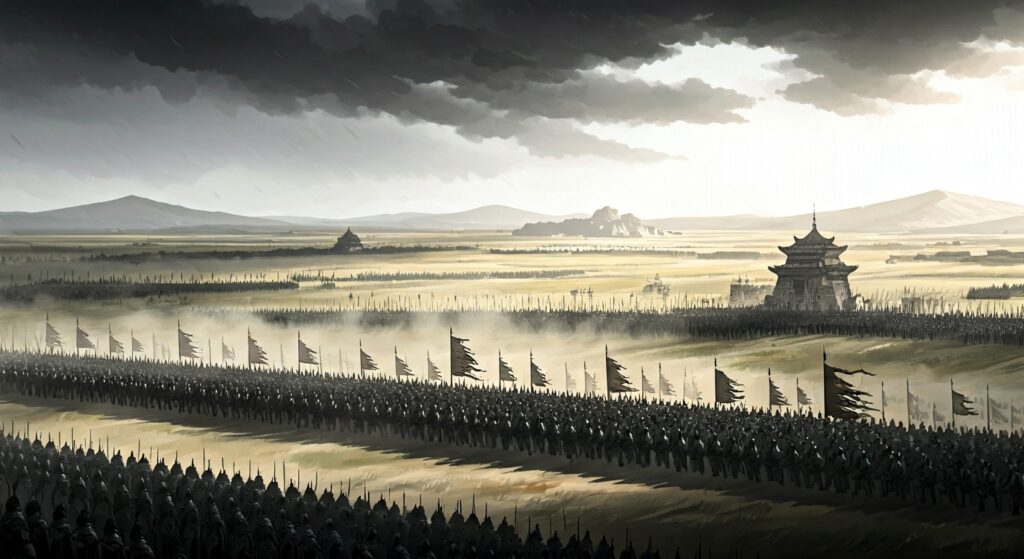
The dust cloud on the horizon wasn’t just an approaching army; it was a death sentence. One hundred and fifty thousand elite enemy troops were marching on the city of Xicheng, their boots shaking the earth, their banners blotting out the sky. Inside the city walls stood the Shu Han strategist Zhuge Liang, a master of the battlefield whose intellect bordered on the supernatural. But intellect alone cannot stop a siege engine. His garrison was empty, his veteran commanders were miles away, and his remaining forces consisted of a handful of aging guards and terrified civil bureaucrats.
A conventional commander would have panicked, barricaded the gates, and prayed for a swift end. But Zhuge Liang was not conventional. Facing absolute annihilation, he executed one of the most audacious, mind-bending psychological bluffs in military history.
The Ultimate Mismatch
The man leading the encroaching war machine was Sima Yi, a brilliant but notoriously paranoid general of the rival Wei state. Moving an army of 150,000 across ancient China was a logistical marvel, and Sima Yi had orchestrated it flawlessly. His hungry, battle-hardened vanguard was pointed directly at Xicheng, ready to crush whatever meager resistance stood in their way.
Zhuge Liang did the math. A physical defense would result in a massacre. If he couldn’t win a battle of swords and shields, he would have to fight a battle of the mind. He initiated what would become immortalized as the Kong Cheng Ji—the Empty City Strategy.
A Robe, a Zither, and an Open Door
Zhuge Liang issued a series of baffling orders. He commanded his men to tear down every military banner. He didn’t reinforce the city gates; he threw them wide open. He then took his few remaining soldiers, stripped them of their armor, and disguised them as ordinary civilians. Handing them brooms, he instructed them to casually sweep the dirt streets near the open gates as if it were a peaceful autumn morning.
Then, the mastermind himself ascended the city wall. Dressed in a pristine Taoist robe, Zhuge Liang lit fragrant incense and sat down with a guqin, a traditional Chinese zither. Flanked only by two young, serene children, he began to pluck a tranquil melody.
It was a display of terrifying, unearned confidence. He was projecting an aura of absolute invulnerability, daring the enemy to step through the front door.
Weaponizing a Reputation
When Sima Yi arrived at the head of his massive vanguard, the sight paralyzed him. He expected frantic barricades, raining arrows, and the stench of fear. Instead, he found open gates, street sweepers, and his greatest rival casually playing a tune on the battlements. The suspense hung in the air, thicker than the incense smoke drifting from the wall.
The sheer brilliance of this strategy relied entirely on Zhuge Liang’s personal brand. Throughout his storied career, Zhuge Liang was famous for his meticulous, almost obsessive caution. He never gambled with his troops’ lives. He never took unnecessary risks.
Staring up at the wall, Sima Yi began to run the mental calculus. He knew his enemy. He knew Zhuge Liang despised reckless gambits. Therefore, Sima Yi reasoned, this serene, unprotected scene couldn’t possibly be real. The empty gates had to be bait for a massive, deadly ambush waiting just inside the city walls. Outsmarting himself entirely, Sima Yi ordered his 150,000 troops to turn around and retreat.
Zhuge Liang had conquered an army of thousands with nothing but a song.
The Truth Behind the Legend
While this encounter stands as a masterclass in suspense, historical reality requires a slight addendum. This specific, highly dramatic showdown at Xicheng is a fictionalized embellishment from the 14th-century epic Romance of the Three Kingdoms. Historical records indicate Sima Yi wasn’t even in the region at the time.
However, the core concept of the Empty City Strategy is deeply rooted in the actual blood-soaked history of the era. Other heavy-hitters from the Three Kingdoms period, such as Zhao Yun and Wen Ping, successfully utilized similar empty-camp bluffs to deter real enemy attacks.
The story of Zhuge Liang and Sima Yi endures not because it’s a perfectly accurate combat log, but because it’s the ultimate lesson in asymmetrical warfare. It proves that if you understand your opponent’s psychology well enough—and if you know exactly how your own reputation lives inside their head—you don’t always need an army to win a war. Sometimes, you just need the audacity to leave the front door open.