Nature’s Great Eraser
The Mesoamerican jungle is a hostile, devouring force. Humidity, blistering heat, and relentless microbes act as nature’s great erasers, breaking down organic material in a matter of weeks. Wood rots, cloth disintegrates, and dyes bleach away under the punishing sun.
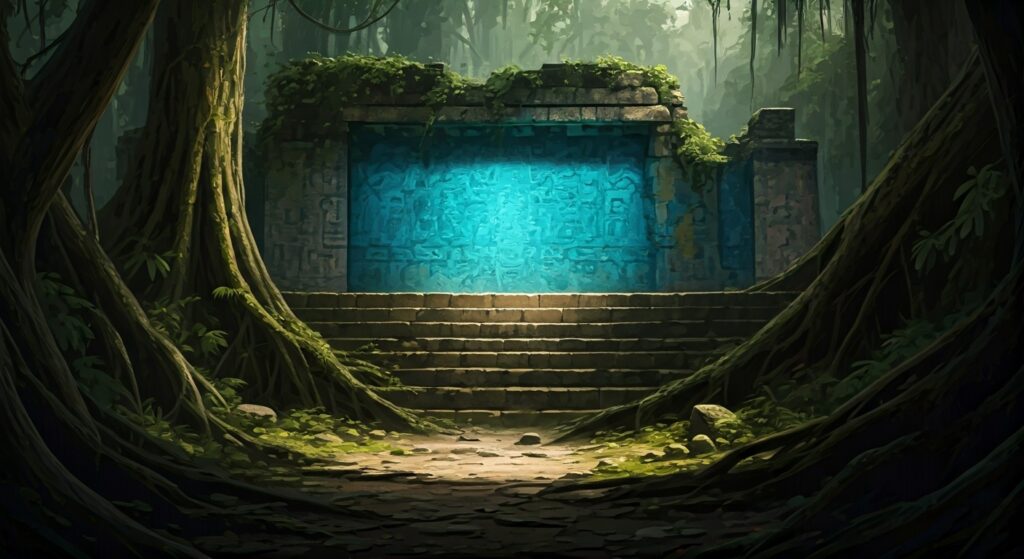
Yet, deep within this unforgiving environment, a stunningly vibrant, azure-turquoise pigment has survived for over a millennium. It clings to temple walls, ancient pottery, and sacrificial artifacts, refusing to fade.
When modern archaeologists and chemists rediscovered this pigment in the 1930s, they were utterly baffled. Organic dyes are notoriously fragile, but this ancient color—known today as Maya Blue—was virtually indestructible. It didn’t just survive the jungle; it laughed in the face of modern chemistry, resisting boiling nitric acid, industrial solvents, and centuries of weathering.
How did a pre-Columbian civilization create a color that modern science couldn’t break?
A Microscopic Fortress
The chemical strategy the Maya employed to create this pigment was nothing short of brilliant. They didn’t just mix a color; they engineered one of the earliest known examples of a synthetic nanomaterial.
The secret to Maya Blue is an ingenious organic-inorganic hybrid. The Maya took an organic dye—indigo, extracted from the leaves of the local añil plant—and combined it with an inorganic white clay called palygorskite.
But if you simply mix indigo and clay together, you get a blue smudge that washes away with the first rain. The magic ingredient was heat.
By heating the mixture to a highly specific window of 150 to 200 degrees Celsius, the Maya forced the organic indigo molecules to physically penetrate the microscopic, tunnel-like channels within the clay’s crystal lattice. Once trapped inside, the indigo formed unbreakable chemical bonds with the clay. The clay acted as a microscopic fortress, locking the color in place and shielding the fragile organic dye from environmental destruction.
The Terrifying Price of Azure
To the Maya, this brilliant azure wasn’t just a pretty shade for decorating pottery. It was the color of the universe’s center. It was the color of water, of agriculture, and most importantly, it was the color of Chaac, the fearsome rain god.
And Chaac demanded a heavy price for his life-giving rains.
While Maya Blue was used in grand architectural murals, its most dramatic and chilling application was in ritual human sacrifice. At the ancient city of Chichen Itza, individuals chosen as offerings to Chaac were stripped, painted entirely in Maya Blue, and thrown into the Sacred Cenote—a terrifyingly deep natural sinkhole.
The ceremonial objects and ritual altars accompanying the victims were also heavily coated in the pigment. Over the centuries, so many painted offerings and victims were cast into the watery abyss that today, a thick layer of indestructible blue sludge still coats the bottom of the sinkhole—a haunting, vibrant testament to the sheer scale of these ceremonies.
The Alchemist’s Altar
For years, a lingering question haunted archaeologists: how exactly were the Maya manufacturing this heat-forged nanomaterial in the middle of a religious ceremony?
The answer was hiding at the bottom of the Sacred Cenote.
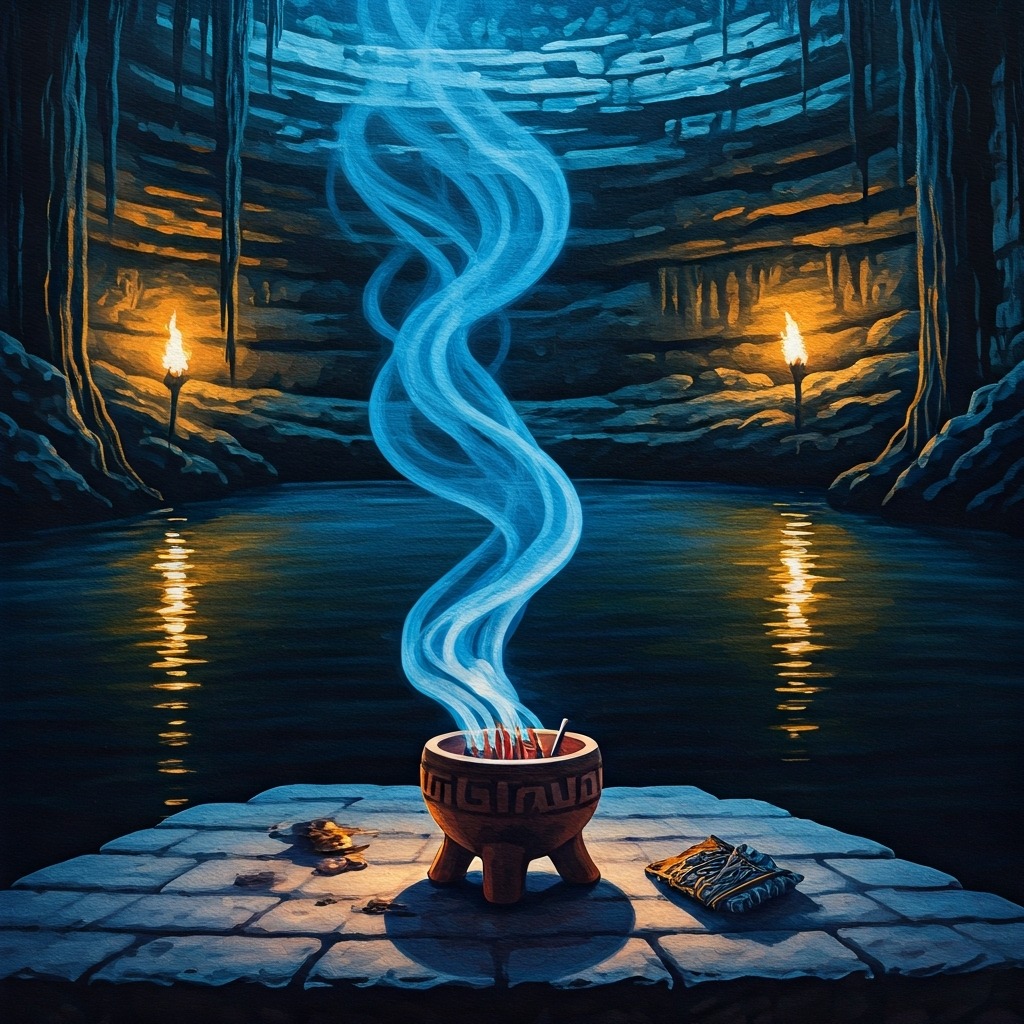
Recent studies of a three-footed bowl recovered from the sinkhole revealed a fascinating chemical fingerprint: traces of copal incense mixed directly with the pigment.
This was the smoking gun. The synthesis of Maya Blue wasn’t a cold, industrial manufacturing process done in a back-alley workshop. It was a deeply sacred ritual act. The burning of the copal incense during the sacrificial ceremony provided the exact, sustained heat necessary to fuse the indigo and the clay.
As the incense burned and the prayers to Chaac echoed across Chichen Itza, the ingredients chemically bonded. The creation of the indestructible blue was simultaneously a chemical reaction and a religious offering. It was a moment where ancient Mesoamerican science and spiritual devotion became entirely indistinguishable, locked together forever in a shade of blue that time simply cannot kill.