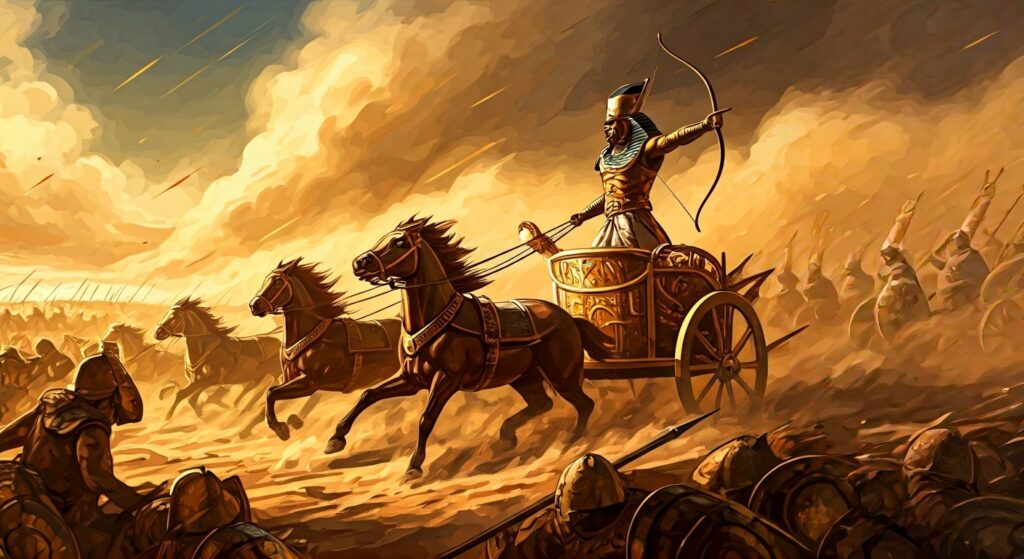
The year is 1274 BC. The air over modern-day Syria is choked with dust, the stench of sweat, and the deafening shriek of bronze tearing through wood and bone. Two of the ancient world’s most terrifying superpowers have collided in a death grip.
This was the Battle of Kadesh. And the bloody stalemate that followed would inadvertently birth one of the greatest diplomatic miracles in human history.
The Mother of All Chariot Clashes
On one side stood the Egyptian Pharaoh Ramses II, a god-king with an ego as colossal as the monuments he commissioned. On the other was the formidable Hittite King Muwatalli II. They converged at Kadesh in what remains the largest chariot battle ever recorded—a chaotic, mechanized meat-grinder involving up to 6,000 chariots.
If you read the hieroglyphs carved into the towering walls of Karnak, Ramses II will gladly tell you how he single-handedly obliterated the Hittite menace. It was a masterclass in ancient propaganda. But the historical reality was far less glamorous.
The battle was a brutal, exhausting tactical draw. Thousands lay dead in the Syrian dirt, imperial coffers were drained, and the geopolitical map remained stubbornly unchanged. Neither empire could land the killing blow.
An Ancient Cold War
For fifteen grueling years, Egypt and Hatti locked horns in a tense, paranoid cold war. But endless hostility is a luxury even god-kings cannot afford forever.
Both empires were bleeding resources, and new nightmares were brewing on their borders. The Hittites watched with mounting dread as the Middle Assyrian Empire crept toward their eastern flank. Meanwhile, Ramses II was plagued by relentless incursions from Libyan tribes to the west.
They needed their armies elsewhere. They needed their borders secured. Above all, they needed a way out of the stalemate.
The Secret Weapon of Antiquity
Around 1259 BC, Ramses II and the new Hittite King, Hattusili III, did something utterly unprecedented. They lowered their bronze swords and picked up clay tablets.
The result was the Treaty of Kadesh, the earliest known surviving parity peace treaty—an agreement forged between two absolute equals.
This was no fragile ceasefire. It was a remarkably sophisticated geopolitical alliance that mirrors modern international law. The treaty established a strict mutual non-aggression pact, but it went much further. It created a mutual defense alliance: if a foreign enemy attacked Egypt or Hatti, the other was legally bound to send military backup. They even drafted an internal security pact to crush domestic rebellions and secure messy royal successions.
A Bronze Age Human Rights Miracle
The ancient Near East was a theater of unimaginable brutality. Defeated enemies were routinely blinded, flayed, or enslaved. Yet, the Treaty of Kadesh contains a twist that still leaves modern historians in awe.
The pact included an extradition clause for political fugitives and defectors. However, it came with a staggering stipulation: the extradited refugees would not be punished.
The text explicitly mandated that these individuals were not to be executed, tortured, or mutilated, and their families were to remain unharmed. In an era defined by ruthless vengeance, this progressive provision was virtually unheard of—a quiet, astonishing nod to human rights millennia before the concept existed.
The Thousand Gods and the Buried Truth
In the Bronze Age, a treaty was only as strong as the divine wrath backing it. To guarantee compliance, the document invoked a “thousand gods” from both pantheons, including the Egyptian sun god Ra and the mighty Storm God of Hatti. It detailed horrifying curses for anyone who broke the pact and promised eternal blessings for those who upheld it.
The survival of this document is an archaeological miracle. Because ancient diplomacy was bilingual, it existed in two versions. The Egyptian text was proudly blasted across temple walls in Thebes. But the Hittite version vanished into the dirt for over three millennia.
In 1906, archaeologists excavating the ancient Hittite capital of Hattusa unearthed baked clay tablets inscribed in Akkadian cuneiform—the lingua franca of ancient diplomacy. When translated, the text matched the Egyptian carvings almost perfectly.
Today, this ancient triumph of human cooperation is considered so foundational that a bronze replica of the Hittite tablet is prominently displayed at the United Nations Headquarters in New York. It stands as a 3,200-year-old reminder that even the bitterest of enemies can step back from the brink of annihilation and choose peace.