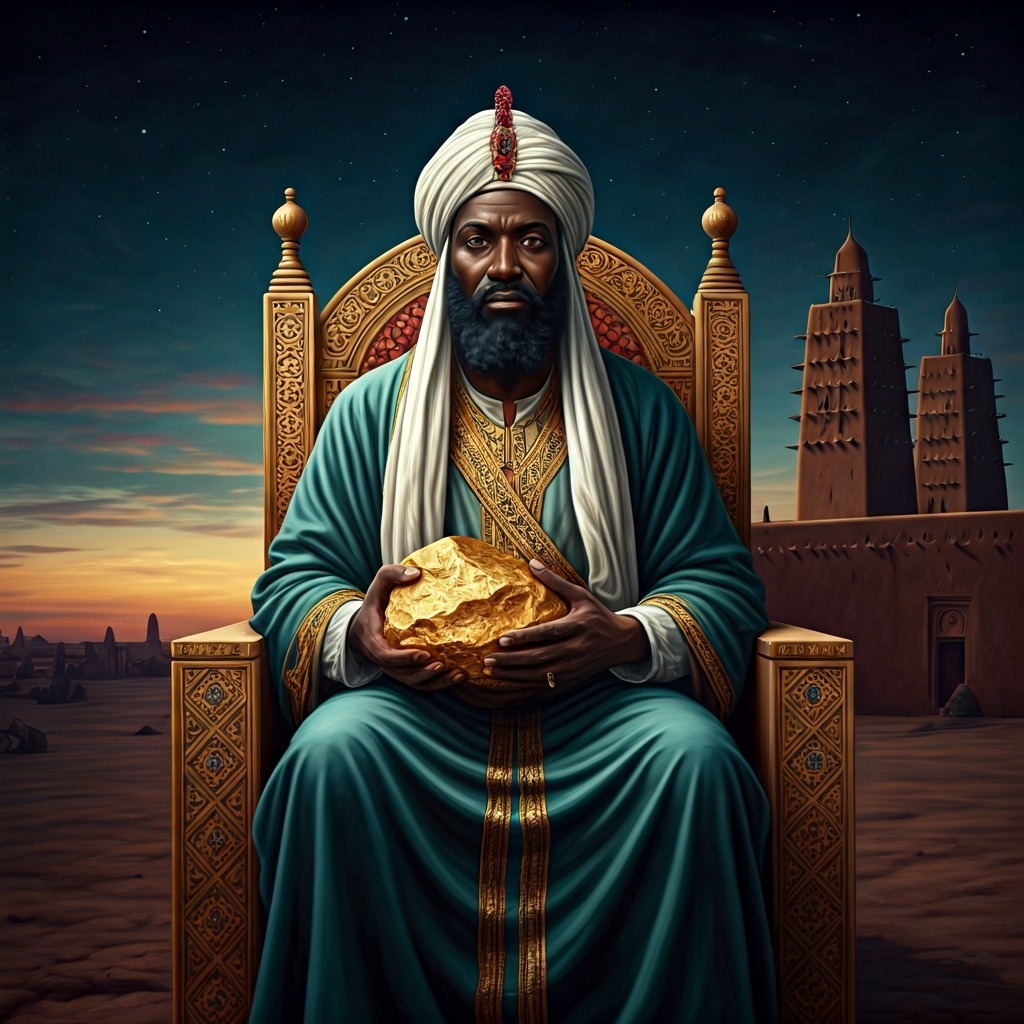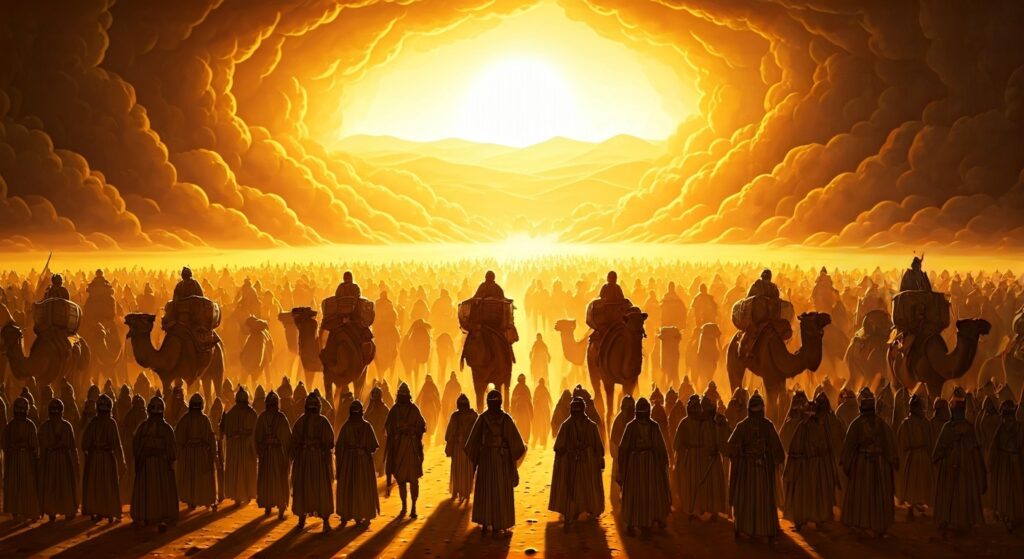
In the blistering heat of the Sahara Desert in 1324 CE, merchants braced for disaster. A colossal cloud of dust was rolling across the horizon, thick enough to blot out the sun. They prepared for a deadly sandstorm. But as the haze parted, it wasn’t weather that emerged from the dunes. It was an endless, glittering city on the move.\n\nThis was the caravan of Mansa Musa, the ninth emperor of the Mali Empire, and he was about to execute the ultimate historical flex.\n\n## A City on the Move\n\nAt the dawn of the 14th century, the Mali Empire was the world’s undisputed engine of gold production. But Mansa Musa was not content to simply sit on his unimaginable wealth behind palace walls. Embarking on his Hajj—the sacred pilgrimage to Mecca—he decided to bring a staggering portion of his empire’s GDP with him across the unforgiving desert.\n\nThe sheer scale of his procession defies modern comprehension. Historical accounts from Arab scholars describe a traveling entourage of up to 60,000 men. Leading the charge were 12,000 slaves, but they were not clad in rags; they were draped in fine Persian silks. More astonishingly, every single one of those 12,000 men carried a four-pound bar of solid gold. Trailing behind them marched thousands of horses and a baggage train of 80 camels, each groaning under the weight of up to 300 pounds of gold dust.\n\nMusa left a trail of unimaginable fortune in his wake. He handed out gold to the destitute, tipped merchants with the casual grace of a modern billionaire, and ordered the construction of a brand-new mosque every single Friday, wherever his caravan happened to pitch its tents.\n\n## The Ultimate Standoff\n\nThe true drama of this legendary road trip ignited when the caravan rolled into Cairo. At the time, Cairo was a bustling, cosmopolitan metropolis ruled by the formidable Mamluk Sultan, Al-Nasir Muhammad.\n\nWhen two rulers of this magnitude collide, the egos involved generate their own gravitational pull. Protocol in the Cairene court was absolute: anyone granted an audience with the Sultan was required to kiss the ground and, specifically, kiss the Sultan’s feet.\n\nMansa Musa, the wealthiest man drawing breath, politely declined.\n\nThe tension in the throne room must have been thick enough to sever with a broadsword. The Sultan’s officials demanded submission. Musa held his ground, a sovereign king who refused to bow to another man’s footwear. Just as the diplomatic standoff threatened to boil over into violence, Musa engineered a brilliant, face-saving loophole. He agreed to bow, but loudly declared to the court that he was prostrating himself only before God, not the Sultan. The crisis was averted, and a relieved Sultan welcomed the Malian emperor with open arms.\n\n## The Generosity That Broke the World\n\nWith the diplomatic awkwardness resolved, Mansa Musa hit the streets of Cairo and began to spend.\n\nHe flooded the markets with so much gold—buying up goods, tipping local officials, and showering the poor with charity—that he inadvertently wrecked the regional economy. By injecting massive, unprecedented amounts of the precious metal into the local market, he caused the value of gold to plummet. The cost of everyday goods skyrocketed. This was no temporary dip; Musa triggered a catastrophic inflation crisis across Cairo, Medina, and Mecca that crippled the region for over a decade.\n\nYet, the story holds a delicious twist of irony. Musa spent so lavishly on his way to Mecca that, upon his return journey, his seemingly bottomless coffers were empty. The richest man in human history had run out of cash. To get his massive entourage back to Mali, he was forced to borrow money at exorbitant interest rates from the very Cairene merchants he had just made filthy rich.\n\nTo this day, Mansa Musa remains the only human being in history to single-handedly control the price of gold in the Mediterranean.\n\n## An Empire Forged in Gold\n\nMusa’s legendary pilgrimage was far more than a display of vanity; it was a calculated, brilliant public relations masterstroke that permanently altered the geopolitical landscape.\n\nNews of this unimaginably wealthy African king rippled across the Mediterranean and into the courts of Europe. Suddenly, the world’s eyes were fixed on Mali. By 1375, European mapmakers had drafted the Catalan Atlas, famously featuring an illustration of Mansa Musa sitting on a throne, clutching a massive nugget of gold. He had literally put his empire on the map.\n\nBut Musa brought back more than just a reputation. Using the funds he still possessed—or had cleverly borrowed—he recruited brilliant Andalusian architects, including Abu Ishaq al-Sahili, alongside top-tier Islamic scholars. They returned to Mali with him, sparking a golden age of construction and intellectual pursuit. Together, they raised grand structures like the iconic Djinguereber Mosque and transformed cities like Timbuktu and Gao into premier global hubs of Islamic learning, culture, and trade.\n\nMansa Musa walked across a desert, refused to kiss a Sultan’s feet, accidentally crashed the economy of the Middle East out of sheer generosity, and turned his home into an intellectual capital of the world. It was a pilgrimage that didn’t just leave footprints in the sand—it left a legacy etched in solid gold.