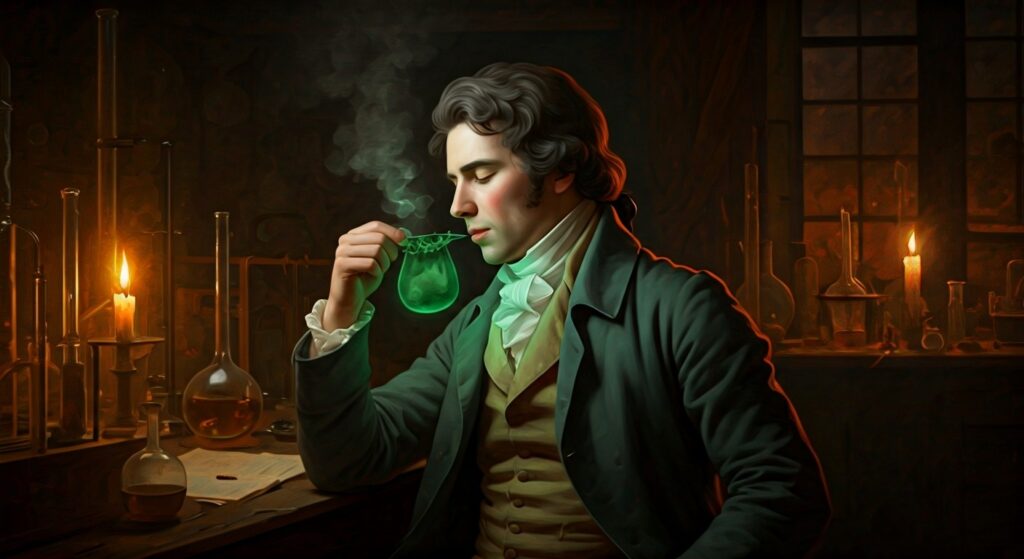
In the dimly lit confines of a Bristol laboratory in 1799, a twenty-year-old chemist held a green silk bag to his lips. Inside the bag swirled a mysterious vapor that the scientific establishment had deemed highly toxic, perhaps even instantly fatal. The young man braced himself for the end, closed his eyes, and inhaled deeply.
He didn’t die. Instead, a thrilling, electrifying tingle washed over his body. His voluntary motor control slipped away, replaced by vivid, swirling hallucinations and an overwhelming, irresistible urge to laugh. He wasn’t dying; he was experiencing a profound, euphoric intoxication.
The young chemist was Humphry Davy, and he had just discovered that nitrous oxide wasn’t a poison. It was a portal.
Forget the stuffy, powdered-wig image of the British Enlightenment. Behind closed doors, the era’s greatest minds were about to embark on a reckless, mind-bending journey into the outer limits of human consciousness.
The Breath of the Unknown
The story begins at the Pneumatic Institution in Bristol, England, founded by a radical physician named Thomas Beddoes. Beddoes had a bold vision: to investigate the medical properties of various newly discovered “factitious airs” (gases). To lead these dangerous experiments, he hired Davy, a brilliant and wildly charismatic young scientist.
Davy soon turned his attention to nitrous oxide. Synthesized decades earlier by Joseph Priestley in 1772, the gas had been largely dismissed by the scientific community as a deadly hazard. A normal person might approach a potentially fatal gas with extreme caution. But Humphry Davy was driven by an insatiable, almost chaotic curiosity. He heated the gas in a chamber, captured it in his green silk bags, and decided the only true way to test its toxicity was to become the guinea pig himself.
When the gas brought him euphoria instead of death, Davy realized he had stumbled upon something extraordinarily exhilarating. And he didn’t just write a paper about it. He threw a party.
The Enlightenment’s Most Exclusive Guest List
Davy began inviting a dazzling circle of friends to the Pneumatic Institution for late-night sessions to partake in the gas. The guest list for these secret gatherings read like a ‘Who’s Who’ of the British Enlightenment and the emerging Romantic movement.
Imagine walking into a shadowy room and seeing James Watt, the legendary inventor of the steam engine, and Josiah Wedgwood, the pottery magnate, passing around a green silk bag. In the corner, poets like Samuel Taylor Coleridge and Robert Southey eagerly awaited their turn. For the Romantics, who were obsessed with the sublime and the hidden depths of the mind, inhaling nitrous oxide was the ultimate philosophical and sensory experiment.
Chasing the Sublime Down the Rabbit Hole
The accounts of these late-night laughing gas parties are nothing short of legendary. When the brilliant Peter Mark Roget—who would later go on to create Roget’s Thesaurus—inhaled the gas, he described feeling as though his imagination had been completely unchained, causing him to lose all sense of space and time.
Robert Southey was completely mesmerized. He wrote a frantic letter to his brother, claiming the gas produced a sensation that was “perfectly new and delightful,” famously declaring, “I am sure the air in heaven must be this wonder working gas of delight!” Coleridge, meanwhile, reported a highly pleasurable sensation of warmth before being overcome by an irresistible urge to beat the ground with his walking stick.
But no one went as far down the rabbit hole as Davy himself.
The line between rigorous scientific inquiry and hedonistic indulgence completely vanished. Davy became heavily addicted to his own discovery. He would lock himself in a dark room and inhale massive quantities of the gas to induce deep, visionary trances. During one particularly intense binge, he emerged from the shadows and proclaimed to his colleagues: “Nothing exists but thoughts! The universe is composed of impressions, ideas, pleasures and pains!”
The Tragic Blind Spot of 19th-Century Medicine
Here is where the story takes a maddening turn. Despite the sheer chaos of these gatherings, Davy was still a meticulous scientist. He recorded his subjects’ pulse rates and subjective experiences, publishing them in his monumental 1800 book, Researches, Chemical and Philosophical.
Tucked away in the pages of this massive volume, Davy casually noted something extraordinary: because nitrous oxide appeared to destroy physical pain, it “might probably be used with advantage during surgical operations.”
It was a revelation that could have immediately ended the agonizing, barbaric torture of 19th-century surgery. So, what did the medical establishment do with this groundbreaking observation?
Absolutely nothing. They completely ignored it for over forty years.
From Carnival Stages to the Operating Room
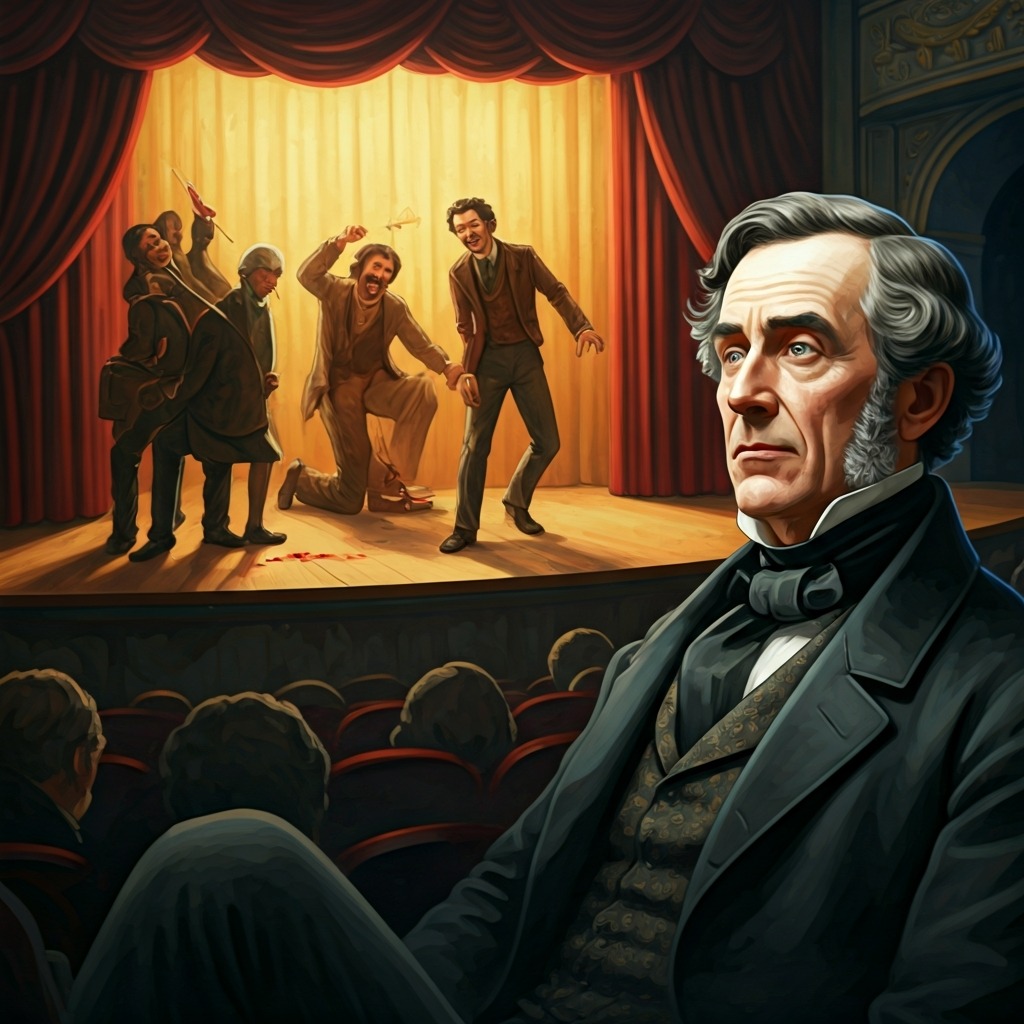
Instead of revolutionizing the operating theater, laughing gas hit the road. By the 1820s and 1830s, it had become a literal fairground attraction. Itinerant showmen and self-proclaimed “professors” traveled across Britain and the United States, hosting public laughing gas demonstrations. Paying crowds would roar with laughter as volunteers inhaled the gas and stumbled around the stage in a euphoric daze.
It wasn’t until 1844 that the universe finally course-corrected. An American dentist named Horace Wells was sitting in the audience of one of these public exhibitions. He watched closely as a volunteer, high on laughing gas, accidentally gashed his leg on the stage—yet showed absolutely no signs of feeling pain.
The gears in Wells’ mind locked into place. This single, quiet observation changed the course of human history.
Decades after Humphry Davy and his poet friends beat the floorboards with their walking sticks and touched the edges of the universe in a dark room in Bristol, laughing gas finally transitioned from a mind-bending parlor trick into a cornerstone of modern medicine. It stands as a thrilling reminder: sometimes the greatest scientific breakthroughs don’t start in a sterile laboratory. Sometimes, they start with a green silk bag, a group of unruly poets, and a spark of beautiful, reckless madness.