Three thousand years ago, the Eastern Mediterranean was the beating heart of a sprawling, hyper-connected global network. It was an era of glittering empires, complex diplomacy, and monumental architecture. Then, in the blink of a historical eye, it all burned to the ground.
Welcome to the Late Bronze Age. And welcome to the end of the world.
The Ancient World’s Gilded Age
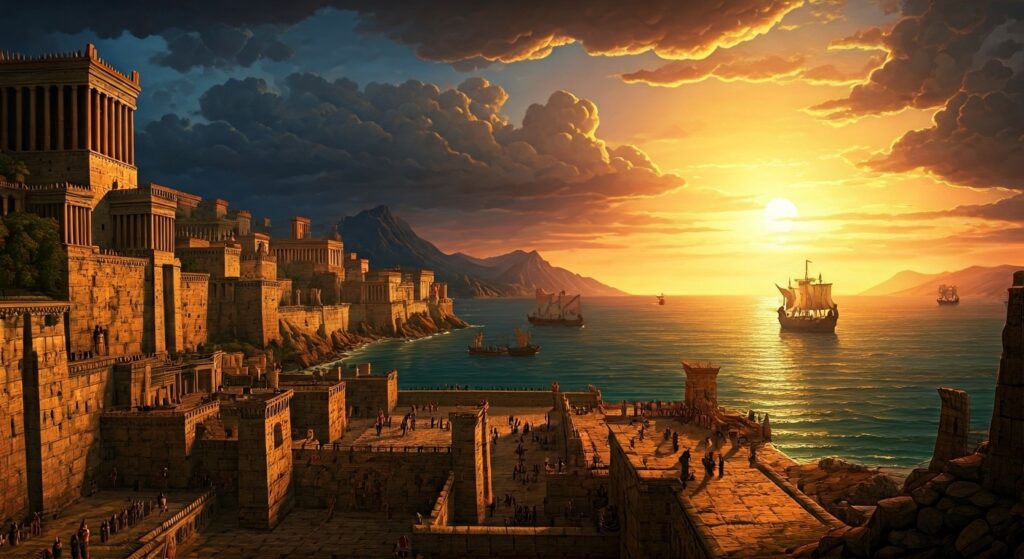
If you were to step into the world between 1500 and 1200 BCE, you would not find a primitive, disconnected landscape. You would enter a vibrant, highly advanced era of unprecedented globalization.
A complex network of superpowers ruled the map: the Mycenaean Greeks, the fierce Hittites of Anatolia, the glittering New Kingdom of Egypt, the Middle Assyrian Empire, and the wealthy, bustling city-states of Canaan. They didn’t just conquer; they engaged in complex diplomacy, royal marriages, and a sprawling international economy.
The lifeblood of this economy was bronze. To forge the weapons that won wars and the tools that fed empires, bronze was non-negotiable. But as an alloy, it required copper—primarily sourced from Cyprus—and tin, which had to be hauled across perilous trade routes from as far away as Afghanistan. The ancient world was fundamentally interdependent. It was a well-oiled, highly specialized machine.
Until, suddenly, the gears violently stopped turning.
The Great Unraveling
Around 1200 BCE, the unthinkable happened. Within the span of just a few decades, this flourishing international system suffered a catastrophic, violent collapse.
Magnificent palaces were torched to the ground and never rebuilt. Entire empires were wiped off the map. The vital trade routes that connected the Mediterranean to the East were severed. Even the very concept of writing—like the Mycenaean Greek script known as Linear B—was swallowed by oblivion.
The region was plunged into a centuries-long Dark Age. But who, or what, could possibly assassinate an entire interconnected world order so quickly?
The Phantom Fleet
If you asked the ancient Egyptians, they had a very clear answer for who pulled the trigger: a mysterious, unstoppable confederation of seafaring raiders known today as the “Sea Peoples.”
According to the dramatic reliefs commissioned by Pharaoh Ramses III, these invaders were a terrifying force of nature. Egyptian scribes recorded that no country could stand before their arms. They swept through the Mediterranean, decimating the Hittites, ravaging Cyprus, and burning the Levant before finally arriving at the borders of Egypt.
This confederation wasn’t a single nation. It was a coalition of shadowy groups with names like the Sherden, the Lukka, the Ekwesh, and the Peleset. For decades, historians viewed the Sea Peoples as the ultimate ancient villains—bloodthirsty pirates who watched the world burn.
But history is rarely so simple. Entire populations do not pack their lives onto boats to fight the greatest militaries on earth unless they are running from something far worse.
The Earth Rebels
Modern archaeologists and paleoclimatologists have begun to piece together a reality much more terrifying than a simple pirate invasion. The Sea Peoples weren’t the sole cause of the Bronze Age Collapse; they were a symptom of a massive “systems collapse.” The very thing that made the Late Bronze Age so advanced—its hyper-specialized, interdependent global network—made it fatally fragile.
And then, a perfect storm hit.
Isotopic data from ancient stalagmites and fossilized pollen analysis reveal that a severe, prolonged mega-drought struck the Eastern Mediterranean. Crops failed year after year. Famine set in. Desperate, starving populations from the Aegean, Anatolia, and the Western Mediterranean were forced to migrate just to survive. These displaced refugees and pirates became the Sea Peoples.
But the earth wasn’t done. Archaeoseismologists have uncovered evidence of “earthquake storms”—a devastating series of seismic events that ruptured along fault lines in Greece and Anatolia over a 50-year period, systematically leveling major cities.
The Fatal Domino Effect
Imagine the sheer panic. Cities are crumbling from earthquakes. Fields are barren from drought. The tin and copper routes relied upon to forge weapons and farm tools have been cut off by marauding bands of starving refugees.
It was a fatal domino effect. The immense pressure of famine and natural disasters sparked violent peasant revolts and internal rebellions. Ruling elites were overthrown by their own starving people. When one node of the international network fell, the entire system unraveled.
The mighty Hittite Empire was completely erased from history. Egypt barely managed to survive the onslaught of the Sea Peoples, but it was left permanently crippled, losing its imperial grip on Canaan and fading from its former glory.
Forged in the Ashes
It sounds like a thoroughly depressing end to a golden age. Yet, from the ashes of this apocalyptic collapse, humanity proved its terrifying resilience.
A new world order had to emerge. Because the international bronze trade was dead, societies were forced to innovate. They turned to a metal that was much harder to work with, but vastly more abundant: iron.
The Bronze Age Collapse ushered in the Iron Age. Furthermore, the power vacuum left by the destruction of the massive, monopolizing empires allowed new, smaller civilizations to finally rise and flourish. The Phoenicians took to the seas to invent the alphabet we use today, and the Israelites emerged in the highlands of Canaan, laying the theological groundwork for much of the modern world.
The collapse of the Bronze Age was a chaotic, brutal reset button. It destroyed a magnificent world, yes—but it also cleared the stage for ours to begin.