Imagine standing on the coast of Peru in 1947, staring down 4,300 miles of open, merciless Pacific Ocean. Now imagine deciding to cross it on a pile of logs.
Throughout history, absolute madmen have looked at the terrifying, freezing, endless ocean and thought, “Let’s build a wooden boat and see what happens.” But even among the annals of maritime exploration, the story of the Kon-Tiki stands alone as a special kind of unhinged.
A Blueprint for Certain Death
Norwegian explorer and ethnographer Thor Heyerdahl had a theory that drove the mid-century scientific community crazy. While the consensus was that Polynesia was settled by ancient peoples migrating from Asia, Heyerdahl believed that pre-Columbian South Americans had actually made the journey first.
When scholars demanded proof, Heyerdahl didn’t just point to ancient statues or wind currents. He decided to build a primitive raft and surf it across the Pacific.
Gathering a crew of five fellow adventurers—Erik Hesselberg, Bengt Danielsson, Knut Haugland, Torstein Raaby, and Herman Watzinger—Heyerdahl traveled to South America to construct a vessel using only the tools and materials available to ancient mariners. They named their raft Kon-Tiki, after the old Inca sun god.
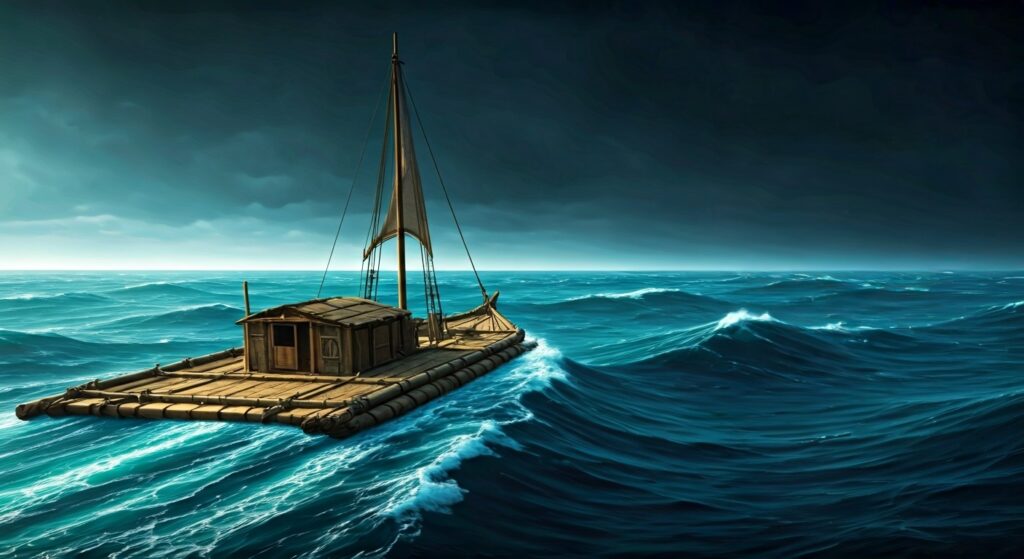
The construction of the Kon-Tiki was enough to give any modern sailor a panic attack. The team sourced massive balsa wood logs from the jungles of Ecuador and lashed them together with hemp ropes. They refused to use a single metal nail. Topping it with a fragile bamboo cabin and hoisting a square sail, they declared the vessel seaworthy.
Maritime experts were horrified, widely predicting the mission would be a suicide run. The balsa logs, they warned, would become hopelessly waterlogged and sink within two weeks. If the raft didn’t sink, the friction of the ocean swells would cause the hemp ropes to chafe, snapping them one by one until the crew was dumped into shark-infested waters.
Heyerdahl listened to the warnings, nodded politely, and on April 28, 1947, set sail from Callao, Peru anyway.
Drifting Above the Abyss
For 101 days, the six men—along with their pet parrot, Lorita—were utterly at the mercy of the Pacific.
Life on the Kon-Tiki was a bizarre mix of absolute tranquility and sheer terror. Drifting just inches above the abyss, the crew survived by catching flying fish that literally crashed onto their deck in the middle of the night. They fished for dorado and tuna, and collected rainwater to stave off dehydration.
But the true suspense came from what lurked beneath the logs. The raft’s slow, silent drift made it a curiosity for the ocean’s apex predators. The men had terrifyingly close encounters with aggressive great white sharks that would bump against the balsa wood. On one occasion, a massive whale shark—longer than the raft itself—trailed them for days, its dorsal fin slicing through the water just feet from their dangling toes. One wrong move, or one snapped hemp rope, and the ocean would swallow them whole.
The Jaws of the Coral
As August approached, the raft was still floating, miraculously defying the experts’ predictions. The balsa wood had absorbed water, but only enough to lower the raft safely into the swells. Meanwhile, the hemp ropes had swollen with seawater, gripping the logs even tighter than before.
But their greatest test was looming just below the surface.
On August 7, 1947, the ocean currents dragged the Kon-Tiki toward the Tuamotu Islands of French Polynesia. Standing between the crew and dry land was the treacherous coral reef of Raroia—a jagged, razor-sharp barrier being pounded by massive ocean swells.
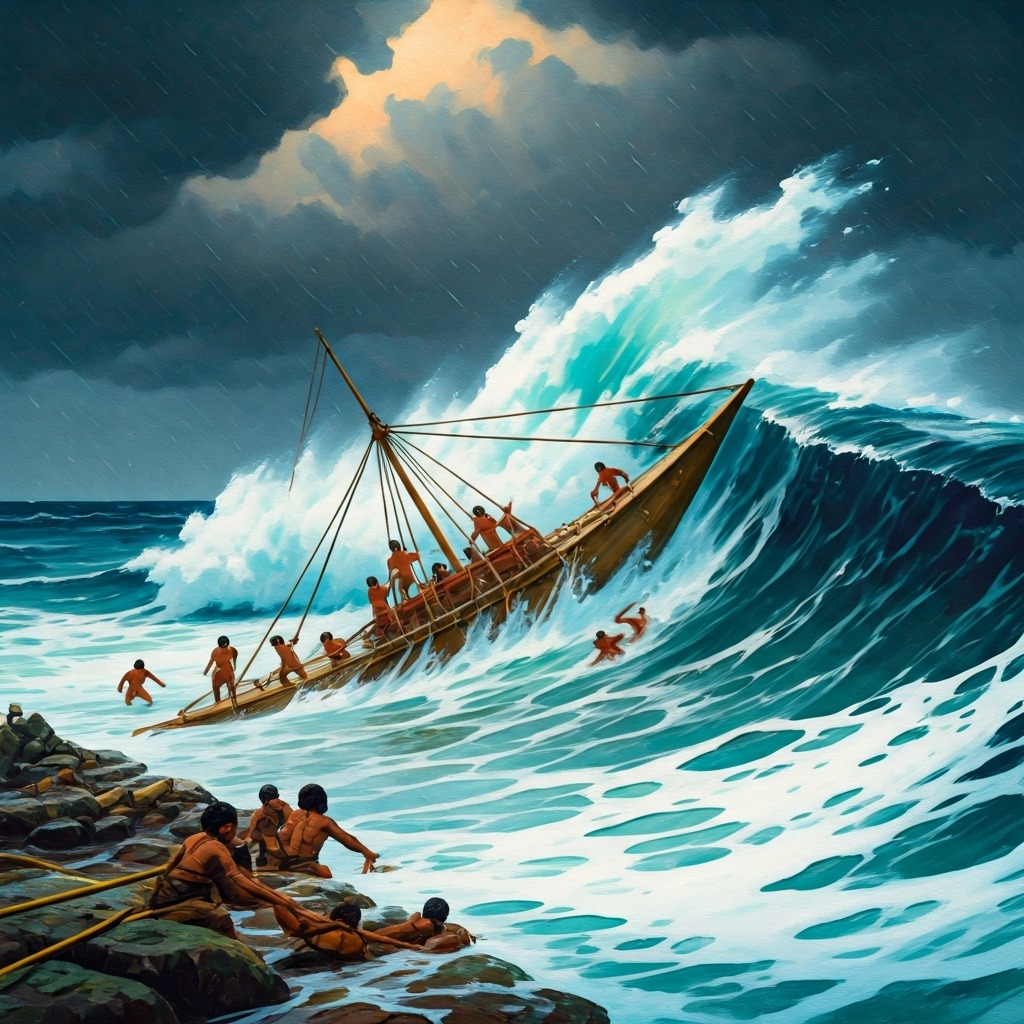
There was no steering away. The crew braced for impact as a colossal wave lifted the Kon-Tiki and hurled it directly into the grinding teeth of the coral. The raft was violently smashed, the bamboo cabin obliterated, and the men were thrown into the churning, foaming surf.
Miraculously, as the tide receded, all six men pulled themselves onto the reef. Bleeding and battered, they had survived the wreck. They had conquered 4,300 miles of ocean.
A Century-Late Vindication
Heyerdahl had successfully proven that a trans-Pacific voyage in a primitive balsa raft was technically possible. The world was captivated by their courage, and the expedition was immortalized in Heyerdahl’s bestselling book and an Academy Award-winning 1950 documentary film.
But what about his grand migration theory? For decades, the scientific community remained staunchly skeptical. Modern genetic and linguistic evidence overwhelmingly established that the primary ancestors of the Polynesians did, in fact, migrate from Southeast Asia and Taiwan. Heyerdahl’s South American origin theory was largely dismissed as a fascinating, but incorrect, footnote.
That is, until recently.
In a plot twist worthy of a Hollywood thriller, modern DNA studies have revealed a small but significant trace of Native American admixture in some Polynesian populations. The genetic markers suggest that some form of ancient contact between South Americans and Polynesians did indeed occur.
It wasn’t exactly the mass migration Heyerdahl had envisioned, but it was a sliver of vindication. Someone, hundreds of years ago, had looked at the terrifying, endless ocean and done exactly what the crew of the Kon-Tiki did.