It was a garment deemed so dangerous it was condemned by the Vatican, outlawed by governments across the globe, and named after a weapon of mass destruction. Today, it is a staple of summer vacations, but in the mid-20th century, the modern bikini was considered a moral threat of apocalyptic proportions. The story of how a few inches of fabric detonated conservative fashion standards is a tale of wartime desperation, fierce rivalries, and a calculated scandal that changed the world forever.
A Secret Buried in Antiquity
If you believe the two-piece swimsuit is a modern invention, history has a surprise waiting in the ruins of the Roman Empire. Long before Hollywood starlets scandalized the public, ancient women were donning bandeaus and matching bottoms. This hidden history is immortalized in the 4th-century AD “Bikini Girls” mosaics at the Villa Romana del Casale in Sicily, which depict women exercising in remarkably familiar athletic garments.
But as empires crumbled and centuries passed, draconian modesty laws clamped down on women’s bodies. By the early 20th century, swimwear was heavily regulated. Women were forced into heavy wool dresses, and literal modesty police patrolled beaches with measuring tape to ensure hemlines were legally compliant. To go from suffocating wool to string ties required a global upheaval. Ironically, it took a world war to make the first cut.
The Wartime Mandate and the Forbidden Anatomy
During World War II, governments were desperate to conserve materials for the war effort. In the United States, the War Production Board issued a strict mandate requiring a 10 percent reduction of fabric in women’s beachwear. Forced into a corner, designers got creative. They sliced away the midsection of the traditional bathing suit, inadvertently birthing the modern two-piece.
Yet, there was a massive catch. These early two-pieces were incredibly high-waisted, strictly covering the navel. At the time, the belly button was considered an anatomical taboo so severe that exposing it in public was practically unthinkable. The world was teetering on the edge of a fashion revolution, waiting for someone daring enough to cross the ultimate line.
A Parisian Rivalry Turns Radioactive
The true revolution didn’t happen on an American beach; it ignited in the summer of 1946 in Paris. The city was recovering from the war, and a fierce rivalry was brewing between two French designers vying for the spotlight.
First was Jacques Heim, a traditional fashion designer who created a minimalist two-piece suit. He named it the “Atome” and confidently marketed it as the world’s smallest bathing suit. But Heim severely underestimated his competition.
Enter Louis Réard, an automotive engineer who had taken over his mother’s lingerie business. Réard wasn’t just a designer; he was a master provocateur. He engineered a suit using a mere 30 inches of fabric, entirely exposing the wearer’s navel. He cheekily marketed his design as “smaller than the world’s smallest bathing suit.”
Réard knew he had created a garment so shocking it would cause a cultural earthquake. Just days before his design was set to debut, the United States conducted its first peacetime nuclear weapons test at Bikini Atoll in the Marshall Islands. Hoping his scandalous creation would generate a similar shockwave, Réard named his swimsuit the “Bikini.”
The Matchbox Stunt That Horrified the World
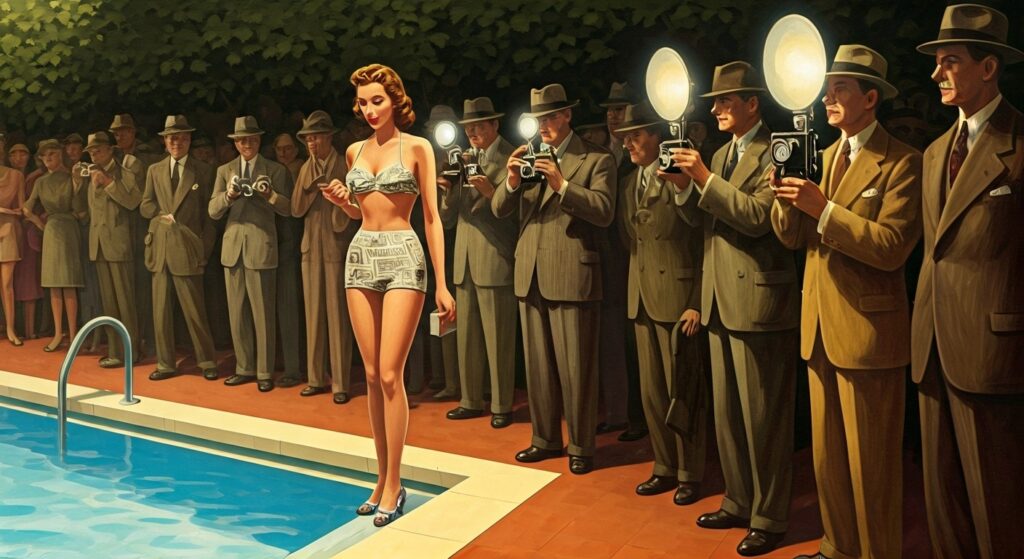
The debut was set for July 5, 1946, at the Piscine Molitor, a glamorous public pool in Paris. But Réard faced a massive problem: his design was so revealing that he couldn’t find a single professional fashion model willing to wear it.
Desperate, he hired Micheline Bernardini, a 19-year-old exotic dancer from the Casino de Paris. Bernardini had no qualms about baring her skin. She strutted around the pool deck holding a tiny matchbox, demonstrating to the gasping press that the entire suit could be folded up and fit inside it.
The stunt worked flawlessly. Bernardini reportedly received 50,000 fan letters, but the global establishment was horrified. The bikini was deemed sinful. The Vatican officially condemned it. It was swiftly banned on beaches in Spain, Italy, Portugal, Australia, and across several US states. When the first Miss World pageant was held in 1951, the winner was crowned in a bikini—triggering such intense outrage from religious groups that the pageant permanently banned the garment.
The Cinematic Rescue
For a moment, it seemed the bikini might be relegated to the shadows of underground fashion. But the cultural tide was turning, driven by the undeniable allure of the silver screen.
In 1953, a young Brigitte Bardot was photographed wearing a floral bikini on the beach during the Cannes Film Festival. The images went viral, making the bikini an instant symbol of youthful rebellion and French Riviera glamour. She cemented its status in her 1956 film And God Created Woman.
The United States finally surrendered to the trend in the early 1960s. Brian Hyland’s infectious 1960 hit song Itsy Bitsy Teenie Weenie Yellow Polka Dot Bikini sparked a massive spike in sales. Two years later, Ursula Andress made cinematic history by emerging from the Caribbean Sea in a white belted bikini in the first James Bond film, Dr. No (1962). That singular moment transformed the bikini from a scandalous taboo into an absolute must-have.
By the mid-1960s, aided by the sexual revolution and the rise of surf culture, the bikini had conquered the globe. What began as a wartime fabric restriction and a navel-baring gimmick named after a nuclear test site ultimately detonated the modesty laws of the 20th century.