Stealing a canvas requires cunning. Stealing an entire room—six tons of fossilized tree resin, gold leaf, and precious mirrors—requires an army.
Welcome to the greatest unsolved art heist of World War II. It is a mystery that has consumed treasure hunters, historians, and true-crime fanatics for decades. How does a room composed entirely of precious gems simply vanish into thin air?
A Room Woven From Sunlight
To understand the magnitude of this theft, you must first understand the prize. The Amber Room was not merely a physical space; it was a blinding, golden masterpiece. Originally gifted by Prussian King Frederick William I to Russian Tsar Peter the Great in 1716, it was a dazzling display of wealth and artistry.
Installed at the Catherine Palace in Tsarskoye Selo, the room was a radiant symbol of imperial Russian splendor. Visitors rightfully dubbed it the “Eighth Wonder of the World.” It survived centuries of changing regimes, political upheaval, and palace intrigue. But it could not survive the brutal, methodical machinery of the Third Reich.
The Paper-Thin Illusion
By the summer of 1941, the world was engulfed in flames, and Hitler’s forces were tearing through the Soviet Union. As the German military machine closed in on Leningrad, Soviet curators at the Catherine Palace faced an impossible dilemma: How do you evacuate six tons of fragile, centuries-old amber?
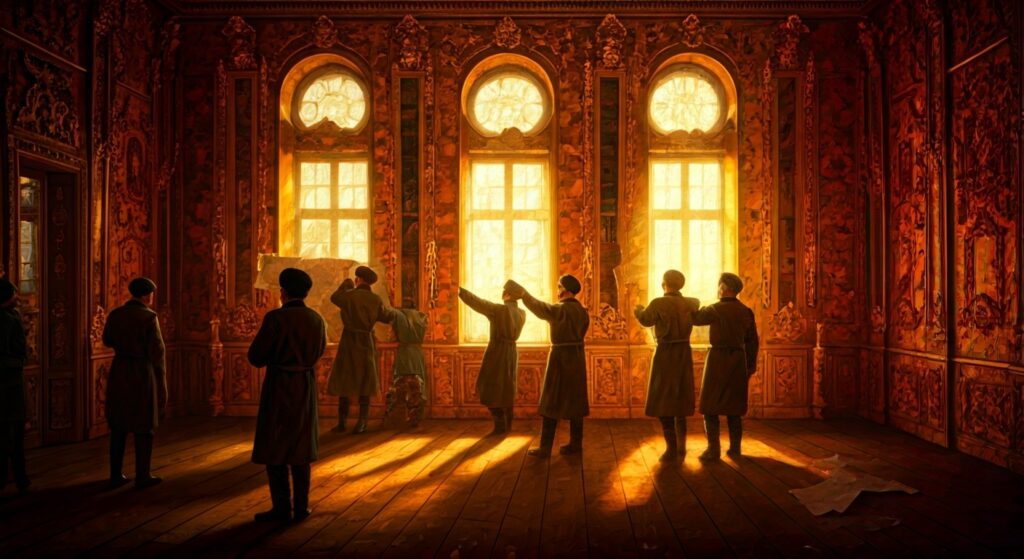
The devastating answer was that you don’t. The amber had grown brittle over time; attempting to dismantle the panels caused them to crumble into dust. In a desperate, heartbreaking move, curators attempted to hide the Eighth Wonder of the World in plain sight by pasting mundane, everyday wallpaper directly over the glittering panels.
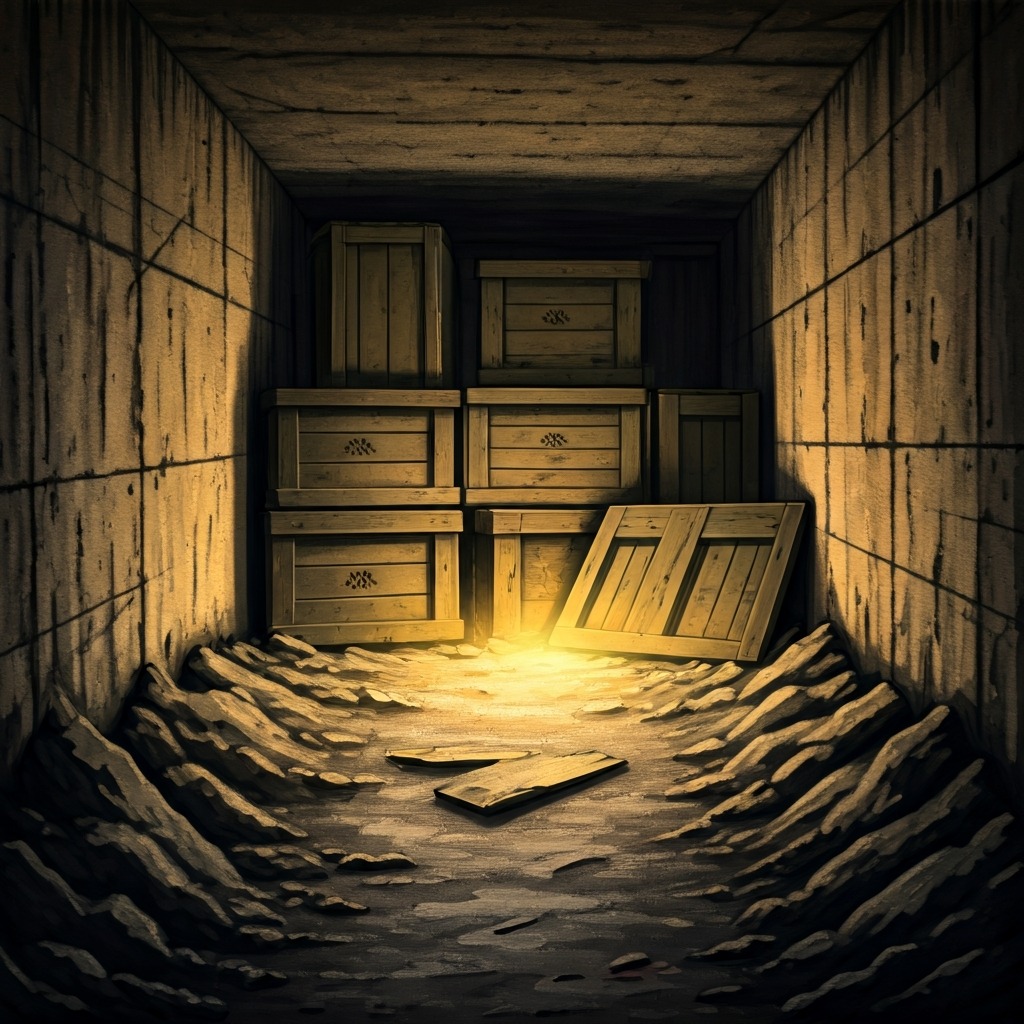
It was a valiant effort, but it fooled no one. In October 1941, the invading forces of Army Group North arrived with a specific target in mind. With ruthless efficiency, Nazi soldiers tore down the wallpaper, dismantled the amber panels, packed them into 27 heavy crates, and shipped the priceless treasure off to Königsberg Castle in East Prussia.
The Castle of Secrets
For a brief, dark period, the Amber Room was proudly displayed in Königsberg as a trophy of conquest. But as the tide of the war turned, the hunters became the hunted. By late 1944, the Red Army was advancing rapidly toward East Prussia, and Allied bombers were pounding Königsberg from the sky.
The room was dismantled once more and packed away into its 27 crates. And then… nothing.
Following the devastating Allied air raids and the subsequent Soviet siege of Königsberg in April 1945, the Amber Room vanished. The castle was reduced to a smoldering ruin, and the trail went ice cold.
This is where historical true-crime theories go into overdrive. Did the room burn to ash in the fires that consumed the castle? Soviet investigator Anatoly Kuchumov spent decades leading state-sponsored searches, scouring the ruins and beyond. Some historians believe the crates were hidden deep inside abandoned salt mines or buried in secret underground bunkers. Others subscribe to a darker maritime theory: that the crates were loaded onto the Wilhelm Gustloff, a transport ship torpedoed by a Soviet submarine in 1945, taking thousands of lives—and possibly the Amber Room—to the bottom of the Baltic Sea.
A Smoking Gun in Stone
For decades, the world assumed the Amber Room was either ash or fish food. But in 1997, a massive clue dropped that shattered the established narrative.
A genuine piece of the Amber Room—a stunning Florentine stone mosaic—suddenly surfaced in Germany. The seller? The son of a deceased Wehrmacht soldier who had been present in Königsberg.
This single mosaic was the smoking gun historians had been praying for. It proved that at least parts of the room had survived the immediate destruction of the castle and were looted by individual soldiers before the fires took hold. If the mosaic survived, what else was sitting in an attic, a basement, or a buried bunker, waiting to be found?
The Ghost in the Gold
Despite countless amateur treasure hunts and ground-penetrating radar scans of European bunkers, the bulk of the original Amber Room remains missing. It is a ghost story told in gold and fossilized tree resin.
If you visit the Catherine Palace today, you can step inside a breathtaking, meticulous reconstruction of the room, completed in 2003 after decades of painstaking labor. It glows just as fiercely as the original once did. But as you stand surrounded by those golden walls, it is impossible not to wonder about the 27 crates. Somewhere out there, hidden in the dark, the real Eighth Wonder of the World might still be waiting.