The Weight of Words
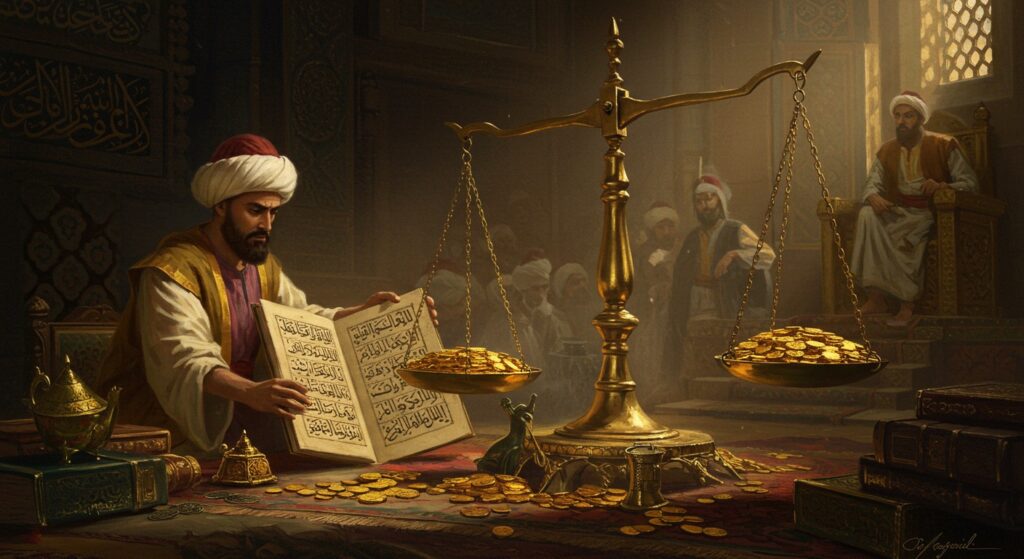
The air in the opulent courts of 9th-century Baghdad is thick with incense and anticipation. You step forward toward the throne, clutching not a sword or a chest of jewels, but a stack of freshly inked paper. You hand your manuscript to the royal treasurer, who places it carefully on a gleaming brass scale. On the opposite side, he begins to stack solid gold coins. He doesn’t stop until the scale perfectly balances.
You have just been paid your book’s exact weight in gold.
While modern students might groan over the extortionate prices of college textbooks, the idea of a ruler purchasing books for their literal weight in gold is a level of bibliophilia most can only dream of. Yet, this was the staggering reality under Caliph Al-Ma’mun, who ruled the Abbasid Caliphate from 813 to 833 CE.
This royal bounty was the engine behind the Graeco-Arabic Translation Movement—a massive, state-sponsored initiative spanning three centuries. The goal was unprecedented: to gather the entirety of human knowledge—Greek, Persian, Indian, and Syriac—and assimilate it into Arabic. But beneath the glittering allure of gold lay a hidden web of geopolitical maneuvering, stolen technologies, and intellectual espionage.
The Sheikh and the Hustle
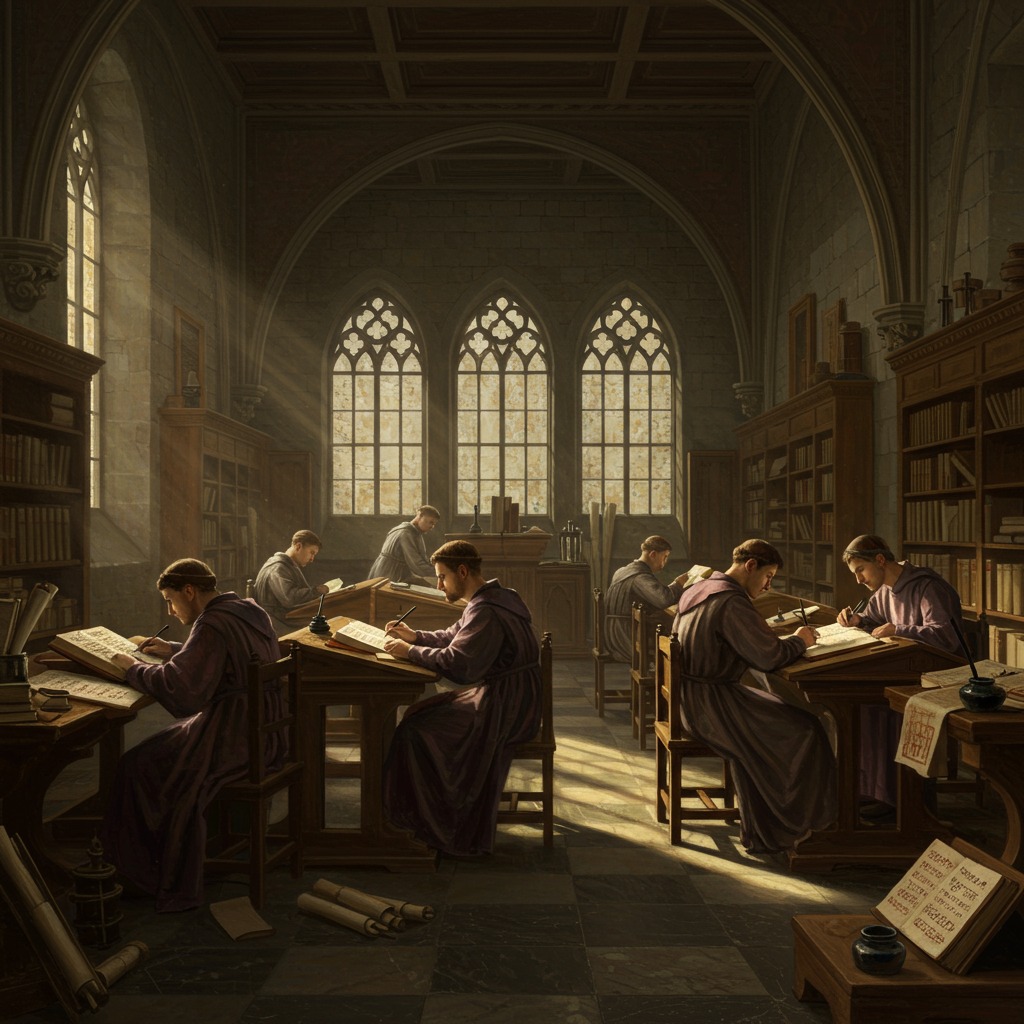
The epicenter of this intellectual explosion was the Bayt al-Hikmah, the legendary House of Wisdom in Baghdad. Far more than a mere library, it was a bustling, pluralistic think-tank where Muslim caliphs enthusiastically employed Christian, Jewish, and Sabian scholars to decode the secrets of the ancients.
The undisputed star of this operation was a brilliant Nestorian Christian polyglot named Hunayn ibn Ishaq, famously dubbed the “Sheikh of the Translators.” Before Hunayn, translations were clunky, word-for-word disasters that often made zero sense in Arabic. Hunayn revolutionized the game. Acting as intellectual detectives, he and his team hunted down multiple Greek manuscripts, cross-referenced them to find the most accurate original text, translated the work into Syriac, and finally into Arabic. They didn’t just translate words; they captured the precise soul and context of the knowledge.
But human nature remains undefeated, and historical gossip suggests the Caliph’s “weight in gold” policy created a highly lucrative loophole. Just as a desperate high school student might bump up the font size and widen the margins to hit a ten-page requirement, some medieval translators allegedly sought out the thickest, heaviest paper available. By writing in unusually large script on dense pages, these ancient hustlers maximized their golden payouts.
A Secret Forged in Blood
How could the empire afford to produce so many massive, heavy books in the first place? The answer lies in a bloody clash of empires and a stolen secret.
Before this era, books were written on parchment (animal skin) or papyrus—both of which were incredibly expensive, fragile, and painstakingly difficult to produce. But the tide of history turned following the Battle of Talas in 751 CE, when Arab forces captured Chinese prisoners of war.
Among these prisoners were artisans who held a world-changing secret: the art of papermaking.
Paper was light, vastly cheaper, and easy to manufacture. Without this sudden influx of captured technology, the mass production of books required for the Translation Movement would have been economically impossible. The Abbasids weaponized this new medium, turning Baghdad into the undisputed intellectual capital of the world.
The Ultimate Geopolitical Flex
It is tempting to look back and view Caliph Al-Ma’mun and his predecessors purely as enlightened scholars driven by a pure love of learning. In reality, the Abbasids were shrewd, cutthroat politicians. The Translation Movement was driven by cold, hard practicality and intense political rivalry.
Practically, a rapidly expanding empire needed cutting-edge infrastructure. They needed the medical texts of Galen and Hippocrates to keep their armies alive. They needed the complex mathematics of Euclid to engineer aqueducts and calculate complicated Islamic inheritance laws. They needed the astronomical data of Ptolemy to navigate the seas, optimize agriculture, and accurately determine the direction of Mecca for daily prayers.
Politically, the movement was a masterstroke of propaganda. The Abbasids adopted the ancient Persian imperial ideology, which dictated that a truly great empire must gather and synthesize all universal knowledge. By doing so, they positioned themselves as the rightful heirs to all ancient civilizations.
More importantly, it was a cultural dagger aimed directly at their greatest rivals: the Byzantine Empire. The Abbasids boldly claimed that the Christian Byzantines had foolishly neglected and suppressed the wisdom of their own Greek ancestors. The Islamic empire, they argued, was the true guardian of civilization, preserving and elevating the knowledge that the Byzantines had cast aside.
The Echo That Woke the West
The Translation Movement did far more than act as a medieval backup drive for ancient Greek philosophy. It forged a unified scientific language and ignited the Islamic Golden Age.
The texts translated by Hunayn and his peers became the bedrock upon which legendary Islamic scholars built entirely new disciplines. Thinkers like Al-Khwarizmi (the father of algebra), Al-Biruni, and Ibn Sina (Avicenna) didn’t just read the ancients; they corrected them, expanded upon them, and pushed human knowledge into uncharted territories.
Centuries later, the wheel of history turned again. In the 12th century, European scholars flocked to places like Toledo, Spain. There, they discovered vast libraries of Arabic manuscripts—both the preserved ancient Greek texts and the groundbreaking original Islamic advancements. As these texts were translated from Arabic into Latin, they flooded into Europe, effectively seeding the Renaissance.
The next time you open a book, think of the Sheikh of Translators, the captured Chinese papermakers, and a Caliph who believed that knowledge was quite literally worth its weight in gold. They didn’t just save history; they wrote the future.