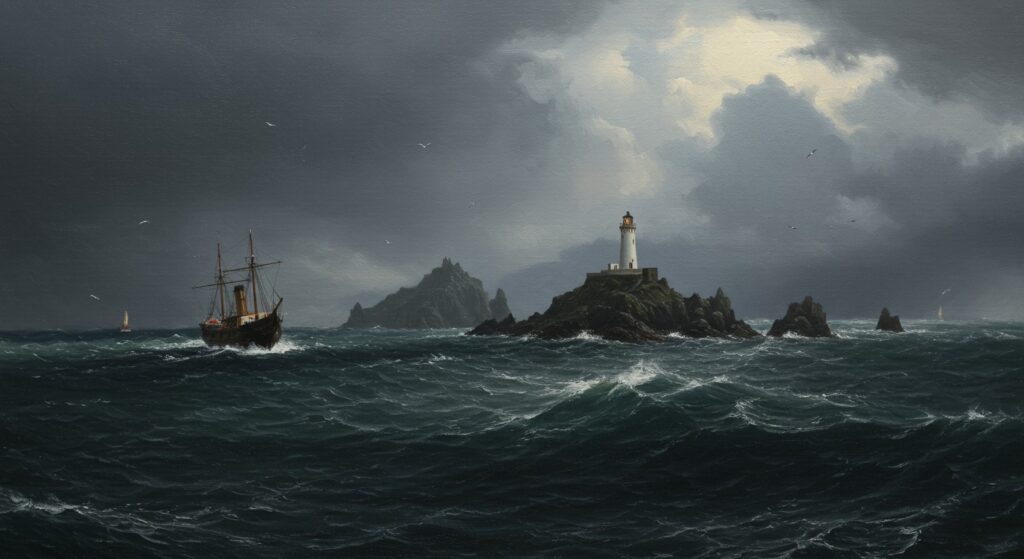
December 26th, 1900. The relief ship Hesperus sliced through the frigid grey waters of the North Atlantic, its destination a jagged rock 20 miles off the Scottish coast: Eilean Mòr, one of the seven uninhabited Flannan Isles. For days, a brutal winter storm had delayed its arrival. Now, an unnerving stillness hung in the air. Captain Jim Harvie raised his spyglass. The lighthouse, a beacon of safety against the treacherous sea, was dark. And silent.
He sounded the ship’s horn, a mournful blast that was swallowed by the immense quiet. He fired a signal flare, a desperate streak of red against the oppressive sky. Nothing. No flag flew from the staff. No provision boxes waited at the landing. A knot of dread tightened in the stomach of Relief Keeper Joseph Moore as he was lowered into a small boat to row ashore. He was about to step into one of the most chilling maritime mysteries of all time.
A Scene of Eerie Calm
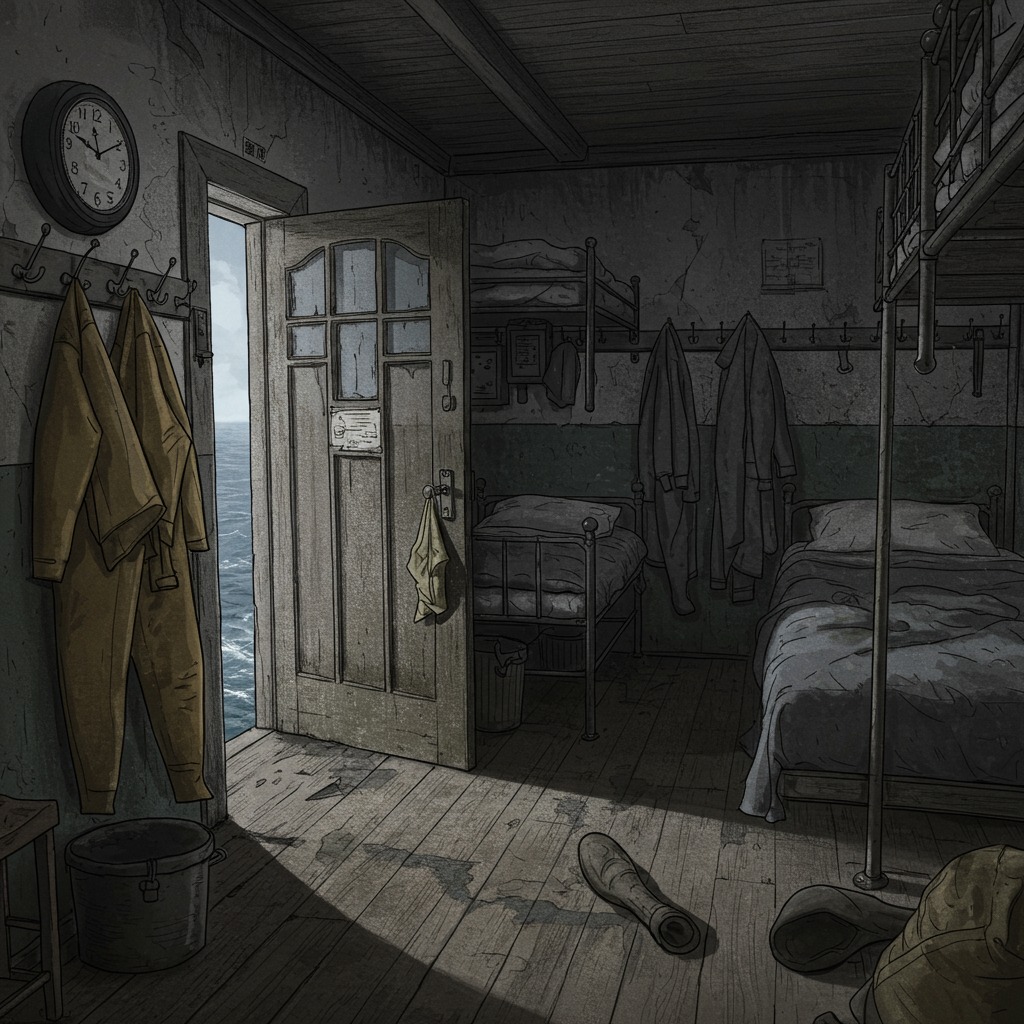
The first thing Moore found was that the entrance gate and the main door to the lighthouse were shut tight. Inside, an unnatural orderliness prevailed. The clocks had stopped, their hands frozen in time. In the kitchen, the dishes were washed and neatly put away. The beds were made. A fire had been laid, ready to be lit. The official logbook was filled out, with the last entry recorded on December 13th. Slate notes indicated the men were still on duty the morning of the 15th. There was no sign of a struggle, no hint of violence or distress.
But by the door hung the most unsettling clue of all. By strict Northern Lighthouse Board protocol, one keeper was required to remain inside the lighthouse at all times. Two sets of heavy oilskins, the keepers’ only defense against the brutal Atlantic weather, were gone. But the third set, belonging to seasoned mariner Donald MacArthur, still hung on its peg. Whatever had happened, it had happened so suddenly that one man had run out into a ferocious storm without his coat.
Evidence of Unimaginable Force
If the inside of the lighthouse was a picture of eerie calm, the outside was a scene of utter devastation. Investigators surveying the island’s West Landing were met with evidence of a force almost beyond comprehension. Thick iron railings, cemented into the rock, were bent and twisted into grotesque shapes. An iron tramway used to haul supplies up the cliff had been ripped from its concrete moorings. A heavy supply crate, stored for safety in a crevice a staggering 110 feet above sea level, had been smashed open, its contents scattered.
This wasn’t the work of men. This was the work of the sea at its most violent. But how could a wave reach so high, with such destructive power? And where were the keepers—James Ducat, Thomas Marshall, and Donald MacArthur?
Madness, Monsters, or a Wall of Water?
With no bodies ever recovered, speculation ran wild. Tabloids invented tales of sea serpents and giant birds. Later fictions added lurid details of an uneaten meal on the table or a knocked-over chair—dramatic flourishes that never actually happened. The truth was far cleaner, and far more terrifying.
The official inquiry, led by NLB Superintendent Robert Muirhead, pieced together the most plausible, and heartbreaking, scenario. He concluded that on the afternoon of December 15th, as the storm gathered, Principal Keeper Ducat and Assistant Marshall likely went down to the West Landing to secure the equipment. From inside the lighthouse, Donald MacArthur must have seen it coming—a rogue wave of apocalyptic size, a sheer wall of water building in the Atlantic and hurtling toward the island.
Knowing his colleagues had only seconds, MacArthur broke the cardinal rule. He abandoned his post, running from the lighthouse without even grabbing his coat in a desperate, doomed attempt to warn them. He was too late. The wave, cresting at over 100 feet, slammed into the cliff face with unimaginable power, sweeping all three men from the rock and into the churning, icy abyss.
We will never know for certain. The ocean keeps its secrets. All that remains is the haunting image of a perfectly tidy lighthouse, a stopped clock, and a single oilskin coat hanging by the door—a silent testament to three men who vanished into the void.
Dig Deeper
Explore the primary sources, historical context, and enduring folklore behind the Flannan Isles mystery.
-
The Official Investigation Report | Northern Lighthouse Board
Read the original, chilling report from the official authority that investigated the disappearance. This page includes transcripts of the telegrams sent from the island and the final conclusions from Superintendent Robert Muirhead, who knew the men personally.
https://www.nlb.org.uk/history/flannan-isles/ -
The Science of Rogue Waves | National Ocean Service
The official theory blames a “rogue wave” of incredible size. But are such waves real? This explainer from the National Oceanic and Atmospheric Administration (NOAA) delves into the science behind these rare but terrifyingly powerful ocean phenomena.
https://oceanservice.noaa.gov/facts/roguewaves.html