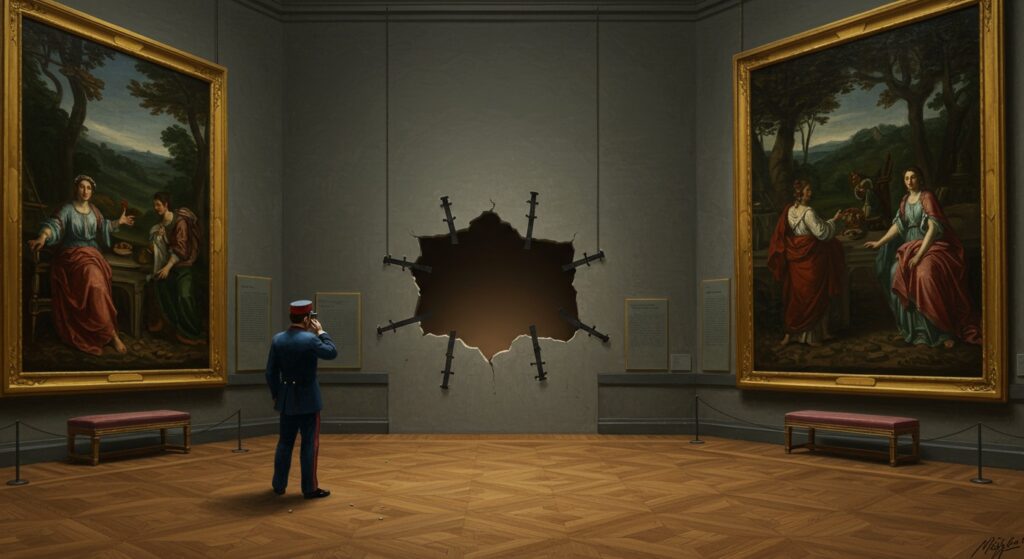
The morning of Tuesday, August 22, 1911, began like any other at the Louvre in Paris—until a visiting artist noticed something peculiar in the Salon Carré. Between Correggio’s Mystic Marriage of St. Catherine and Titian’s Allegory of Alfonso d’Avalos, there was a glaring, rectangular gap on the wall. Four iron pegs protruded from the plaster like bare teeth.
The Mona Lisa was gone.
What followed was a frantic, globe-spanning mystery that inadvertently transformed a respected Renaissance portrait into the most famous painting in human history.
The Phantom in the Broom Closet
The heist itself was almost laughably simple. While modern museum thefts conjure images of laser grids and acrobatic cat burglars, the man who walked out with the world’s most precious Leonardo da Vinci needed only a closet and a smock.
His name was Vincenzo Peruggia, an Italian handyman hired by the Louvre to construct protective glass cases for its masterpieces. He knew the museum’s blind spots intimately. On Sunday, August 20, Peruggia slipped into a broom closet and waited in the dark.
When the museum remained closed to the public the following Monday morning, Peruggia emerged wearing the standard white smock of a Louvre employee. He casually lifted the Mona Lisa off its four iron pegs, discarded its heavy wooden frame in a nearby stairwell, tucked the painted panel beneath his smock, and walked out a side door into the bustling Parisian streets. Just like that, a masterpiece vanished into thin air.
Framing Picasso
Desperate for leads and facing immense public humiliation, the French police began grasping at straws. Their frantic investigation soon took a bizarre detour into the Parisian avant-garde, ensnaring two men who would go on to shape 20th-century culture.
Detectives zeroed in on a recent string of minor thefts at the Louvre orchestrated by Honoré-Joseph Géry Pieret, a Belgian adventurer who routinely pocketed small Iberian stone statues. Pieret’s former roommate was the prominent poet and art critic Guillaume Apollinaire. And Apollinaire had recently introduced Pieret to a fiery, 29-year-old Spanish painter named Pablo Picasso.
The connection was damning. Picasso had actually purchased the stolen Iberian heads from Pieret—fully aware they were hot—and used them as inspiration for his groundbreaking, proto-Cubist masterpiece, Les Demoiselles d’Avignon.
When detectives arrested Apollinaire on suspicion of masterminding the Mona Lisa theft, the terrified poet cracked and implicated Picasso. Hauled before a magistrate in a moment of sheer, weeping panic, Picasso blatantly lied, claiming he had never even met Apollinaire. Ultimately, the judge realized these bohemian artists were merely hoarding stolen statues and lacked the cunning to pull off the century’s greatest heist. Both were released, leaving the police back at square one.
The Magnetism of an Empty Wall
While the authorities fumbled, the theft birthed a global cultural phenomenon. It is hard to believe today, but prior to 1911, the Mona Lisa was not a household name. It was highly regarded by art critics and historians, but it lacked a mythical status among the general public.
The heist changed everything. Newspapers worldwide splashed the mysterious woman’s enigmatic smile across their front pages, transforming her into the first mass-reproduced artwork of the 20th century. The public became utterly obsessed. Cabarets wrote satirical songs about the missing woman, and postcards of the painting sold by the millions.
Most incredibly, thousands of people—including the writer Franz Kafka—flocked to the Louvre simply to stare at the empty space on the wall. The void itself became a major tourist attraction, a shrine to a ghost.
The Masterpiece in the Trunk
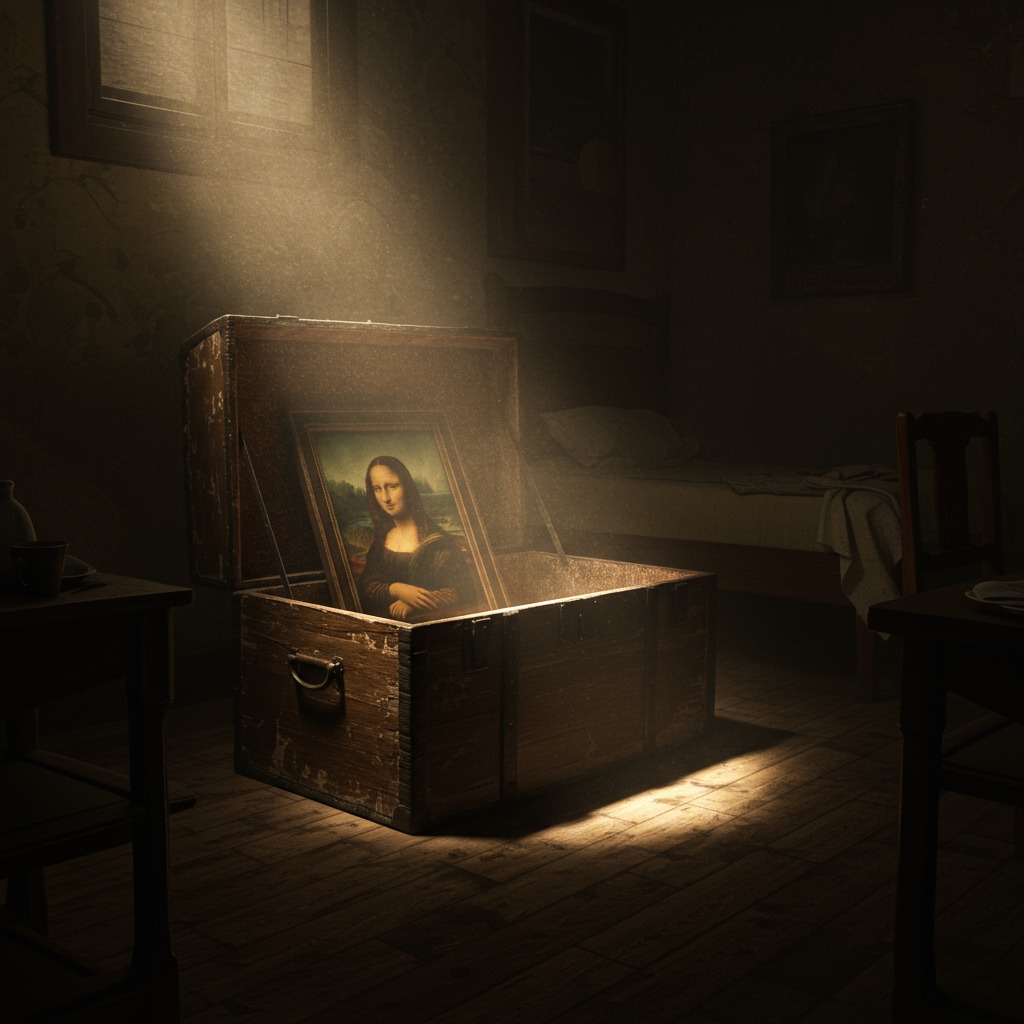
For over two years, the whereabouts of the painting remained a total mystery. Peruggia hadn’t fled the country or sold it to a shadowy billionaire. He had kept the Mona Lisa hidden in a false-bottom trunk in his dingy Paris boarding house the entire time.
The mystery finally unraveled in December 1913 when Peruggia traveled to Florence, Italy. He reached out to a local art dealer named Alfredo Geri, offering to return the painting to its “homeland,” fully expecting a handsome financial reward and a hero’s welcome.
Instead, he got handcuffs. When arrested, Peruggia proudly claimed he was an Italian patriot avenging Napoleon’s looting of Italian art. It was a romantic defense, but historically ignorant: Leonardo da Vinci himself had brought the painting to France in 1516 and sold it to King François I.
Despite his flawed history, Peruggia’s patriotic defense won over the Italian public. He served a remarkably brief prison sentence of just seven months and was hailed by many as a national hero.
As for the Mona Lisa, she was exhibited triumphantly throughout Italy before making a highly publicized, heavily guarded return to the Louvre. She had left the museum as a mere masterpiece, but she returned as an untouchable, global pop-culture icon—a status she retains to this day, all thanks to a handyman in a white smock.