The air in Rome was thick with incense and the stifling heat of a late summer day in 857 AD. The city’s faithful had crammed into the narrow, winding streets to catch a glimpse of their Holy Father. The grand papal procession was making its solemn journey from St. Peter’s Basilica to the Lateran Palace. At the center of the spectacle rode the Pope—a pontiff revered for boundless intellect and deep piety, who had flawlessly ruled the Church for two years.
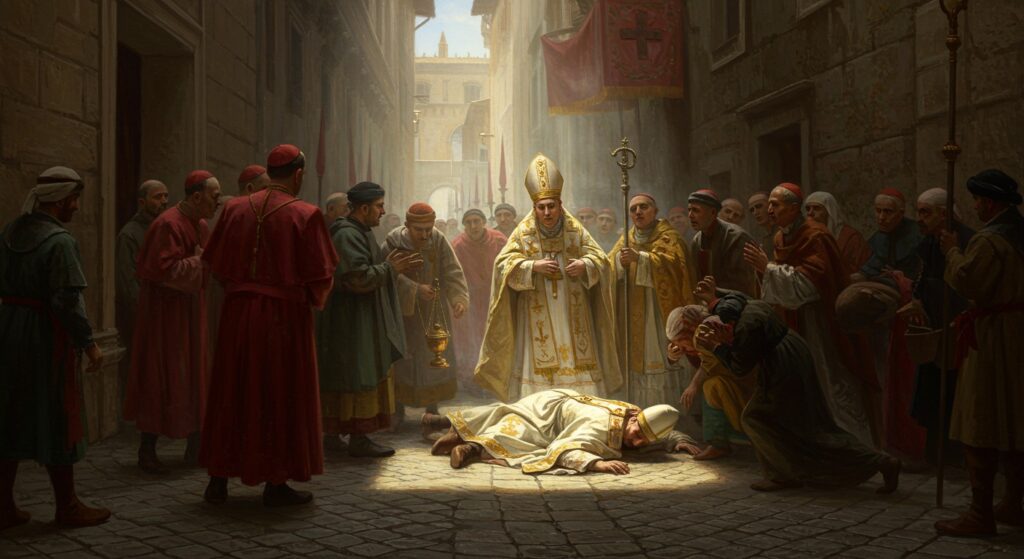
But as the procession squeezed through a particularly cramped alleyway, the Pope suddenly collapsed. The crowd gasped as the Holy Father began to writhe in agony on the ancient cobblestones. Murmurs of concern morphed into shrieks of absolute horror when, right there in the dirt of the Eternal City, the Pope went into labor and delivered a child.
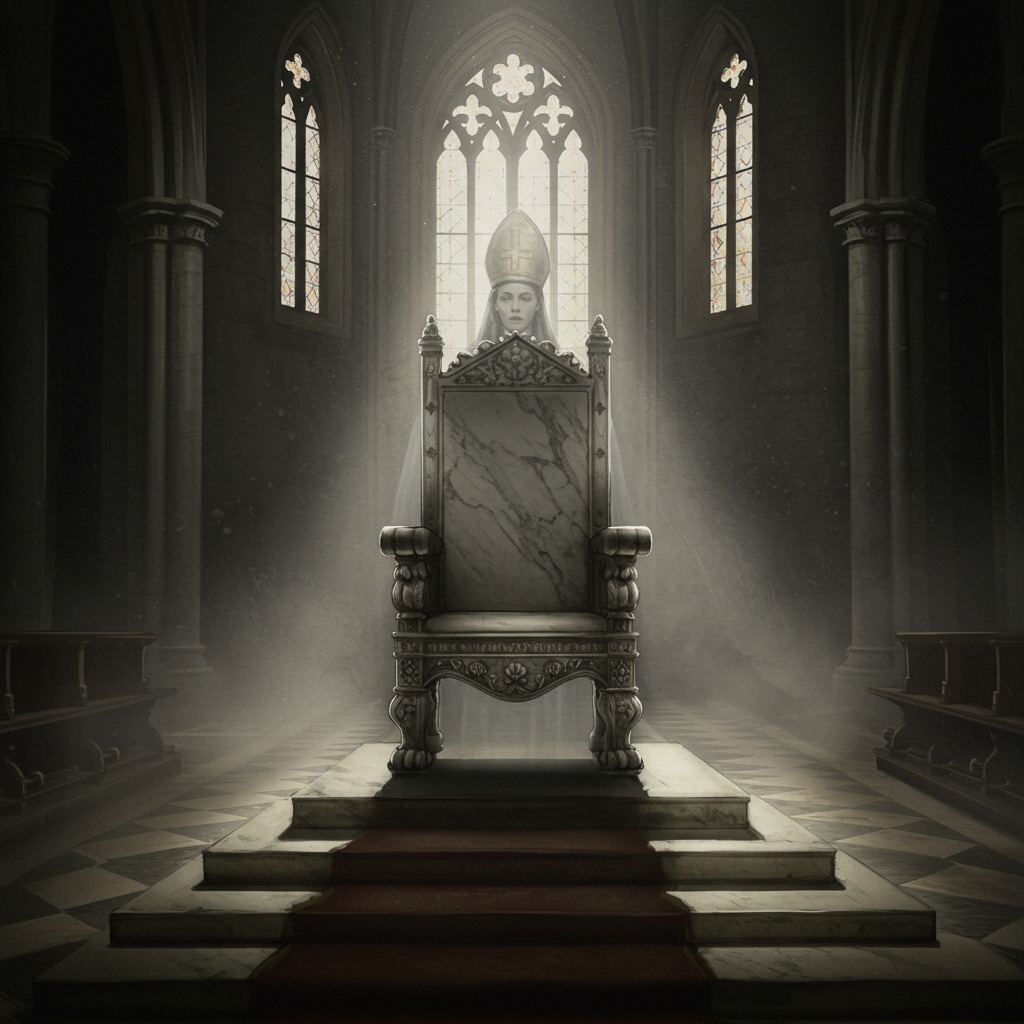
The Vicar of Christ was a woman.
It is a tale of ultimate deception, forbidden knowledge, and violent unmasking. But as with all great historical mysteries, the line between undeniable fact and masterful fiction is written in invisible ink.
The Phantom Pontiff’s Perfect Disguise
According to the lore that would captivate Europe for centuries, the woman who would become Pope was born in Germany to English parents in the 9th century. In an era when the doors of academia were violently slammed in the faces of women, Joan possessed a dangerous and insatiable thirst for knowledge.
Realizing that her gender was a life sentence of intellectual obscurity, she made a radical choice. She bound her chest, donned men’s clothing, and adopted the name “Johannes Anglicus” (John of the English). Alongside a lover who shared her passion for learning, she traveled to Athens to immerse herself in theology and philosophy.
Eventually, Joan relocated to Rome. Her disguise was flawless, and her brilliance was unmatched. She rose rapidly through the fiercely competitive ranks of the Catholic Church, her reputation for wisdom catching the attention of the highest clerical authorities. When Pope Leo IV died in 855 AD, the cardinals unanimously elected the brilliant John to the Throne of St. Peter.
For two years, Pope Joan supposedly ruled with wisdom and grace. But the illusion was shattered on that fateful procession. The consequences of her exposure were brutal. Depending on the medieval chronicler you ask, she either died in the agonizing throes of childbirth, was tied to the tail of a horse and stoned to death by an enraged mob, or was quietly deposed and locked away in a convent.
The 400-Year Silence
For hundreds of years, the Catholic Church and the public accepted Pope Joan as a historical reality. If you had walked into the Cathedral of Siena before the 16th century, you would have seen a bust of Pope Joan proudly displayed alongside the other pontiffs.
But how did this sensational scandal become accepted as gospel truth?
The mystery deepens when we look at the contemporary records of the 9th century: there is absolute silence. No historian, monk, or diplomat of the era mentions a female pope. The story didn’t surface until over 400 years later. It first appeared as a passing mention around 1250 in the writings of a Dominican chronicler named Jean de Mailly, who vaguely placed her reign in the 11th century.
The legend was ultimately weaponized and cemented into the historical bedrock by Martin of Opava in his wildly popular Chronicon Pontificum et Imperatorum (c. 1278). It was Martin who attached the specific dates, the name Johannes Anglicus, and the dramatic mid-procession birth. Because Martin’s work was widely copied and trusted, the phantom pope was written into reality.
The Ultimate Alibi: The Ticking Clock
Modern historians, armed with archives and numismatic evidence, have systematically dismantled the legend. The greatest enemy of the Pope Joan story is the relentless, unbroken ticking of the 9th-century clock.
Pope Leo IV died on July 17, 855. The papal throne did not sit empty, nor was it occupied by a disguised woman. Benedict III was elected almost immediately, with his consecration taking place in September of that very same year.
We have the receipts. There are surviving coins minted with Benedict III’s image alongside the Holy Roman Emperor Lothair I. Because Emperor Lothair died in September 855, those coins had to have been struck immediately after Leo’s death, leaving zero chronological room for Joan’s supposed two-year reign before her disastrous procession in 857. Furthermore, 9th-century Byzantine critics—who despised Rome and would have gleefully used a female pope as ultimate propaganda to discredit the Western Church—never breathed a word of it.
Anatomy of a Medieval Smear Campaign
If Pope Joan never existed, who invented her, and why?
Historians believe the myth is a potent cocktail of political satire, misunderstood monuments, and bizarre papal rituals. The legend likely originated as a veiled critique of the Saeculum Obscurum—the so-called “Dark Century” or “Pornocracy” of the 10th-century papacy. During this chaotic era, the Vatican was heavily controlled by powerful, corrupt aristocratic women, most notably Theodora and her daughter Marozia, who essentially made and unmade popes at will. The idea of a “female pope” was likely a satirical jab at these women pulling the strings.
The myth was further fueled by the city of Rome itself. The street where Joan supposedly gave birth, the Via San Giovanni in Laterano, was indeed deliberately avoided by later papal processions. The medieval rumor mill claimed popes detoured out of shame for Joan’s scandalous birth. The mundane truth? The street was simply too narrow for a grand papal entourage to safely pass through.
Then there is the infamous sedia stercoraria—a pierced stone chair used during papal consecrations. Whispers claimed the chair was designed for a cardinal to manually verify the sex of a newly elected pope to ensure another “Joan” could never trick the Church again. In reality, these were ancient Roman bath or birthing chairs. The Church had merely repurposed them for their imperial aesthetic, symbolizing the Pope as the “mother” of the church.
The Ghost Who Conquered History
The irony of Pope Joan is that she caused more trouble in death—or rather, non-existence—than she ever could have in life.
During the Protestant Reformation, figures like Jan Hus and Martin Luther gleefully pointed to the legend of Pope Joan as undeniable proof of the Catholic Church’s deceit, framing the papacy as the literal “Whore of Babylon.” It took a 17th-century French Protestant scholar named David Blondel to look past the religious mudslinging, analyze the chronological evidence, and prove once and for all that the story was a medieval fabrication.
Today, the phantom pontiff continues to evolve. For medieval society, she was a terrifying cautionary tale about the subversion of natural gender roles. But in modern literature and film, she has been resurrected as a feminist icon—a brilliant, daring woman who beat an oppressive patriarchal system at its own game.
Pope Joan may never have sat upon the Throne of St. Peter, but she conquered something far more enduring: the human imagination.