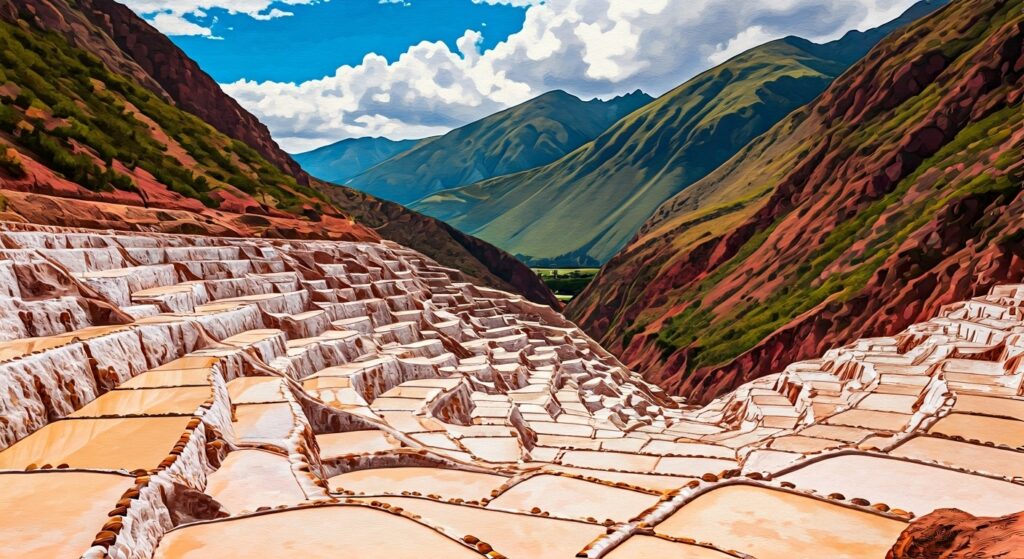
High in the Peruvian Andes, where the air grows thin and rugged peaks pierce the clouds, lies an impossible anomaly. You are standing nearly 10,000 feet above sea level, surrounded by the plunging, emerald valleys of the Inca Empire. Yet, as you round a steep mountain bend, the earth suddenly falls away to reveal a blinding, geometric mosaic of white, rose, and tan. It looks like an alien art installation carved directly into the cliffside. But this is no modern marvel. It is a 1,000-year-old machine, and it is still running.
An Ocean in the Clouds
These are the Salineras de Maras. Comprising over 3,000 terraced pools clinging to the steep slopes of the Qaqawiñay mountain, this cascading reservoir defies logic. Salt is the currency of the sea. So how did a massive, hypersaline reservoir end up thousands of meters in the sky?
To solve this mystery, we must rewind the clock millions of years. When cataclysmic tectonic shifts violently buckled the earth’s crust to forge the majestic Andes, massive pockets of ancient ocean water were swallowed whole. Trapped deep beneath the rock, this subterranean sea spent millennia interacting with halite deposits. Today, that buried ocean bleeds out of the mountain through a single, natural spring known as Qoripujio.
Architects of the Abyss
While the Maras Salt Mines are famously linked to the Inca Empire—who expanded the site to fuel their empire’s need for food preservation and mummification—the true masterminds predate them by centuries. Archaeological evidence points to the Wari or Chanapata cultures, ancient engineers who conquered this unforgiving terrain well over a millennium ago.
These pre-Columbian architects designed an intricate, gravity-fed network of channels that meticulously trickles the mountain’s saltwater into thousands of shallow pans. It is an engineering marvel so flawless that it has survived the rise and fall of empires, the Spanish conquest, and the relentless march of modernization without a single upgrade.
The Alchemist’s Sun
The harvesting process is a masterclass in ancient alchemy, relying entirely on the brutal intensity of the Andean sun.
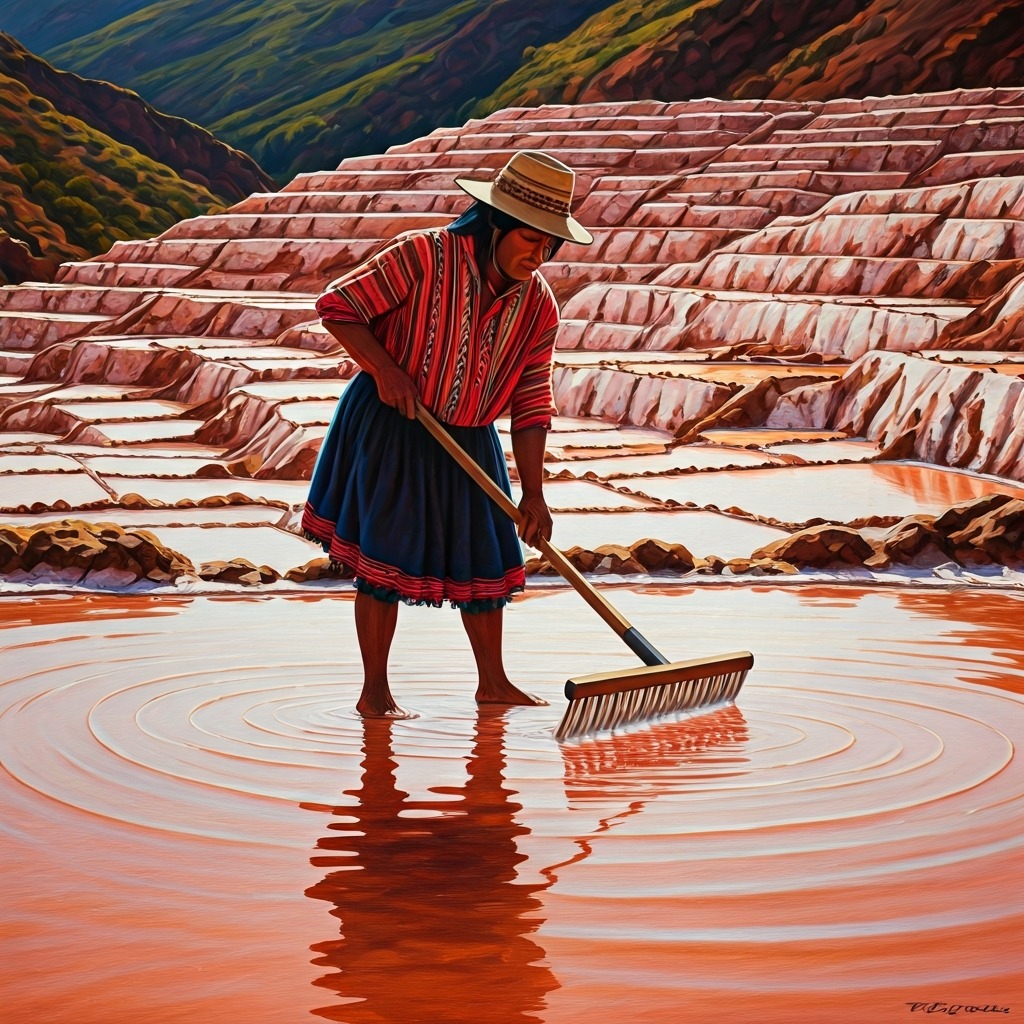
The hypersaline water is allowed to fill a pool to a depth of just a few centimeters before the feeder canal is temporarily blocked. Over the next month, the sun slowly evaporates the water, precipitating pure salt crystals into thick, glittering layers. Local miners then step in, harvesting the salt entirely by hand. Wielding simple wooden rakes, they move with practiced precision to avoid scraping the delicate clay bottoms of the pools.
The harvest yields three distinct treasures: a pristine white table salt at the top; a mineral-rich, world-renowned Peruvian pink salt in the middle; and a dark, earth-laden brown salt at the bottom.
A Bloodline of Salt
But the true mystery of Maras isn’t just its geology or its engineering—it is the unbroken chain of its people. The mines operate under a deeply rooted, ancient communal system. There are no faceless corporations here. The pools are exclusively owned and operated by local families from the nearby communities of Maras and Pichingoto.
Ownership is a bloodline. The size of a family historically dictates the number of pools they manage. If a lineage ends, the pools do not sit empty; they are reabsorbed by the cooperative and reassigned to growing families. It is a brilliant, self-sustaining economic engine that has kept the wealth of the mountain in indigenous hands for centuries.
Protecting the Pink Gold
In recent years, the secret of Maras has slipped out. Peruvian pink salt has become a highly coveted ingredient for gourmet chefs globally, triggering an economic boom—and a tidal wave of tourism.
But popularity exacts a heavy toll. The sheer volume of visitors walking along the rims of the pools began to contaminate the delicate salt layers with dirt and debris. In a bold move to protect their ancestral heritage, the local cooperative banned tourists from walking among the pans in 2019. Today, visitors can only witness the mosaic from designated viewpoints.
It was a vital, uncompromising step to preserve the purity of the harvest. The Maras Salt Mines are not a static relic of a forgotten past; they are a living, breathing testament to ancient ingenuity, continuing to provide for their people, one pink crystal at a time.