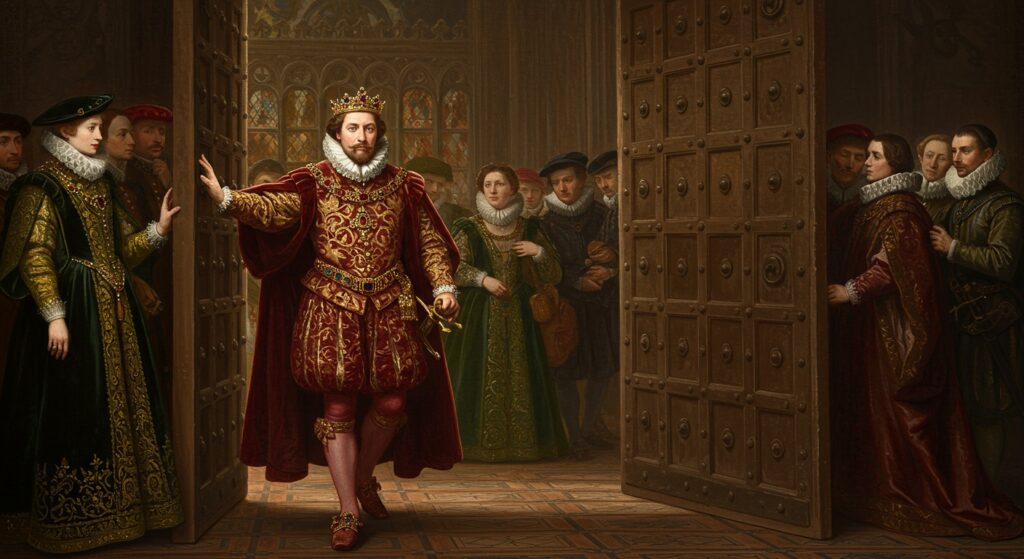
The heavy oak doors of the 16th-century royal court swing open. The king emerges, dripping in velvet and gold. He commands absolute authority, yet the eyes of his courtiers are not drawn to his jeweled crown or his broad shoulders. They are fixed squarely on his crotch.
He is sporting a codpiece—an exaggerated, heavily padded, gem-encrusted protrusion that leaves modern onlookers utterly speechless.
For centuries, this bizarre sartorial choice was dismissed as a comical byproduct of massive royal egos. But the journey of the codpiece from a humble modesty patch to a weaponized display of masculinity hides a much darker, gruesome medical secret.
A Glaring Gap in the Armor
To understand how European nobility ended up strutting around with stylized, permanent erections, we must rewind to the 14th century. Back then, the origins of the codpiece were entirely practical.
During the Middle Ages, men didn’t wear trousers. Their lower garments consisted of “chausses”—two separate leggings that tied at the waist to a belt beneath a long tunic. For decades, this worked perfectly. But as fashion evolved, the hemlines of men’s tunics began to rise drastically. Men wanted to show off their strong legs and enjoy better mobility on horseback and the battlefield.
This sartorial shift created a highly embarrassing problem. When a man bent over or mounted a horse, his tunic would ride up, exposing his linen undergarments—or his bare genitals—through the unjoined gap in his hose.
The Church and moralists of the era were outraged by these sudden, unwanted flashes of male anatomy. To quell the scandal, tailors introduced a simple, triangular flap of cloth that laced across the groin to bridge the gap. Deriving its name from the Middle English word ‘cod’—meaning scrotum or bag—the original codpiece was born purely out of a desperate need for modesty.
The Renaissance Arms Race
As the 16th century dawned, the cultural mindset shifted violently. The goal was no longer to conceal the male anatomy, but to aggressively weaponize it. The codpiece transformed from a modest linen patch into a highly decorated focal point of male attire.
Tailors began “bombasting” the codpiece, stuffing it to the brim with sawdust, wool, or horsehair to make it protrude outward and upward. The fashion craze reached its zenith during the reign of King Henry VIII. For Henry and his contemporaries, the oversized codpiece was a potent symbol of virility, military prowess, and unyielding political dominance.
It became a literal measuring contest among the nobility. Aristocrats commissioned codpieces crafted from luxurious silks, heavily embroidered and studded with pearls. The trend even bled into warfare, with military gear featuring massive, riveted metal codpieces designed to strike fear into the hearts of enemies on the battlefield.
The Gruesome Truth Beneath the Velvet
For centuries, historians assumed this inflation was driven entirely by male ego. But medical anthropologists have recently unearthed a much darker, less glamorous theory.
In the late 1490s, Europe was swept by a devastating epidemic of syphilis, then known as the ‘Great Pox.’ The disease ravaged the population, and the medical treatments of the time were often as horrific as the affliction itself. Doctors treated the afflicted areas by applying bulky, mercury-soaked bandages and thick, greasy ointments.
Scholars now suggest that the enlarged codpiece wasn’t just a boastful display; it was a grim medical necessity. The exaggerated pouch provided a friction-free space to accommodate swollen anatomy and thick medical dressings. Furthermore, the dense padding protected a nobleman’s incredibly expensive outer silk garments from being permanently stained by toxic, greasy medicines. Suddenly, that jewel-encrusted velvet pouch seems a lot less intimidating—and a lot more tragic.
The Most Intimate Pocket in History
Beyond its symbolic power and grim medical utility, the codpiece occasionally served a surprisingly mundane purpose: it acted as a pocket.
In an era before modern pockets were sewn into trousers, men had very few places to store their daily items. It became common practice for men to stash small valuables, coins, handkerchiefs, and even half-eaten fruit within the padding of their codpieces. While finding a forgotten receipt in your jeans today is a minor annoyance, pulling a bruised apple out of your underwear was simply a part of 16th-century life.
The Deflation of an Empire
Like all extreme fashion trends, the craze eventually burned itself out. By the late 16th century, during the Elizabethan era, the focal point of men’s fashion moved upward to the torso.
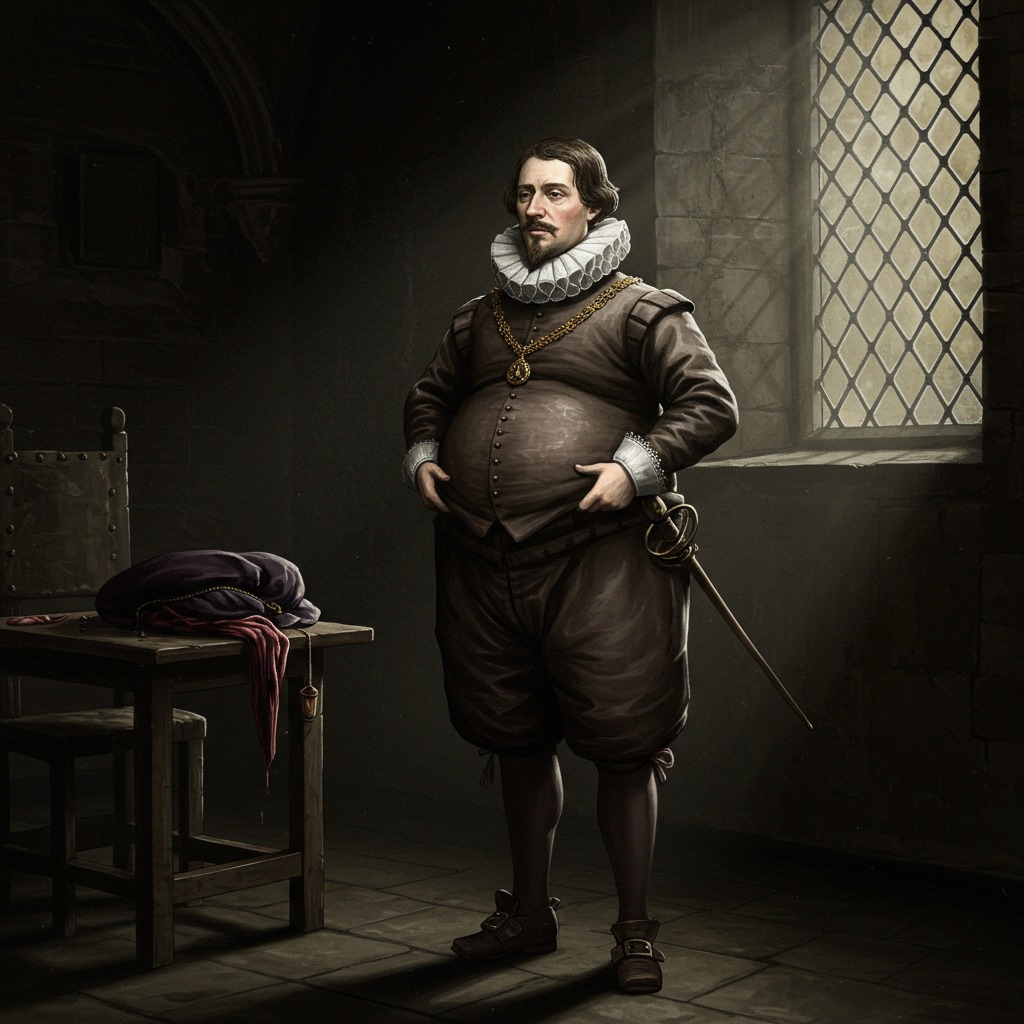
The new status symbol was the ‘peascod belly’ doublet, a garment that artificially padded the stomach to simulate a portly figure—a sign of immense wealth and a rich diet. As the belly grew, the codpiece shrank. It slowly deflated back into a small, flat flap before disappearing entirely by the 1590s.
Quietly replaced by the modern, much more discreet buttoned fly, the codpiece faded into obscurity. Today, it leaves behind a legacy as one of history’s most absurd, ostentatious, and strangely tragic displays of masculinity.