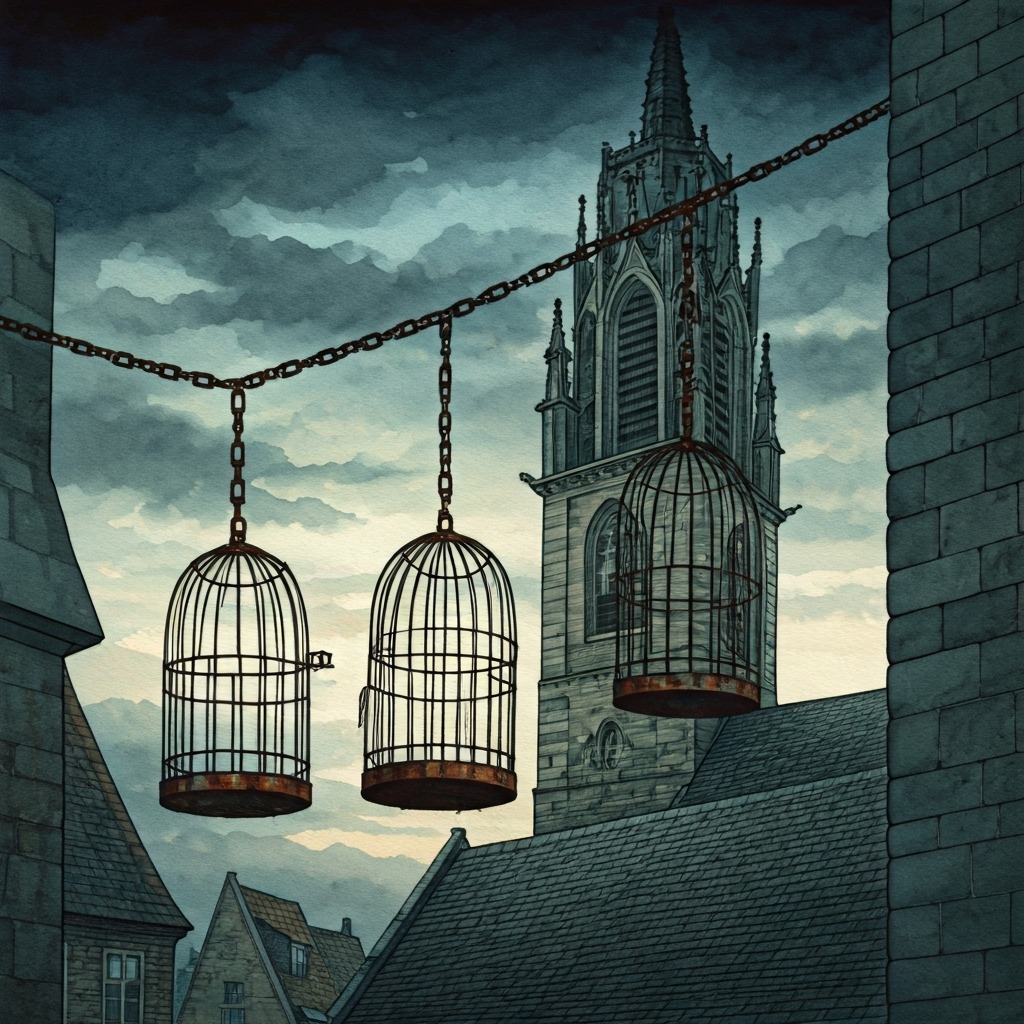
High above the cobblestone streets of Münster, Germany, three rusted iron cages dangle from the gothic spire of St. Lambert’s Church. They have hung there for nearly five centuries. Today, they are empty. But in the winter of 1536, they held the mutilated remains of three men who orchestrated one of the most terrifying apocalyptic cults in European history.\n\nThis is the dark, forgotten saga of the Münster Rebellion—a masterclass in megalomania that transformed a sanctuary into a slaughterhouse.\n\n## A City Seized by the End Times\n\nIn the early 1530s, Europe was burning with the religious fervor of the Protestant Reformation. Fleeing severe persecution, radical Anabaptists converged on the German city of Münster. They were not merely seeking a safe haven; they were driven by a fanatical prophecy. They believed Münster was destined to become the “New Jerusalem,” the sole city on Earth that would survive an impending, fiery apocalypse.\n\nThe movement was initially spearheaded by Jan Matthys, a charismatic Dutch baker with a dangerous talent for mass manipulation. Under his spell, the radicals seized control of the city council, effectively locking Münster down. Matthys swiftly abolished personal wealth, declaring all property communal. Those who dared to question his extreme theology were violently expelled into the freezing, lethal winter.\n\nOutside the walls, the furious forces of the local Prince-Bishop, Franz von Waldeck, laid siege to the city. But the true horror was not the army gathering at the gates. It was the madness brewing within.\n\n## The Rise of the Tailor King\n\nIntoxicated by his own apocalyptic delusions, Matthys led a suicidal military charge against the Prince-Bishop’s heavily armed besiegers. He was slaughtered instantly.\n\nIn the wake of his death, a power vacuum emerged, and a new, far more sinister architect of doom stepped out of the shadows: Jan of Leiden.\n\nJan was not a theologian. He was a young, flamboyant tailor with a flair for the theatrical and a thirst for absolute power. He didn’t just take control of the city—he declared himself the King of the New Jerusalem. Jan swiftly instituted a bizarre, totalitarian regime that would make modern dystopian fiction pale in comparison. He abolished money entirely and ordered the burning of all books except the Bible.\n\nCiting Old Testament patriarchs, he legalized polygamy, a decree that rapidly devolved into systemic coercion. While the city suffocated under the siege, the Tailor King built a personal harem, taking sixteen wives and ruling with an iron fist.\n\n## A Crown of Gold in a City of Bones\n\nAs the Prince-Bishop’s siege dragged on, the situation inside Münster turned desperate. The food supply vanished. The citizens of the “New Jerusalem” were reduced to eating rats, chewing on grass, and boiling their own shoe leather just to survive.\n\nBut the Tailor King did not starve.\n\nWhile his people withered away in the streets, Jan of Leiden dressed in lavish, theatrical robes. He wore a gleaming golden crown and held opulent court in the town square, completely detached from the suffering of his followers. Dissent was met with swift, brutal justice. When one of his own wives, Elisabeth Wandscherer, dared to criticize his luxurious lifestyle while the populace starved, Jan had her publicly beheaded.\n\n## The Gates Open to Hell\n\nEvery cult has its breaking point. By June 1535, the apocalyptic kingdom finally collapsed. Starving, broken, and disillusioned, betrayers from within sneaked to the city gates and opened them to the Prince-Bishop’s mercenary army.\n\nWhat followed was a merciless massacre. The mercenaries tore through the city, slaughtering the radicals and bringing the twisted reign of the Tailor King to a bloody end. But for Jan and his top lieutenants, death would not come so quickly.\n\n## The Iron Cages of St. Lambert’s\n\nThe Prince-Bishop was determined to make an example of the rebel leaders—a warning so gruesome it would echo through eternity.\n\nJan of Leiden and two of his highest-ranking lieutenants, Bernhard Knipperdolling and Bernhard Krechting, were subjected to a public execution of unimaginable cruelty. For an agonizing hour, their flesh was ripped from their bodies with red-hot iron tongs before they were finally put out of their misery.\n\nBut the Prince-Bishop wasn’t finished. To serve as a permanent, terrifying monument against future uprisings, their mutilated corpses were shoved into three custom-built iron cages. These cages were hoisted high into the sky, chained to the steeple of St. Lambert’s Church in the center of Münster.\n\nEventually, the bones of the Tailor King and his lieutenants rotted away, scattered by the wind. But the cages? They never took them down. If you visit Münster today and look up at the spire, you will see those exact same iron cages hanging in the sky—a chilling, 500-year-old shadow of an apocalypse that came from within.