Forget dynamite. Forget volatile chemicals. The most bizarre and terrifying industrial bomb in American history was forged from a simple baking ingredient. It didn’t just explode; it swallowed a city block whole. This is the story of the day a bustling metropolis was decimated by a 25-foot tsunami of boiling-hot syrup.
The Brown Behemoth’s Deadly Secret
The year was 1915. As World War I raged across the Atlantic, the United States Industrial Alcohol Company (USIA) scrambled to cash in on the booming munitions market. They needed a massive storage facility in Boston’s densely populated North End to hold molasses, which would be fermented into industrial alcohol for explosives.
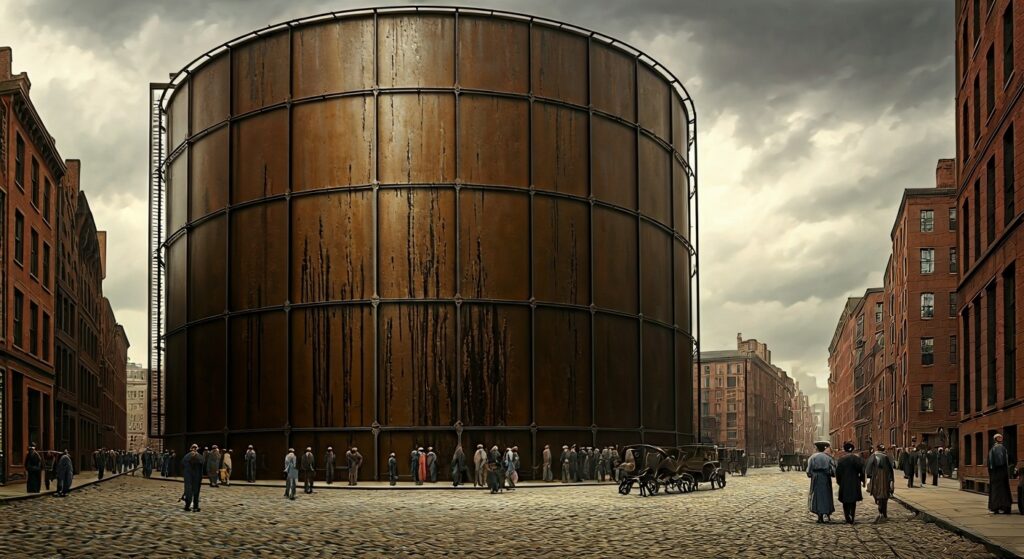
A USIA subsidiary hastily erected a steel tank on Commercial Street. It was a staggering 50 feet tall and 90 feet in diameter, designed to hold roughly 2.3 million gallons of dense, sticky molasses.
But the project harbored a fatal flaw. Construction was overseen by Arthur Jell, a USIA treasurer with absolutely zero engineering or architectural background. Driven by corporate greed and tight deadlines, Jell bypassed basic safety protocols. The tank was never even filled with water to test for leaks before millions of pounds of syrup were pumped inside.
For years, the metal behemoth groaned under the immense weight. It leaked so profusely that local children would run up with cups to collect the dripping molasses. The company’s solution to this glaring structural warning sign? They didn’t reinforce the steel. In a move of staggering negligence, they simply painted the tank brown to hide the leaks.
A Ticking Time Bomb of Sugar and Steel
By January 15, 1919, the tank was filled to the brim with a fresh, massive shipment from Puerto Rico.
Boston was in the grip of a bizarre weather anomaly. The temperature had rapidly spiked from near zero to 40 degrees Fahrenheit. Sudden heat and raw sugar are a volatile combination. The warming molasses began to rapidly expand and ferment inside the tank, producing a massive buildup of carbon dioxide gas.
Inside that poorly constructed steel drum, the pressure was rising to catastrophic levels. The tank wasn’t just a storage container anymore—it was a bomb waiting for a spark.
The Machine Gun in the Metal
At roughly 12:30 PM, the North End was bustling with workers on their lunch breaks. Suddenly, a deep, guttural rumble echoed through the cobblestone streets.
Witnesses later described a terrifying sound that followed: a rapid, deafening staccato that sounded exactly like a heavy machine gun firing. But it wasn’t gunfire. It was the sound of massive steel rivets violently popping out of the tank’s sides as the metal finally gave way.
With a deafening roar, the tank catastrophically ruptured, tearing itself apart under the immense internal pressure.
A Tsunami in the Streets
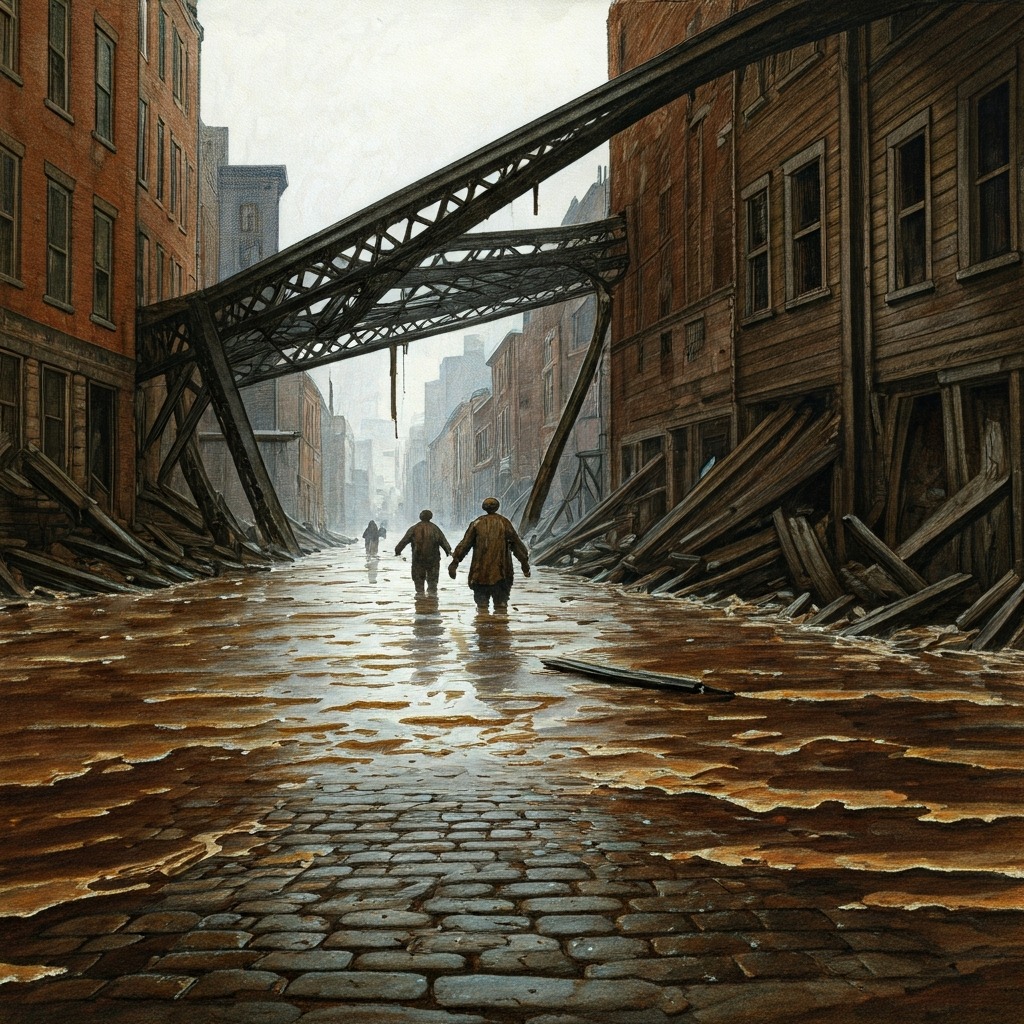
What happened next defies belief. A colossal wave of dark, sticky sludge—estimated to be 25 feet high and 160 feet wide—exploded into the streets at speeds reaching 35 miles per hour.
Molasses is incredibly dense, roughly 1.4 times heavier than water. This wasn’t a splash; it was a battering ram of fluid dynamics. The sheer kinetic energy of the wave snapped the steel girders of the adjacent elevated railway like dry twigs, lifting a train right off its tracks. It flattened buildings in its path and completely crushed the nearby Engine 31 firehouse, trapping horrified firefighters beneath a mountain of sticky rubble.
The human toll was absolute nightmare fuel. First responders, including local police, Red Cross volunteers, and sailors from the USS Nantucket, rushed into the fray only to find themselves wading into waist-deep goo.
The molasses acted like quicksand—the more victims struggled to get out, the deeper they sank into the viscous sludge. Rescuers literally had to cut people out of their clothes to pull them free. Tragically, 21 people were killed and 150 were injured, with many suffocating or drowning in the syrup. Horses caught in the flood were so hopelessly trapped they had to be humanely shot.
The Smokescreen and the Science
When a disaster of this magnitude strikes, the finger-pointing begins immediately. USIA executives tried to dodge responsibility by claiming the tank had been blown up by Italian anarchists—a highly convenient and plausible excuse given the political unrest of the era.
But the public wasn’t buying it. A massive class-action lawsuit was launched against the company, one of the first of its kind in Massachusetts. After three grueling years of hearings, a court-appointed auditor named Colonel Hugh Ogden delivered the final verdict: there was no bomb. The culprit was corporate greed and terrible engineering.
Modern scientific analysis has since vindicated Ogden’s findings. The steel used for the tank was incredibly brittle and lacked the manganese necessary to withstand freezing temperatures. Worse, the steel walls were only half the thickness required to hold that volume of liquid.
The company was forced to pay out approximately $300,000 in damages (equivalent to millions today), setting a massive legal precedent for corporate liability.
But the most lasting legacy of the Great Molasses Flood is something we take for granted today. The disaster triggered a total overhaul of municipal building codes. Because of this tragedy, it became a strict legal requirement in Boston—and eventually across the entire United States—that all architectural and engineering plans be signed and sealed by a registered, credentialed professional before a single brick could be laid.
The cleanup took weeks. Fresh water did nothing to the hardened sludge, forcing crews to use harbor saltwater and sand to scour the streets. It is said that for decades afterward, on the hottest days of summer, Boston’s North End still smelled faintly of molasses—a sweet, lingering ghost of the day a treasurer tried to play engineer, and a city paid the ultimate price.