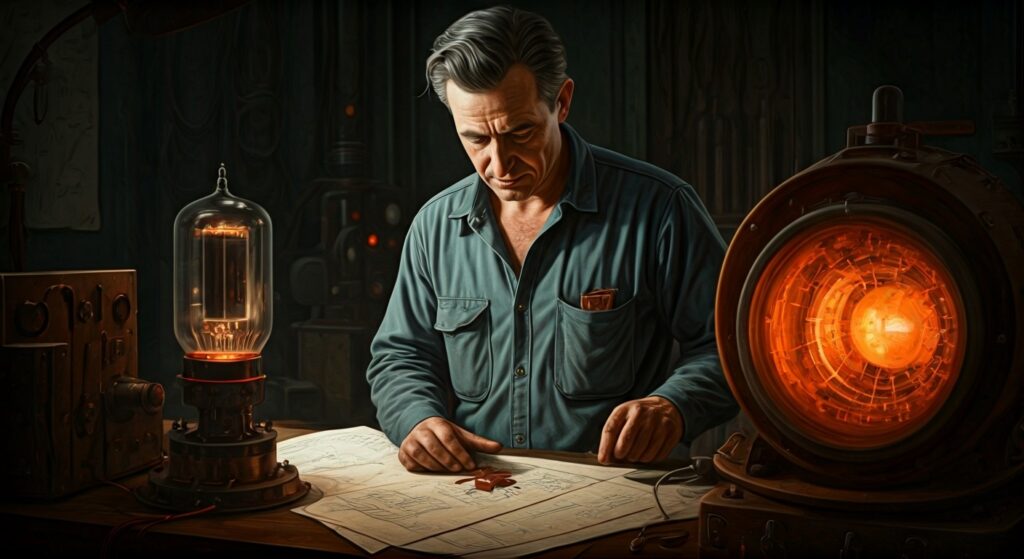
The Invisible Weapon
The year is 1945. The Allied forces are locked in a desperate struggle, and their most vital secret weapon isn’t a bomb or a bullet. It is an invisible wave of energy.
Deep inside the classified laboratories of the Raytheon Corporation, a man named Percy Spencer is mass-producing magnetrons—high-powered vacuum tubes that generate short radio waves. These microwaves are the beating heart of early radar systems, allowing Allied forces to pierce the dead of night and bounce invisible signals off enemy warships. It is deadly serious, highly classified work.
But Spencer isn’t your typical polished, Ivy League scientist. Orphaned as a child and a grammar-school dropout, he is a self-taught maverick with an intuitive, almost superhuman grasp of electronics. And on one fateful day in a freezing lab, his military-grade tech is about to trigger a global culinary revolution.
The Mystery of the Melted Chocolate
While testing an active, high-powered magnetron, Spencer noticed something bizarre. He wasn’t looking at a radar screen; he was looking down at his shirt.
A peanut cluster candy bar tucked into his pocket had inexplicably melted into a gooey, scalding mess. In a freezing laboratory, this made absolutely no sense. Other scientists had previously noticed that operating radar equipment generated a mild ambient heat, but they had shrugged it off as a harmless byproduct.
Spencer, however, possessed an insatiable curiosity. He didn’t ignore the anomaly—he leaned into it. He hypothesized that the invisible microwave radiation from the magnetron was literally cooking the candy in his pocket. To prove it, he needed to run a few highly unorthodox, impromptu experiments.
Weaponizing Breakfast
First, Spencer grabbed a handful of unpopped popcorn kernels and placed them near the active magnetron tube. To his absolute delight, the invisible waves agitated the kernels until they violently popped, scattering across the pristine military laboratory.
But popcorn wasn’t enough. He needed something with a little more dramatic flair.
Spencer took a raw egg, placed it inside a tea kettle, and aimed the military-grade magnetron directly at it. As the invisible energy bombarded the kettle, a skeptical colleague leaned in close to observe the phenomenon. The low-density microwave energy was rapidly agitating the water, fat, and sugar molecules inside the egg, creating intense friction that generated massive heat from the inside out.
Pressure built. The shell fractured. And right as the colleague peered over the rim of the kettle—BANG.
The rapidly heating egg exploded right in his face. Spencer had just successfully weaponized breakfast. More importantly, he had discovered a brand-new way to prepare food using invisible friction.
The 750-Pound Behemoth
Recognizing the immense commercial potential of this accidental discovery, Raytheon filed a United States patent for a microwave cooking process on October 8, 1945. By 1947, they had built the first commercial microwave oven. They called it the Radarange.
If you’re picturing the sleek little box sitting on your kitchen counter right now, think again. The original Radarange was a terrifying technological behemoth. It stood nearly six feet tall, weighed a floor-buckling 750 pounds, and cost around $5,000 (north of $60,000 in today’s money). Because the magnetron ran so incredibly hot, the oven actually required dedicated plumbing to water-cool the internal components.
Unsurprisingly, everyday consumers weren’t exactly lining up to install a water-cooled, 750-pound radar cabinet in their homes. For the first two decades of its existence, the microwave was strictly a commercial workhorse, used in restaurants, hospital kitchens, and naval ships where massive quantities of food needed to be heated at lightning speed.
From Battleship to Countertop
The story of the microwave is a perfect snapshot of post-war American industry. Companies that had swelled into massive empires through wartime defense contracts suddenly had to figure out how to pivot, transforming the tools of destruction into tools of domestic convenience.
It took twenty years of relentless engineering to shrink Spencer’s discovery down to a manageable size. The real breakthrough came after Raytheon acquired Amana Refrigeration, leading to the release of the Amana Radarange in 1967.
This new model was a game-changer. It was compact enough to fit on a kitchen counter, relied on simple air-cooling rather than a tangle of plumbing, and was priced at a much more accessible $495.
The next time you’re impatiently watching your leftover pizza spin in circles, take a second to appreciate the wild history humming inside that little box. You aren’t just reheating food; you’re harnessing the exact same invisible energy that helped win World War II—all because a genius with no formal education decided to figure out why his pocket candy melted.