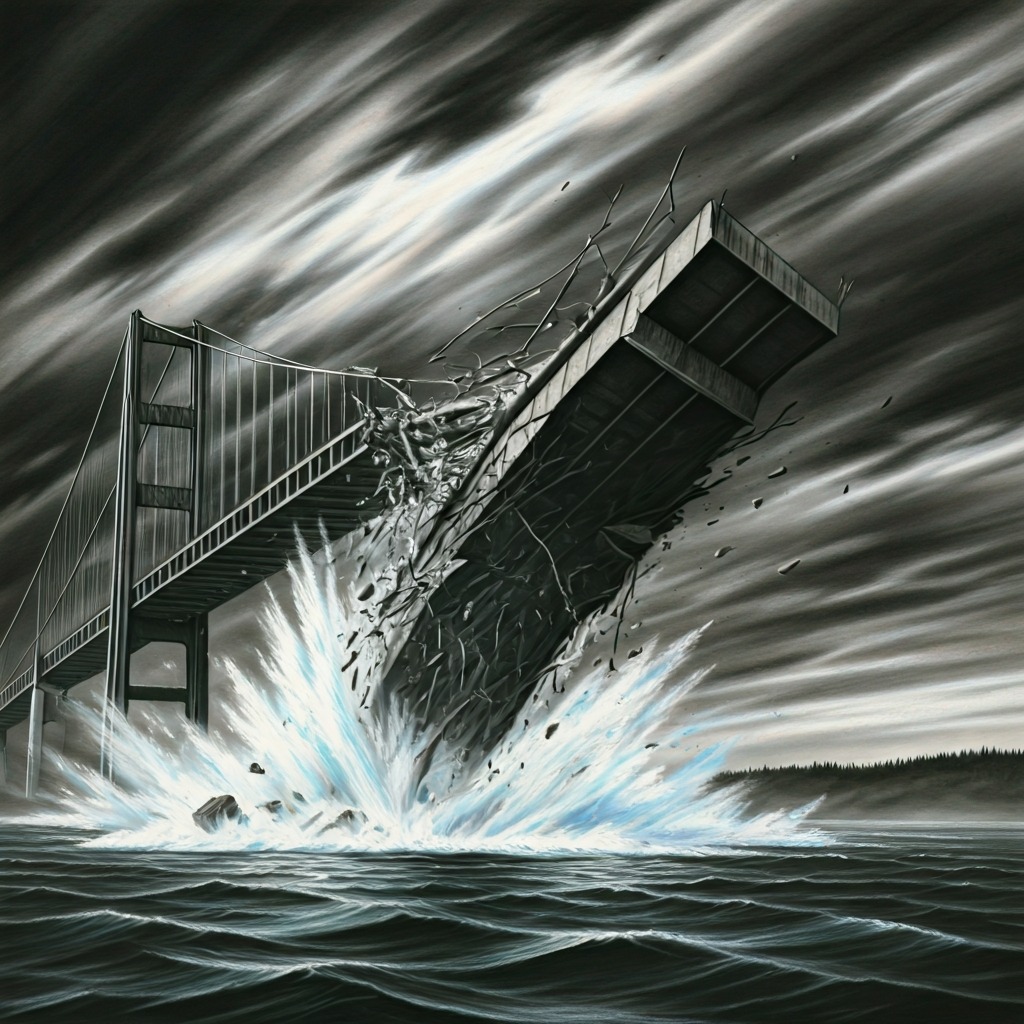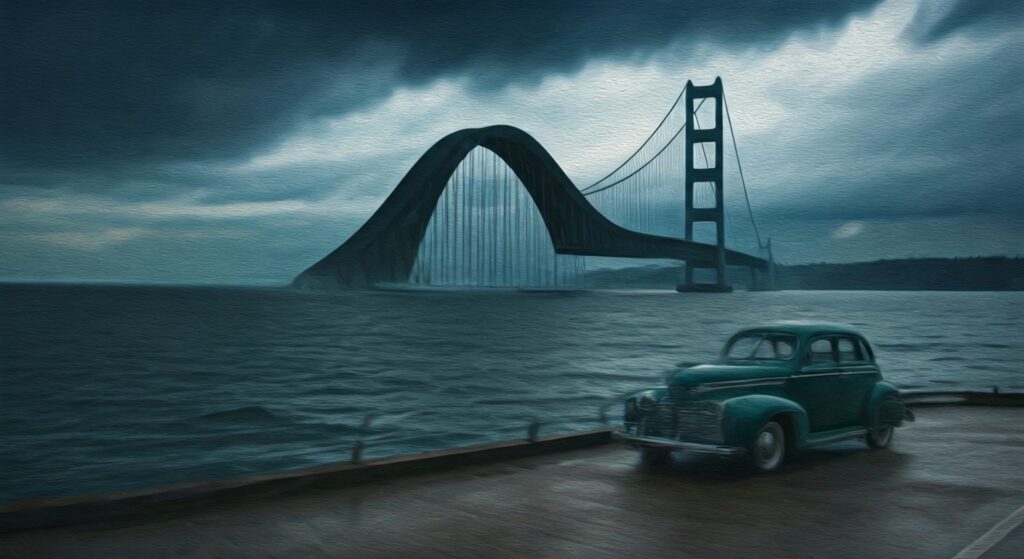
Concrete is not supposed to ripple. Steel is not supposed to flutter. Yet, on a freezing November morning in 1940, a marvel of modern engineering weighing thousands of tons began to undulate like a ribbon caught in a breeze. When the world’s top civil engineers make a miscalculation, the results are not just costly—they are spectacular. Nowhere in the history of science is that more evident than in a disaster that looks like a special effect from a retro sci-fi movie, but was entirely, terrifyingly real.
A Sleek, Slender Trap
When the Tacoma Narrows Bridge officially opened in Washington state on July 1, 1940, it was hailed as a triumph of human ingenuity. Spanning the Puget Sound between Tacoma and the Kitsap Peninsula, it was an absolute beauty.
The bridge was the brainchild of Leon Moisseiff, a rockstar in the world of suspension bridge engineering. Moisseiff was obsessed with a sleek, slender aesthetic. He wanted a bridge that looked like a silver thread draped across the water. To achieve this look—and to cut costs—he made a fateful design choice. Instead of using the deep, open lattice trusses that engineers traditionally used to allow wind to pass safely through the structure, Moisseiff utilized shallow, solid plate girders.
This gave the bridge its gorgeous, impossibly thin profile. It also made it incredibly light and flexible. But out in the real world, where Mother Nature doesn’t care about aesthetics, this solid-sided design essentially turned the bridge into a giant, miles-long airplane wing.
The Carnival Ride of Doom
Almost immediately, the bridge started acting strangely. Even in relatively mild winds, the deck would roll and undulate vertically. It was so pronounced that locals quickly gave it a nickname: “Galloping Gertie.”
Today, a bouncing suspension bridge would send drivers running for the hills. But in 1940, people were actually thrilled by it. Drivers would come from miles around just to experience the rollercoaster-like thrill of crossing Gertie. They’d watch the cars ahead of them completely disappear into the troughs of the concrete waves, only to pop back up a moment later. It was treated as an amusement park ride, a quirky but harmless engineering oddity.
But beneath the surface, a deadly aerodynamic equation was balancing itself out, waiting for the exact right conditions to strike.
The Monster Awakens
The morning of November 7, 1940, brought sustained winds of about 40 to 42 miles per hour howling through the Narrows. At first, the bridge exhibited its usual, almost comforting vertical rippling. But then, the physics shifted.
The wind hitting those solid plate girders induced a terrifying phenomenon known as aeroelastic flutter. This wasn’t just wind pushing a bridge; it was a self-exciting aerodynamic instability. The aerodynamic forces coupled with the structure’s natural motion, feeding on each other, amplifying the movement with every passing second.
Suddenly, the bridge stopped rippling and began to violently twist.
This was the torsional mode. The massive steel deck began tilting at extreme, physics-defying angles—up to 45 degrees in each direction. The roadway was practically standing on its side, twisting back and forth in a mesmerizing, horrifying dance.
A Roar of Snapping Steel
Caught in the middle of this nightmare was a local reporter named Leonard Coatsworth. As the twisting began, he abandoned his car and crawled on his hands and knees to safety. Tragically, he was forced to leave behind the only casualty of the disaster: a Cocker Spaniel named Tubby, who was too terrified to leave the vehicle. Miraculously, no humans were killed.
As the violent twisting continued, the immense strain on the metal became too much. The suspender cables began to snap like gunshots. With a deafening roar, the center span tore itself apart, sending chunks of concrete, twisting steel, and Coatsworth’s car plummeting into the freezing, churning waters of the Puget Sound below.
The sleek, beautiful bridge was gone, reduced to jagged ruins in a matter of hours.
A Legacy Captured on Film
We know exactly what this looked like because a local camera shop owner named Barney Elliott was standing on the shore with a 16mm color film camera. He captured the impossible twisting and the catastrophic collapse in crystal clear detail. It remains one of the most famous pieces of footage in history, still shown in physics and engineering classrooms worldwide to terrify young students into checking their math.
The disaster fundamentally revolutionized civil engineering. It was a brutal wake-up call that you can’t just design for gravity and static weight; you have to design for aerodynamics. It led to the mandatory use of wind tunnel testing in bridge design—something that seems so obvious to us now, but was a hard-learned lesson in 1940.
When the replacement Tacoma Narrows Bridge was finally completed in 1950, it was built with deep, open trusses to let the wind howl right through it, and significantly increased torsional stiffness to ensure it would never flutter again. It stands today as a stark reminder that in the battle between human engineering and the raw forces of nature, nature always bats last.