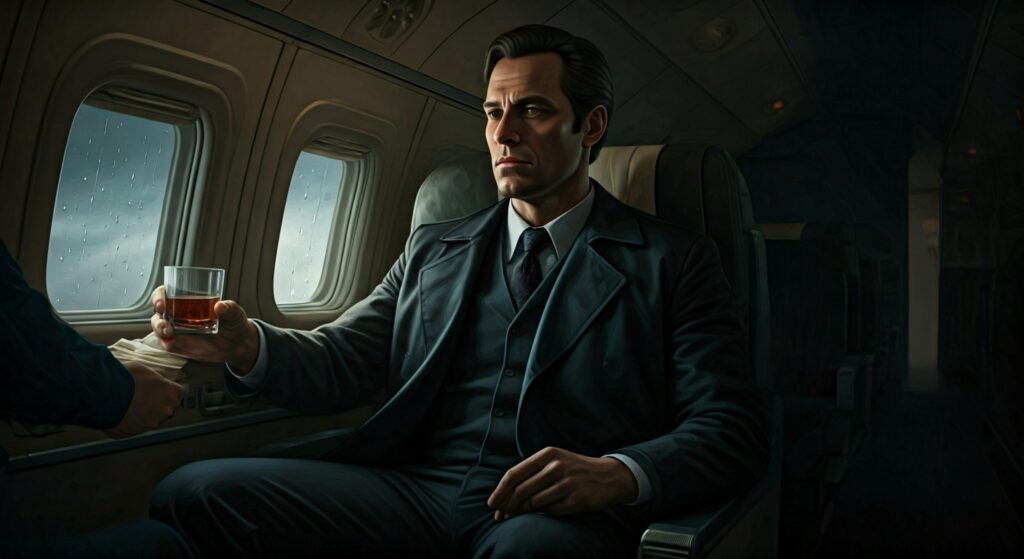
Picture it: November 24, 1971. Thanksgiving Eve. A relentless rain batters the tarmac in Portland, Oregon. Through the storm walks a quiet, unassuming man in a dark business suit and a black trench coat. He approaches the Northwest Orient Airlines counter, pays cash for a one-way ticket to Seattle, and gives a name that will soon be etched into the annals of American infamy: Dan Cooper.
What follows is the ultimate locked-room mystery—only the room is a Boeing 727 cruising at 10,000 feet, and the suspect literally vanishes into the night sky. To this day, it remains the only unsolved case of air piracy in commercial aviation history.
A Bourbon, a Note, and a Bomb
Shortly after Northwest Orient Airlines Flight 305 took off, Cooper ordered a bourbon and soda. With chilling nonchalance, he slipped a folded piece of paper to flight attendant Florence Schaffner. Assuming he was just another lonely businessman passing along his hotel room number, she dropped it unopened into her purse.
Cooper leaned in, his voice devoid of emotion. “Miss, you’d better look at that note. I have a bomb.”
When she opened his briefcase, Schaffner was met with a terrifying tangle of red cylinders and wires. Cooper’s demands were precise, calculated, and wildly audacious: he wanted $200,000 in twenty-dollar bills, four parachutes, and a fuel truck waiting on the tarmac the second they landed in Seattle. The airline and the FBI scrambled to comply, swapping the 36 terrified passengers for the ransom money and the parachutes.
But Cooper wasn’t done. The real magic trick was about to begin.
The 10,000-Foot Vanishing Act
Cooper ordered the remaining crew back into the air, pointing the nose toward Mexico City. But he dictated a bizarre set of flight parameters: the pilots had to maintain an unusually low altitude of 10,000 feet, keep the speed under a sluggish 150 knots, leave the landing gear down, and lower the rear airstairs.
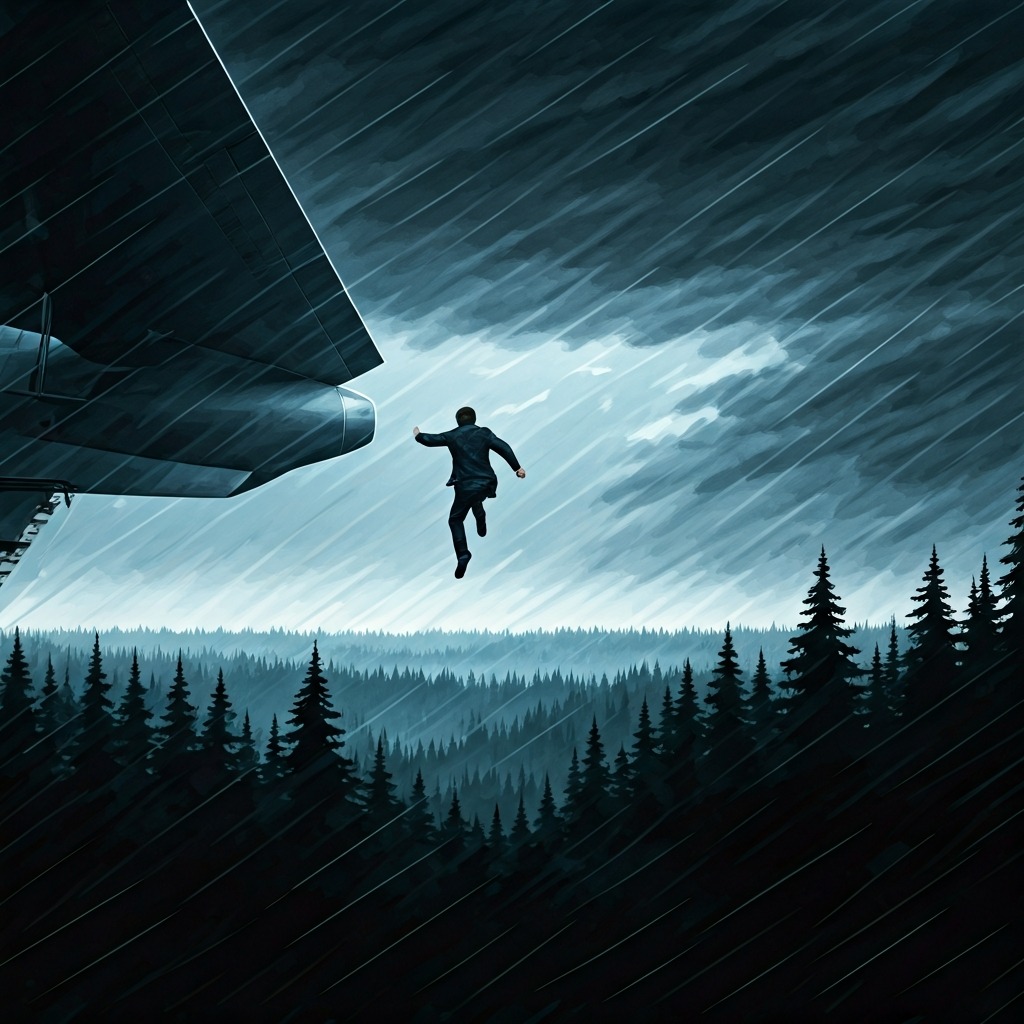
At approximately 8:13 PM, somewhere over the rugged, heavily wooded terrain of southwestern Washington, the cabin pressure suddenly shifted. A warning light flashed in the cockpit, indicating the aft stairs had been deployed. Stepping into a pitch-black, freezing rainstorm, Cooper walked down the stairs and plunged into oblivion.
He vanished without a trace. Did he survive the fall? Was he a seasoned paratrooper, or a desperate man who miscalculated his final move?
A Cold Trail and a Muddy Clue
The FBI launched NORJAK (Northwest Hijacking), which quickly became one of the longest and most exhaustive investigations in American history. Despite a massive manhunt through the unforgiving Washington wilderness, they found absolutely nothing. The trail went completely cold.
The only physical evidence Cooper left behind on his seat was a black J.C. Penney clip-on tie and a mother-of-pearl tie clip. Decades later, the FBI managed to extract a partial DNA profile from the tie, but the results were maddeningly inconclusive.
It wasn’t until 1980 that the ghost finally left a footprint. An eight-year-old boy digging a fire pit along the banks of the Columbia River unearthed three bundles of decaying twenty-dollar bills totaling $5,800. The serial numbers were a perfect match for the ransom money.
The Phantoms in the Lineup
Over the decades, the FBI investigated over a thousand suspects for the crime of the man the media erroneously dubbed “D.B. Cooper.” A few standout characters emerged from the pack:
- Richard Floyd McCoy Jr.: A man who staged a nearly identical hijacking just five months later. He had the guts and the know-how, but his timeline and physical description didn’t perfectly align.
- Robert Rackstraw: A former paratrooper with a criminal record and a penchant for dramatic stunts. He possessed the exact skills needed to survive a blind jump in a rainstorm.
- Kenneth Christiansen: A former Northwest Airlines employee who knew the inner workings of a Boeing 727 like the back of his hand.
Despite tantalizing circumstantial evidence, none of these men were ever definitively linked to the crime.
The Legacy of a Ghost
In 2016, the FBI officially suspended active investigation of the case, closing the book on a 45-year manhunt.
Yet, Cooper’s midnight jump changed the way we fly forever. It led to the mandatory installation of the “Cooper vane”—a mechanical device that prevents aft airstairs from being lowered during flight—and ushered in the modern era of universal baggage searches and metal detectors.
Dan Cooper stepped out of a plane and into modern mythology. He became a legendary folk hero, the ultimate symbol of a daring strike against the establishment. Whether he ended up rich on a tropical beach or buried in the Washington mud, the man in the black suit pulled off the greatest disappearing act of the 20th century.