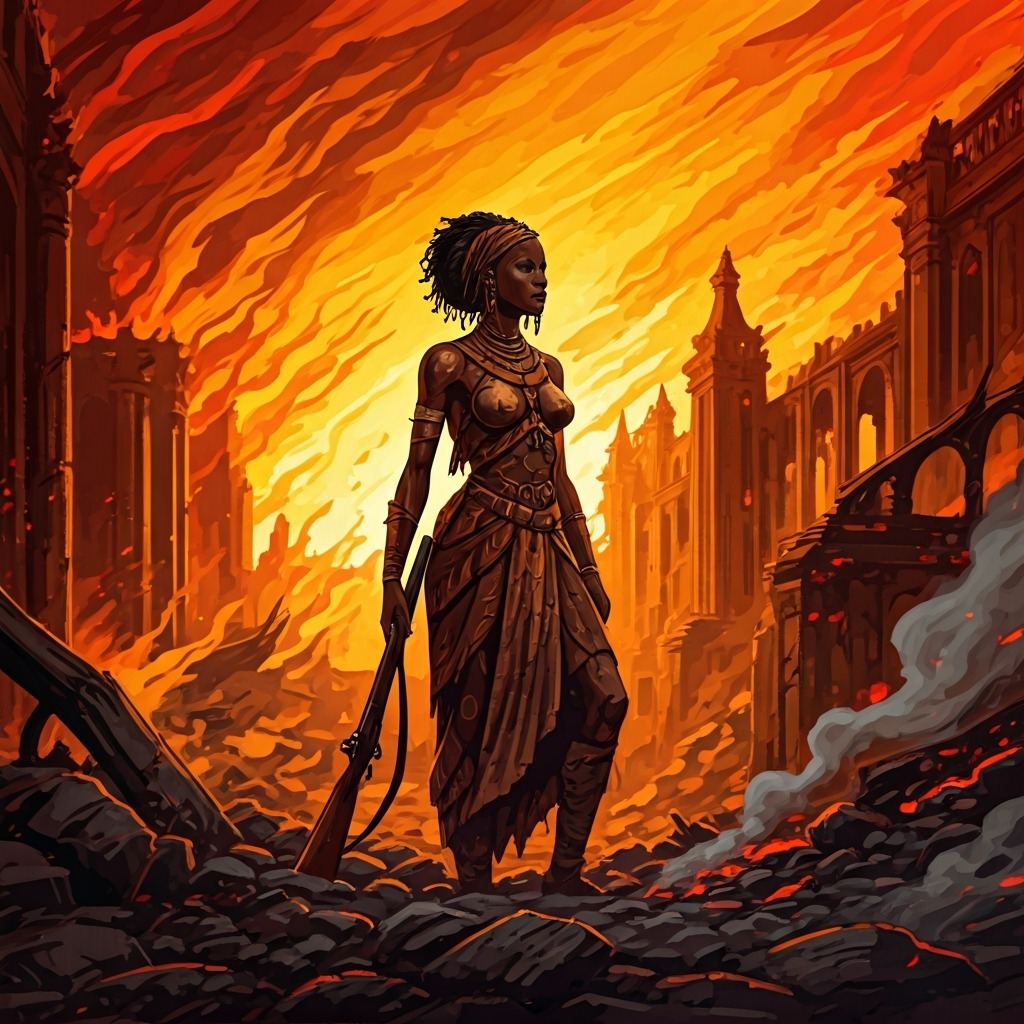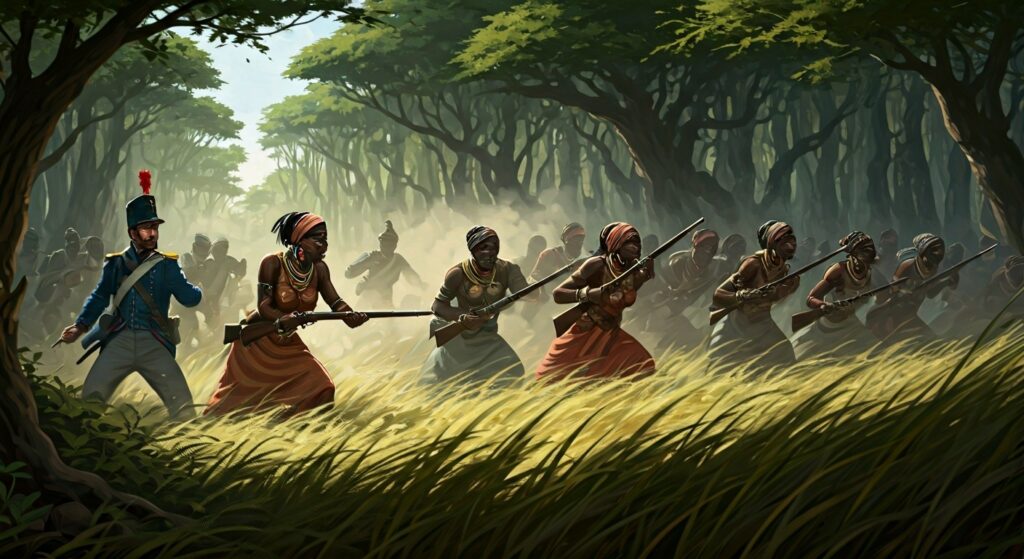
Imagine being a 19th-century French soldier, armed to the teeth, marching into the suffocating heat of the West African bush. You hear the rustle of leaves. You brace for a standard infantry charge. Instead, the jungle erupts. You are ambushed not by ordinary soldiers, but by a vanguard of fiercely disciplined, heavily armed women who do not know the meaning of the word “retreat.”
They were the Dahomey Amazons, and they were about to show the world what true ruthlessness looked like.
Whispers in the Tall Grass
The exact origins of this all-female front-line combat unit are shrouded in the mists of oral tradition. Some historical accounts trace them back to the 17th century under King Houegbadja, where they allegedly began as a corps of elite elephant hunters. Other whispers credit Queen Hangbe, who briefly held the throne, with their creation.
But it was under King Ghezo in the mid-19th century that this group transformed from a royal detail into a terrifying standing army. The Kingdom of Dahomey (in the present-day Republic of Benin) was locked in constant, brutal warfare with the neighboring Oyo Empire. Furthermore, the empire’s wealth was deeply tied to the transatlantic slave trade, requiring a constant influx of captives. Needing a massive military edge, Ghezo expanded the female corps. At their peak, these warriors numbered between 4,000 and 6,000 women, making up nearly a third of the entire Dahomean military.
Locally, they weren’t called “Amazons”—that was a term coined by European observers who exoticized them to fit Western mythology. In the Fon language, they were known as the Mino, meaning “our mothers,” or Ahosi, meaning “king’s wives.”
Forged in Thorns and Blood
You don’t become an elite shock troop by taking it easy. The Mino underwent physical and psychological training so grueling it makes modern boot camps look like a vacation.
To ensure absolute ruthlessness in battle, recruits were subjected to brutal desensitization exercises, which included executing prisoners of war. They practiced scaling massive barricades made of razor-sharp acacia thorns—and they did it without showing a single flinch of pain.
Because they were legally considered Ahosi (wives of the king), their social status was uniquely elevated. But this privilege came with a strict catch: they were required to remain celibate and childless during their service. Intimacy with men was strictly forbidden. In exchange for dedicating their lives to the blade and the musket, they lived in the royal palaces, had access to immense wealth, smoked tobacco, drank alcohol, and wielded massive political influence, often sitting on the king’s grand council to shape state policy.
The Vanguard of Shock and Awe
When the Mino took the battlefield, they didn’t hold the rear. They were the vanguard.
Armed with Dutch muskets, machetes, and heavy, razor-sharp clubs, they were famous for their aggressive shock tactics. Adversaries and European observers alike noted with sheer terror that the Mino were better organized, incredibly disciplined, and far more ferocious than their male counterparts. They engaged in intense hand-to-hand combat, crashing into enemy lines with a fearlessness that broke the morale of anyone standing in their way.
The Iron Rain of Empire
The invincibility of the Mino faced its ultimate, tragic test during the First and Second Franco-Dahomean Wars (1890, 1892-1894). France had its eyes set on colonizing Dahomey, but they were met with a meat grinder of resistance.
Initially, French soldiers hesitated to fire upon women. That hesitation was a fatal mistake. The French were quickly shocked by the Mino’s sheer ferocity in lethal close-quarters combat. But bravery, no matter how legendary, cannot easily defeat industrialized warfare. Despite fighting to the bitter end, the Mino were ultimately decimated by the French military’s superior weaponry, including the devastating fire of modern artillery and machine guns.
Following the fall of Dahomey, the regiment was disbanded. The very last known surviving member of the Mino, a woman named Nawi, passed away in 1979, taking the living memory of the sisterhood with her.
A Legacy Written in Blood and Gold
History is rarely a simple story of heroes and villains. The legacy of the Dahomey Amazons is intensely complex. From an anti-colonial perspective, they are celebrated as ultimate symbols of female empowerment, national pride, and fierce resistance against European imperialism. Yet, the darker reality remains: they were the vanguard of an expansionist empire that built its immense wealth by conquering neighboring African tribes and selling captives into the horrors of the transatlantic slave trade.
Today, their martial spirit echoes loudly in popular culture. They are the direct historical inspiration for the Dora Milaje in Marvel’s Black Panther and served as the basis for the epic film The Woman King.
They were brilliant, brutal, and utterly unforgettable.