The Edge of the Abyss
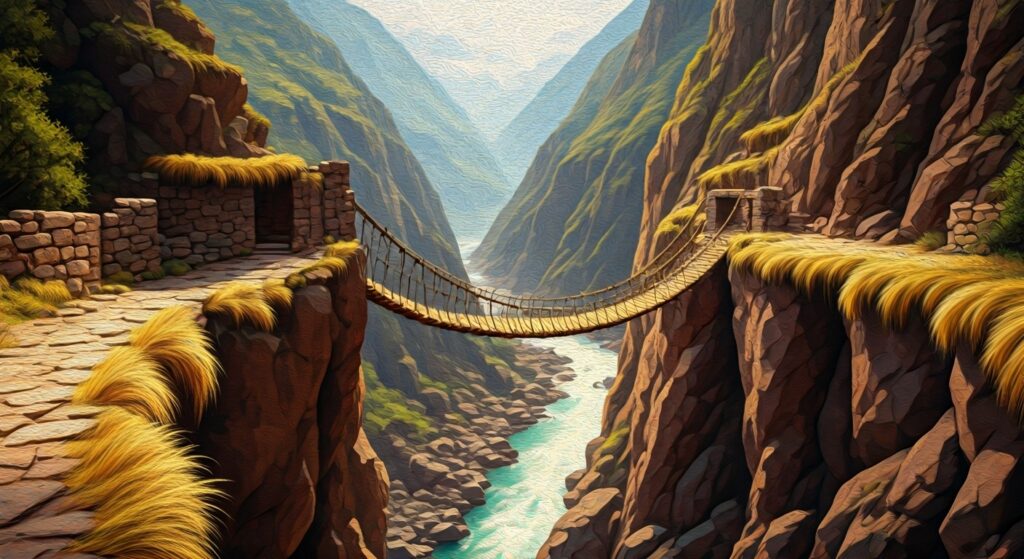
Imagine standing at the precipice of a sheer Andean cliff. One hundred and eighteen feet below, the Apurímac River violently carves its way through the jagged rock. You need to cross the chasm, but there is no iron, no steel, no timber. Your only lifeline is a bundle of wild, rough grass.
It sounds like a death wish, but for the Inca Empire, it was a masterpiece of engineering. Hidden in the remote Canas Province of Peru lies the Q’eswachaka Rope Bridge—the last remaining authentic Incan suspension bridge in the world. Yet, the most mind-bending secret of Q’eswachaka isn’t just its survival. It is the fact that this ancient marvel is technically only a few months old, having been continuously destroyed and rebuilt every single year for over five centuries.
Ghosts of a Vanished Empire
To understand the mystery of Q’eswachaka, one must look to the ghosts of the Qhapaq Ñan, the vast and intricate network of roads that once connected the massive Inca Empire. Moving armies, goods, and lightning-fast messengers across the treacherous Andes was a logistical nightmare.
The Inca solved this by engineering hundreds of suspension bridges made entirely of woven plant fibers. When Spanish conquistadors invaded, many of these vital crossings were burned to halt their advance, while time and the elements claimed the rest. Q’eswachaka survived only because of its fierce isolation and the unyielding dedication of the local Quechua communities.
The secret to defying gravity over the Apurímac River lies in q’oya, an indigenous Andean bunchgrass. When braided, its tensile strength is nothing short of miraculous. Anchored to massive, ancient stone abutments on either side of the abyss, the bridge relies entirely on tension to hold the weight of those brave enough to cross.
Severing the Lifeline
Every year, during the second week of June, a profound and dangerous ritual begins. Four Quechua communities gather to execute a masterclass in minka—the ancient Incan tradition of communal labor for the public good.
Weeks in advance, women and children collect the tough q’oya grass, pounding it with round stones and soaking it in water. They twist these fibers into thin ropes called q’eswa. The men then braid them into six massive cables: four for the floor, two for the handrails.
But before the new bridge can be born, the old one must die.
In a terrifying leap of faith, the ancient ropes are severed. The entire bridge plunges into the raging river below, carried away to decompose naturally—a symbolic return to Pachamama (Mother Earth). To protect the builders from the deadly drop, a local shaman (paqo) conducts urgent ceremonies, offering coca leaves, corn, and sometimes a llama fetus to the Apus (mountain spirits).
Masters of the Void
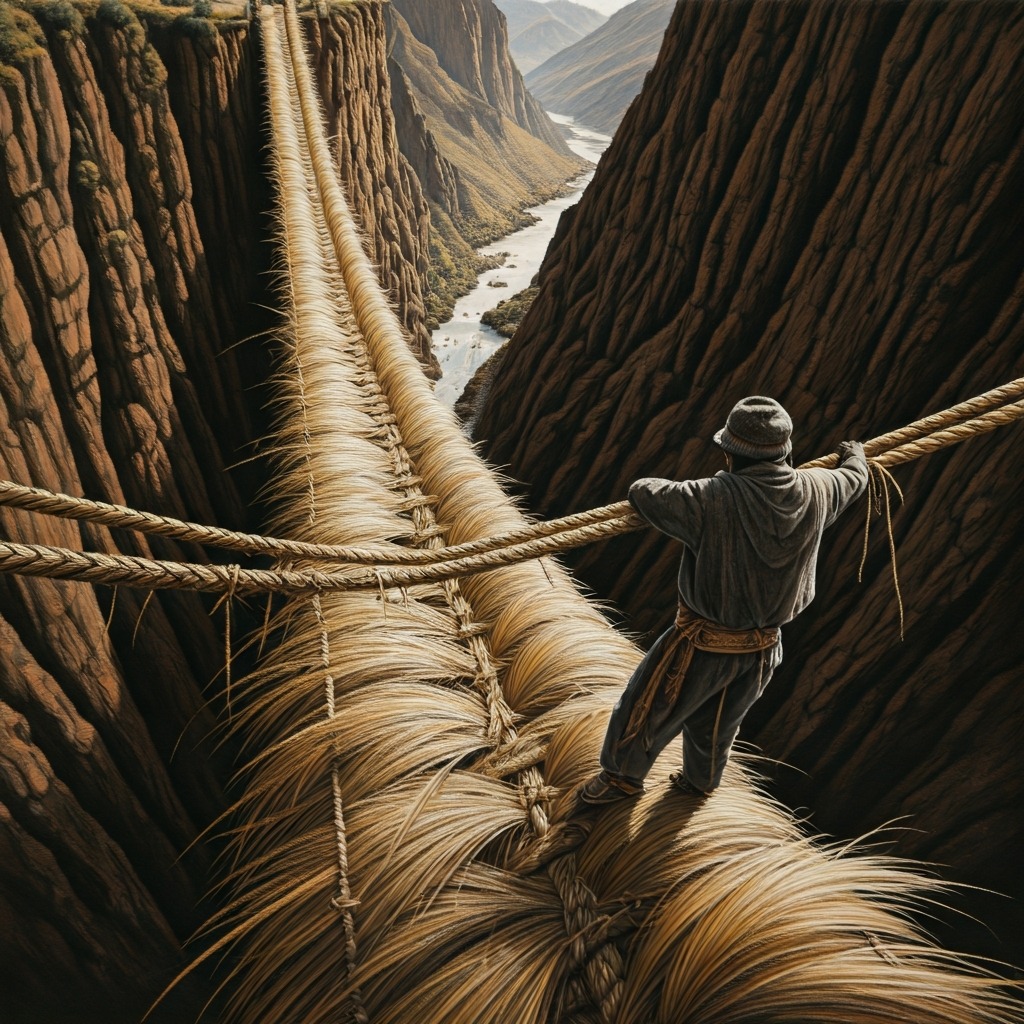
With the old bridge gone, the new, incredibly heavy cables are hauled across the canyon and lashed to the ancient stone anchors. Then, the Chakaruwaq—the master Incan bridge engineers—step up to the precipice.
There are no safety nets. There are no harnesses. Working from opposite ends of the canyon, two teams of Chakaruwaq balance on the freshly strung lower cables, suspended directly over the void. Slowly, they inch their way toward the center of the canyon, weaving smaller ropes between the handrails and the floor cables to create the bridge’s V-shaped sidewalls. They lay down a flooring of woven branches and leaves as they go, trusting their lives to the grass beneath their feet.
The tension in the air is as tight as the ropes themselves. Only when the two teams finally meet in the middle is the bridge complete.
A Blueprint Woven in Memory
By the fourth day, the suspense dissolves into a massive, vibrant festival. The communities cross their newly built bridge, filling the canyon with traditional music, indigenous dances, and feasts.
In 2013, UNESCO inscribed the knowledge and rituals of the Q’eswachaka bridge on the Representative List of the Intangible Cultural Heritage of Humanity. “Intangible” is the perfect word. There are no written blueprints for Q’eswachaka. There are no engineering manuals passed down through the generations.
The blueprint lives entirely in the minds, hands, and community spirit of the Quechua people. It is a vital cultural artery, proving that some of the strongest things humanity can build aren’t made of steel or stone, but of memory, and an unbreakable connection to the past.