The Butcher’s Blade and the Phantom Surgeon
If you were to fall gravely ill in the year 950 AD, your best hope for survival was a prayer. If you required surgery, your fate rested in the hands of a local barber or butcher—men who wielded crude, unsterilized blades with the same brute force they used to slaughter livestock. Mortality rates were catastrophic. To open the human body was to invite agonizing infection and almost certain death.
Ask a modern patient where the sterile, precise world of contemporary surgery began, and they might guess the Victorian operating theaters of London or the blood-soaked battlefields of the American Civil War. They would be wrong. The true architect of the modern surgical tray did not wear a Victorian top hat. He walked the sunlit courtyards of 10th-century Islamic Spain, quietly turning a barbaric chore into a life-saving science.
A Masterpiece Forged in Cordoba
Born around 936 AD in Medina Azahara near Cordoba, Abu al-Qasim Khalaf ibn al-Abbas Al-Zahrawi—known to the West as Abulcasis—was a visionary operating centuries ahead of his time. While much of Europe languished in the medical dark ages, the Islamic Golden Age was in full bloom. Yet, even in this enlightened era, surgery was viewed with deep suspicion, dismissed as a secondary, manual labor beneath the dignity of true physicians.
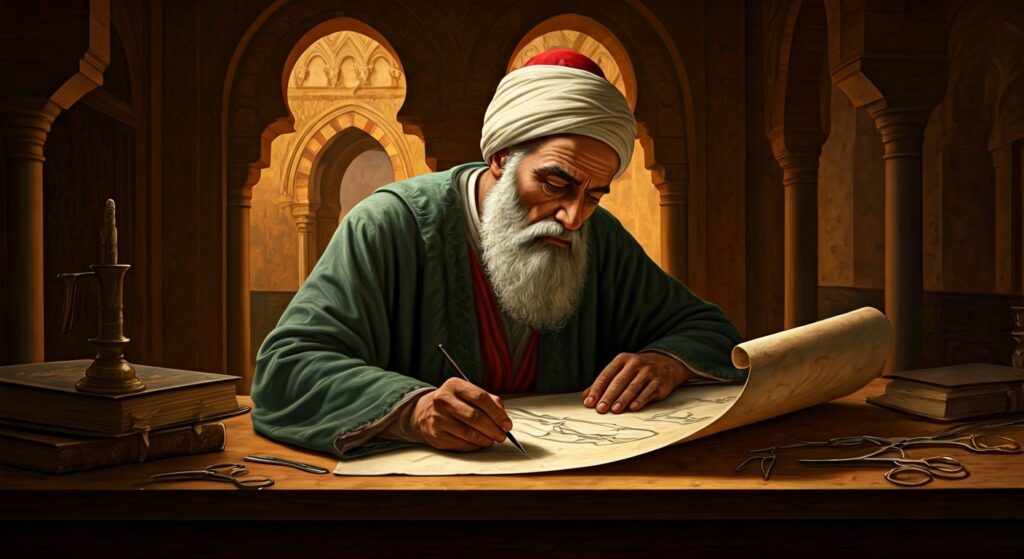
Al-Zahrawi refused to accept this. He spent decades meticulously observing, operating, and inventing, culminating in his magnum opus: the Kitab al-Tasrif (The Method of Medicine). This staggering 30-volume encyclopedia was a triumph of medical literature, but its final volume held a secret that would change human history.
Volume 30 was dedicated entirely to surgery. In an era where medical texts relied solely on vague descriptions, Al-Zahrawi did the unthinkable: he drew. He provided meticulous, anatomically precise illustrations of over 200 surgical instruments, many of which he invented himself. He knew that if his life-saving tools were to survive him, future generations needed exact blueprints.
The Invisible Thread of Life
Imagine the terror of a medieval surgeon who has just successfully removed a deadly intestinal blockage. The tumor is gone, but a lethal problem remains: how do you close the internal wound? Leave a piece of silk or cotton inside the abdomen, and the body will reject it, sparking a fatal infection.
Al-Zahrawi solved this impossible puzzle with a stroke of absolute brilliance. He pioneered the use of catgut for internal sutures. Derived from the intestines of sheep or cattle, catgut was the only natural material the human body could safely absorb and dissolve over time. If you or a loved one has ever received internal stitches, you owe your life to this 10th-century Andalusian genius.
His mastery of the human body didn’t stop there. Centuries before the famed French surgeon Ambroise Paré “invented” the technique, Al-Zahrawi was already using ligatures on blood vessels to halt severe hemorrhaging, pulling patients back from the brink of death.
The Empath’s Arsenal
What makes Al-Zahrawi a truly riveting historical figure isn’t just his towering intellect—it is his profound empathy. He understood the visceral, paralyzing dread his patients felt when facing the knife. To spare them the agony of watching a blade approach their flesh, he invented a specialized concealed scalpel. Hidden seamlessly in the palm of his hand, the blade was revealed only at the exact fraction of a second it was needed to open an abscess.
This empathy extended to the most perilous medical crisis of the ancient world: childbirth. When a delivery went catastrophically wrong, the mother’s life hung by a thread. To extract a deceased fetus and save the mother from fatal sepsis, Al-Zahrawi designed the world’s first obstetric forceps—a harrowing but necessary innovation that saved countless women.
His surgical toolkit reads like an inventory of a 21st-century hospital: retractors, curettes, pincers, specula, lithotomy instruments for crushing bladder stones, and specialized drills for trepanation.
Echoes in the Operating Room
Genius of this magnitude could not be contained within the borders of Al-Andalus. In the 12th century, Volume 30 of the Kitab al-Tasrif was translated into Latin by Gerard of Cremona. Retitled De Chirurgia, the text swept across Europe like wildfire. For over five hundred years, it stood as the absolute, undisputed surgical authority in European medical schools.
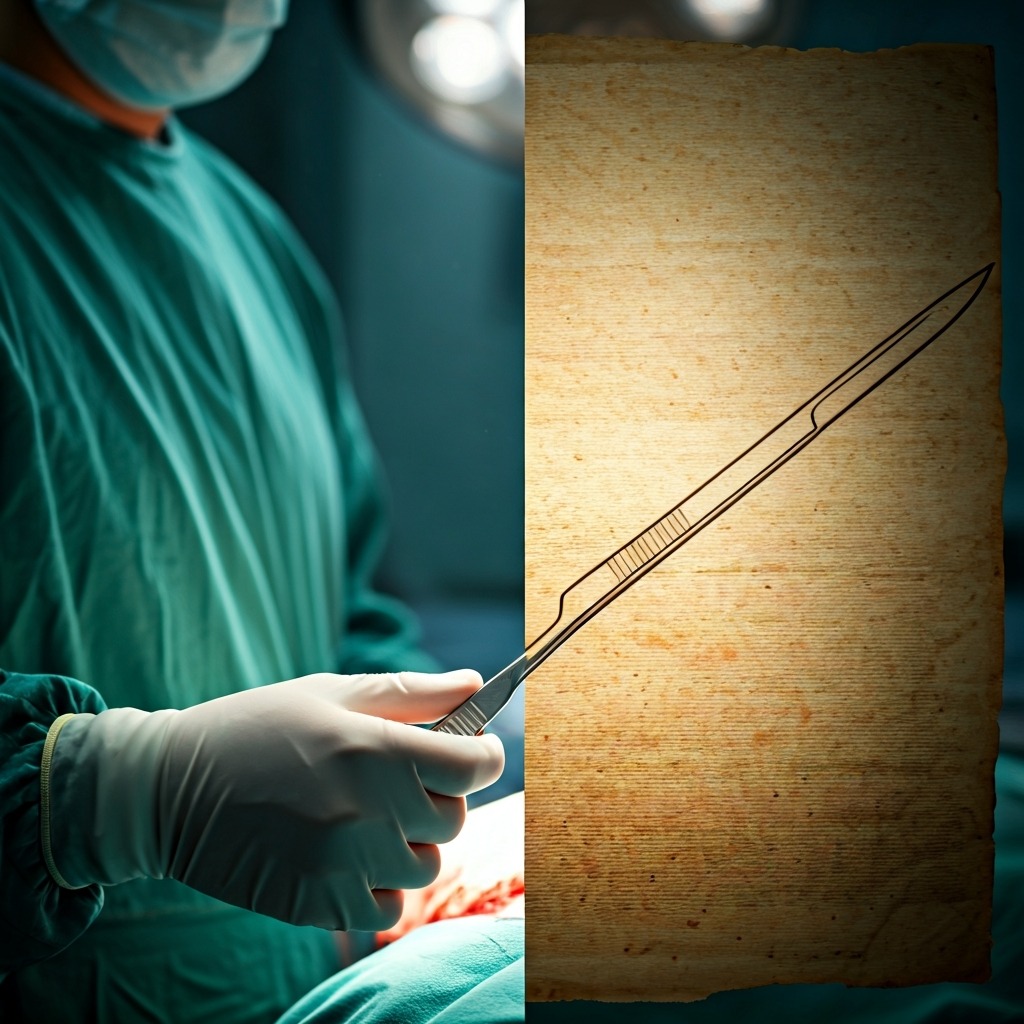
Today, if you place Al-Zahrawi’s original 10th-century sketches next to the gleaming stainless-steel instruments resting on sterile trays in modern operating rooms, an eerie realization washes over you. The designs are virtually identical.
The next time you marvel at the miracles of modern medicine, look past the blinding surgical lights and the rhythmic beeping of heart monitors. Look back across a millennium to a brilliant physician in Cordoba, who sketched the future of human survival with a quill, a steady hand, and an unparalleled mind.