When we think of saints, we picture gentle peacemakers, selfless ascetics, or tragic martyrs whispering a final prayer. We rarely picture an architect of mass destruction.
But medieval history hides a story so steeped in blood and absolute vengeance that it reads less like a religious text and more like a grimdark fantasy novel. Recorded in the Primary Chronicle, the foundational history of Kievan Rus’, the tale of Saint Olga of Kiev is a masterclass in patience, deception, and unyielding wrath.
To understand how a ruthless warlord earned a halo, we must travel back to the year 945 CE—to a dark forest where a prince made a fatal miscalculation.
The Birch Tree Execution
Prince Igor of Kiev was a man who didn’t know when to walk away. After successfully extorting tribute from the Drevlians, a neighboring East Slavic tribe, Igor looked at his haul and decided it wasn’t enough. Driven by greed, he turned his army around and marched back to demand more.
The Drevlians had finally had enough. They ambushed Igor, took him captive, and decided to make a horrific spectacle of the greedy prince. Bending two massive, supple birch trees to the ground, they tied Igor’s legs to the trunks. When they released the trees, the immense, snapping force tore the Prince of Kiev in half.
Back in the capital, the news reached his wife, Olga. With her husband dead and her son Sviatoslav merely a toddler, Olga was suddenly the sole regent of Kievan Rus’. The Drevlians saw a golden opportunity. Assuming Olga was a weak, grieving widow who would easily fold, they plotted to seize her lands.
They had no idea the monster they had just awakened.
An Invitation to the Grave
Believing Kievan Rus’ was leaderless and vulnerable, the Drevlians sent twenty of their best men to Kiev with an audacious, insulting proposal: Olga should marry their leader, Prince Mal. The very man who had just ordered her husband ripped apart by trees.
Olga welcomed the emissaries with a serene, accommodating smile. Feigning humble submission, she told them she found the proposal agreeable. She instructed the men to return to their boats for the night and wait to be carried into her court the next morning—a supreme sign of honor.
The Drevlians went to sleep dreaming of a bloodless conquest. But under the cover of darkness, Olga ordered her people to dig a massive, gaping trench in the courtyard.
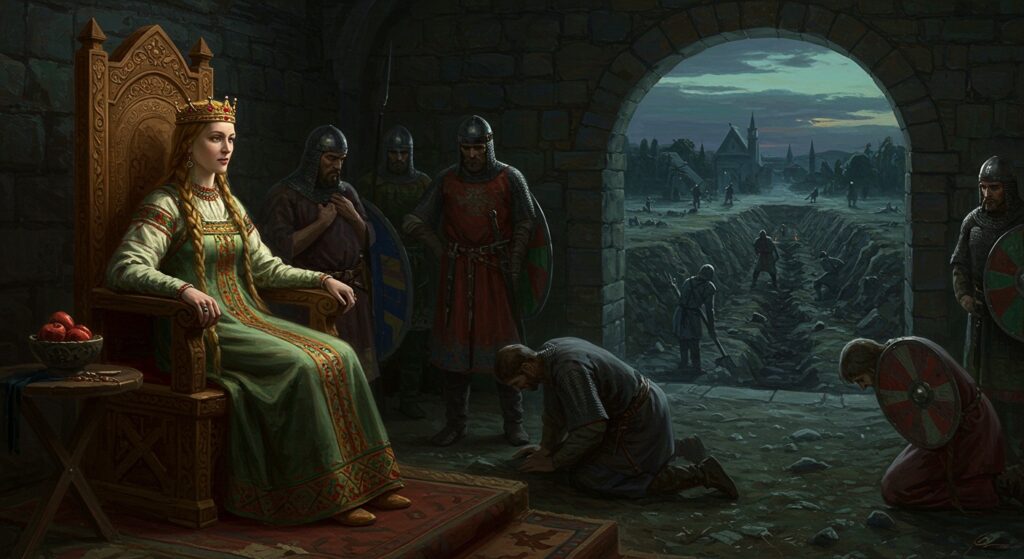
The next morning, the emissaries sat proudly in their boat as Olga’s men hoisted it upon their shoulders. They were marched into the royal court, beaming with arrogance, until they were unceremoniously dumped, boat and all, into the pit.
As the emissaries panicked in the dirt, Olga walked to the edge. She looked down at the trapped men and coldly asked if they found the honor to their liking. Before they could even formulate a plea for mercy, she gave a single, chilling order: bury them alive.
The Bathhouse Trap
Step one of Olga’s revenge was complete, but her thirst for vengeance was far from quenched. To truly break her enemies, she needed to cripple the Drevlian leadership.
Olga sent a messenger back to Prince Mal, claiming she would graciously accept his hand in marriage. However, to legitimize the union to her people, she required an escort of the Drevlians’ most distinguished nobles and governors to accompany her back to their territory.
Prince Mal, completely unaware that his first twenty emissaries were currently suffocating under a layer of Kievan dirt, eagerly agreed. He sent the absolute elite of Drevlian society to Kiev.
When the nobles arrived, Olga played the perfect host. She warmly welcomed the travel-weary elite and invited them to wash the dirt of the road off in a traditional bathhouse. Grateful for the hospitality, the men filed inside, disrobed, and began to bathe.
Once the last man was inside, Olga’s guards bolted the heavy wooden doors shut from the outside. Torches were tossed onto the roof. The Drevlian nobility was burned alive in a blazing inferno, leaving the tribe entirely devoid of its top military and political strategists.
A Feast to Die For
With the Drevlian leadership reduced to ash, Olga finally left Kiev. She traveled into Drevlian territory with a heavily armed retinue, but she kept her swords sheathed.
She sent word ahead that she had arrived to marry Prince Mal, but requested that they first hold a tryzna—a traditional funeral feast—to properly mourn her late husband before the wedding. The Drevlians, incredibly, still had no idea what had happened to their emissaries or their nobles. They assumed the men were simply waiting in Kiev.
Thousands of Drevlians attended the feast. Olga’s servants played the role of gracious hosts, constantly refilling the Drevlians’ cups with strong mead. Olga watched in silence as the sun set and the Drevlians became thoroughly intoxicated.
Once the crowd was entirely incapacitated, Olga gave a silent signal. Her retinue drew their swords. In the ensuing bloodbath, approximately 5,000 Drevlians were slaughtered in the dark.
The Skies Rain Ash
Olga’s terrifying campaign culminated in 946 CE when she marched her army to Iskorosten, the very city where her husband had been executed.
She laid siege to the Drevlian capital, but the city was heavily fortified. For an entire year, the residents held out behind their walls. Realizing that a brute-force breach was costing her too much time, Olga shifted tactics back to what she did best: psychological manipulation.
She offered the city a peace treaty. The terms seemed laughably merciful. She told the starving residents that she was tired of the war and would lift the siege if every household simply paid a light tribute: three pigeons and three sparrows.
Relieved that they wouldn’t have to surrender their gold or their lives, the Drevlians eagerly trapped the birds and handed them over to Olga’s troops.
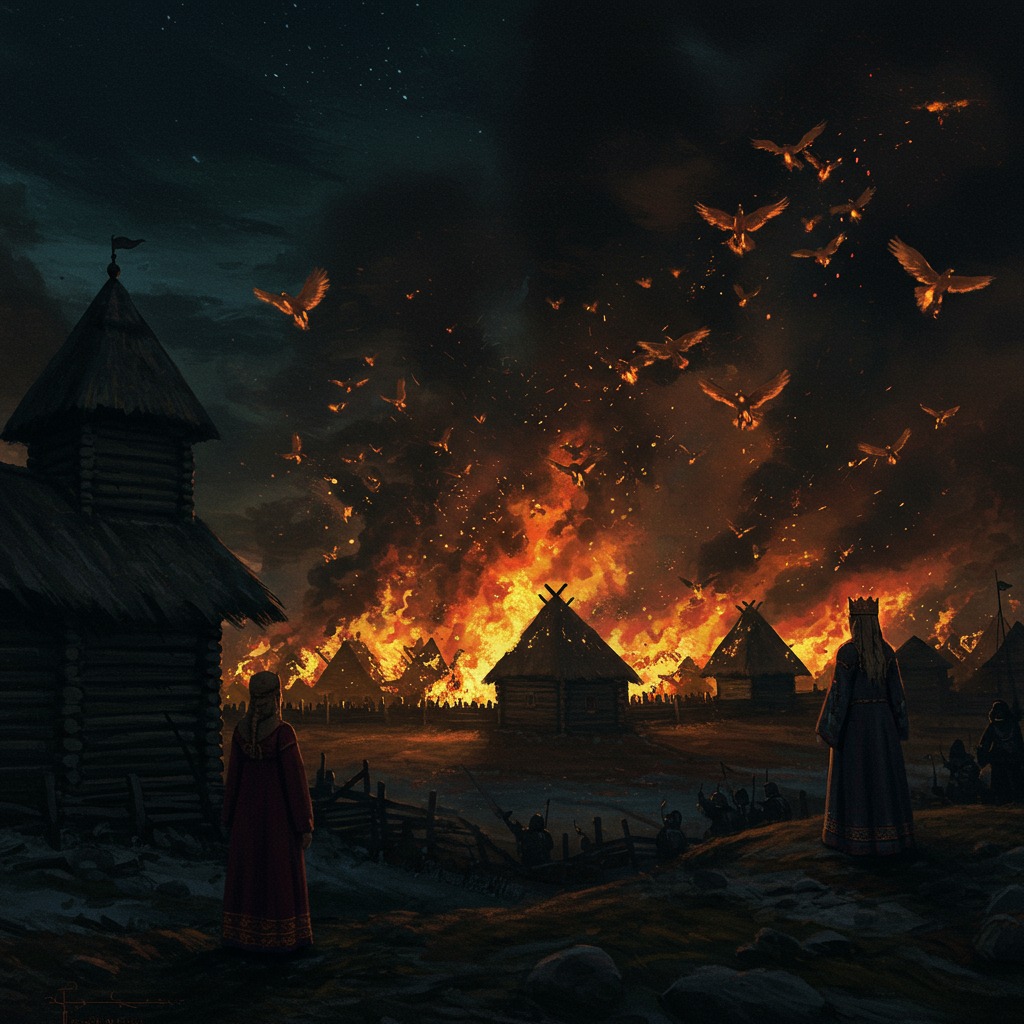
As dusk fell, Olga distributed the birds to her soldiers. She ordered them to tie small pieces of sulfur, bound in bits of cloth, to the legs of the birds. The soldiers lit the cloth on fire and released the flock.
Terrified by the flames, the birds instinctively flew straight back to their nests tucked inside the thatched roofs, wooden dovecotes, and dry eaves of Iskorosten. Within minutes, every single house in the city caught fire simultaneously. There was no way to fight an inferno that started everywhere at once.
As the desperate residents fled the burning city, Olga’s army was waiting. The leaders were executed, the survivors were enslaved, and the broken remnants of the Drevlian tribe were forced to pay a crippling tribute. The revenge was absolute.
From Warlord to Altar
So, how does a woman who buried, burned, and slaughtered her way through an entire civilization end up with a halo in the Eastern Orthodox Church?
The answer lies in the later years of her life. In the 950s, Olga traveled to Constantinople, the heart of the Byzantine Empire. There, she made a decision that would alter the course of Eastern European history forever: she converted to Christianity, taking the baptismal name Helena.
She was the very first ruler of Kievan Rus’ to adopt the Christian faith. While she couldn’t convince her fierce, warrior son Sviatoslav to abandon the old pagan gods, her conversion planted a seed. She brought priests back to Kiev, built churches, and laid the crucial cultural groundwork for her grandson, Vladimir the Great. In 988 CE, Vladimir would officially Christianize the entirety of Kievan Rus’.
Because she was the spark that eventually brought millions into the faith, the Church canonized her. They didn’t just make her a saint; they bestowed upon her the incredibly rare and prestigious title of Equal-to-the-Apostles.
Saint Olga of Kiev remains one of history’s most striking paradoxes—a woman whose devotion helped forge a massive religious empire, and whose terrifying vengeance ensured no one would ever dare cross her family again.