Picture a paleontologist. You likely envision a quiet academic in a tweed jacket, delicately brushing dust off an ancient femur in a sunlit museum. You almost certainly don’t picture train heists, corporate espionage, and literal sticks of dynamite.
But the true story of how humanity discovered the titans of the prehistoric world is not a tale of quiet study. To understand the dawn of modern paleontology, you have to look at two mad geniuses who waged a ruthless, scorched-earth campaign across the American West.
Welcome to the Bone Wars.
The Head on the Wrong End
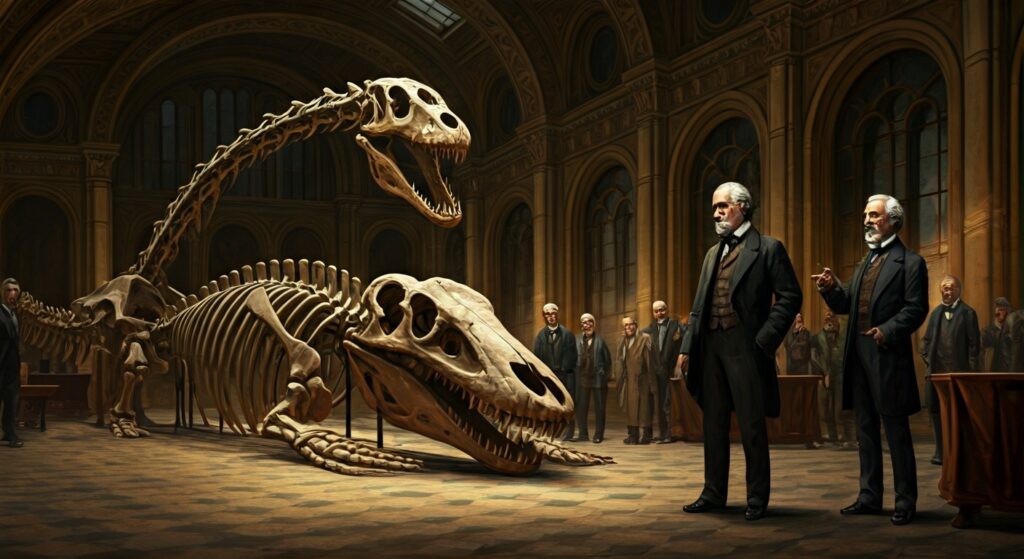
The year was 1877, and the battle lines were drawn. On one side stood Edward Drinker Cope of the Academy of Natural Sciences in Philadelphia—a wealthy, impulsive, and brilliant self-taught naturalist. On the other was Othniel Charles Marsh of the Peabody Museum at Yale—a methodical, politically ruthless academic backed by the massive fortune of his philanthropist uncle.
In the beginning, the two men were actually friends, even naming newly discovered species after one another. But in the obsessive world of scientific discovery, there could be only one king.
The spark that ignited their lifelong hatred wasn’t a dispute over money or land; it was pure, unadulterated academic humiliation. In 1868, Cope proudly unveiled his reconstruction of an ancient marine reptile called an Elasmosaurus. He had painstakingly assembled the beast, but in his frantic excitement, he made a catastrophic error: he placed the creature’s skull on the tip of its tail.
Marsh, ever the calculating rival, didn’t just point the mistake out privately. He publicly humiliated Cope, exposing the anatomical blunder to the entire scientific community. Cope never forgave him. But Marsh wasn’t done. Shortly after the incident, Marsh secretly slithered into Cope’s primary fossil site in New Jersey and bribed the quarrymen to send any new, exciting finds directly to Yale.
The ultimate betrayal had been committed. The gloves were off.
Sabotage in the Wild West
When massive dinosaur bone beds were discovered in the unforgiving terrains of Colorado, Nebraska, and Wyoming’s Como Bluff, the feud exploded into an all-out war.
Both men deployed heavily armed excavation teams to the frontier. What should have been a glorious era of cooperative scientific discovery quickly devolved into a paranoid game of cat and mouse. They hired spies to infiltrate each other’s camps. They intercepted and destroyed each other’s mail. They bribed workers to switch allegiances in the dead of night. Trains transporting priceless fossils back east were hijacked or mysteriously diverted.
But the most breathtakingly ruthless tactic of the Bone Wars was their use of explosives. When Cope or Marsh’s teams finished excavating a site, they wouldn’t just pack up and leave. They would pack the remaining quarry with dynamite and blow the unexcavated fossils to kingdom come. They would rather destroy priceless remnants of the Mesozoic era than let their rival claim a single leftover bone.
Phantom Beasts and Hasty Telegrams
The sheer desperation to beat the other to the punch led to an era of incredibly sloppy, chaotic science. Both men wanted the glory of naming the most species, leading them to telegraph brief, often highly inaccurate descriptions of new dinosaurs back east just to plant their flag first.
Before their feud, there were only nine named dinosaur species in North America. By the end of their war, they had discovered and named over 130 new species. Their frantic, dynamite-fueled excavations unearthed some of the most iconic creatures we know today: Triceratops, Stegosaurus, Diplodocus, and Allosaurus.
But the rush also led to famous taxonomic disasters. In his haste to outpublish Cope, Marsh slapped the wrong skull onto the body of an Apatosaurus and hastily named his “new” discovery the Brontosaurus. It was a monumental blunder that would confuse the public and scientists for over a century, proving that when you prioritize speed over science, you invent phantom beasts.
Mutual Destruction
By the 1890s, the Bone Wars had consumed them both. They had poured their vast personal fortunes into funding expeditions, buying fossils, and sabotaging one another.
The battle eventually spilled out of the dusty quarries and onto the front pages of the New York Herald. In a sensationalized series of articles, they dragged each other through the mud, hurling accusations of plagiarism, incompetence, and financial mismanagement. Marsh leveraged his political connections to ruthlessly cut off Cope’s government funding, even attempting to confiscate Cope’s private fossil collection. Cope retaliated by unleashing a secret journal he had kept for years, detailing every one of Marsh’s misdeeds in a desperate bid to destroy his reputation.
In the end, the war had no victor. Both men died nearly destitute—Cope in 1897 and Marsh in 1899. They had sacrificed their wealth, their reputations, and their sanity on the altar of discovery.
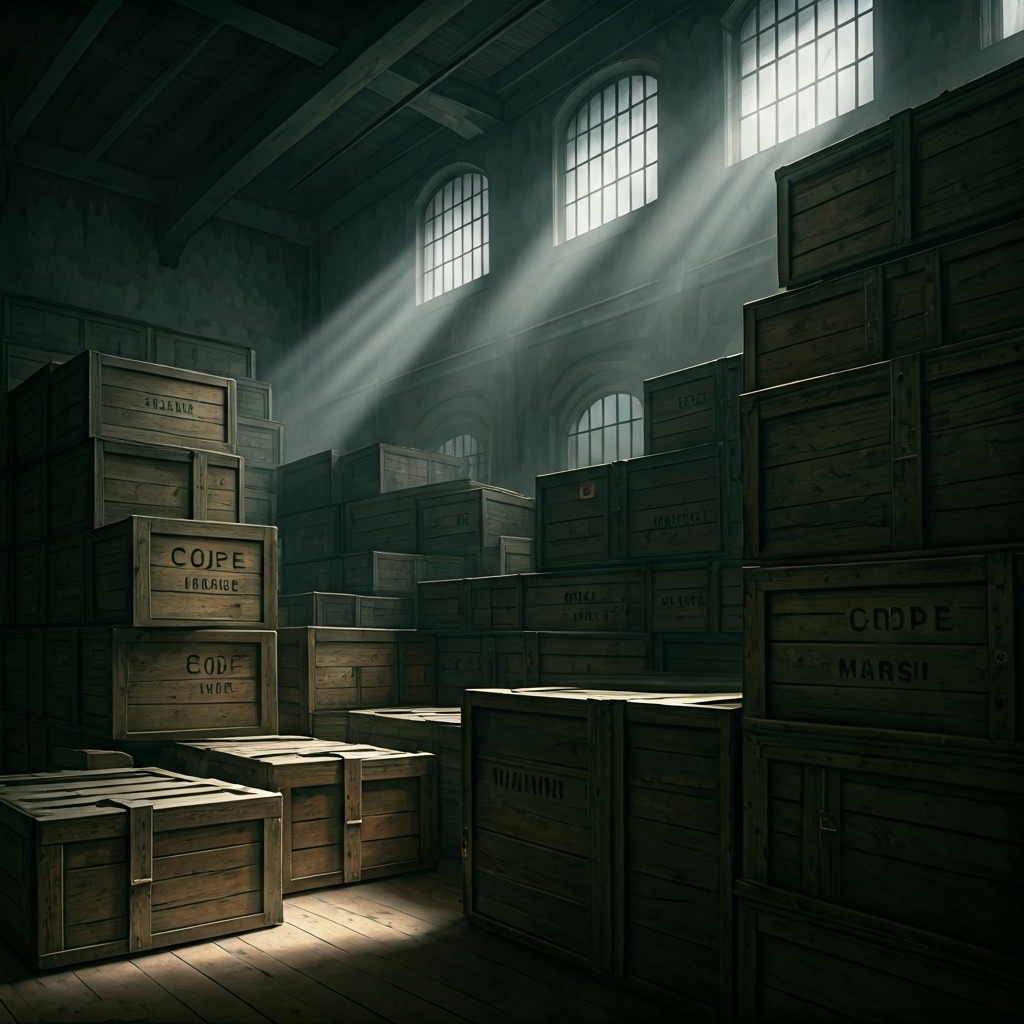
Yet, their toxic rivalry fundamentally shaped modern paleontology. When the dust finally settled, they left behind literal tons of fossils—so many that massive crates of bones remained unopened in museum basements for decades after their deaths. Through their hatred, Cope and Marsh unwittingly established the United States as the epicenter of global paleontology, leaving a legacy built on brilliant discoveries, bitter grudges, and a whole lot of dynamite.