A Desperate Escape
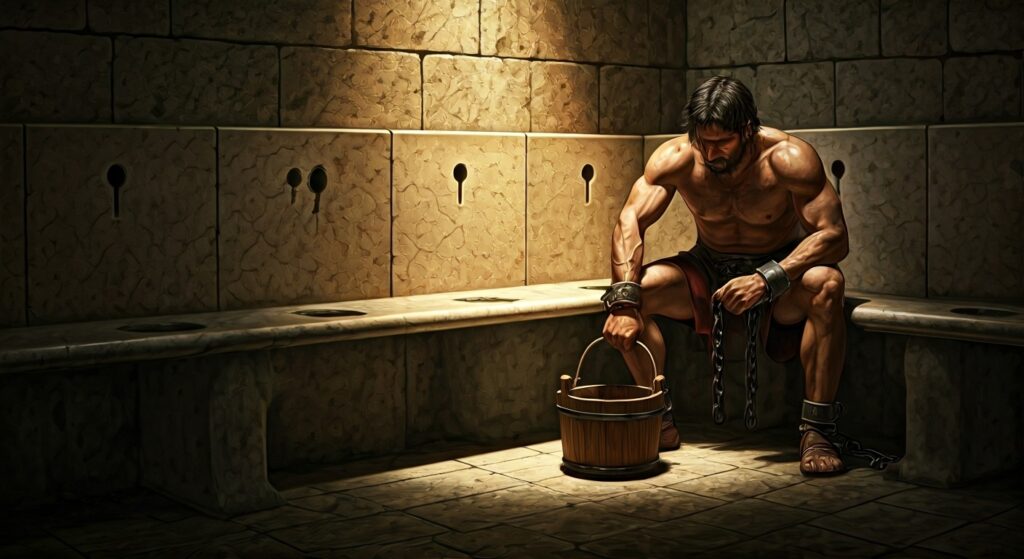
The roar of the Colosseum crowd was a death sentence. For a captive Germanic gladiator awaiting his turn in the arena, the impending slaughter was a certainty. Desperate to avoid a highly public, agonizing demise for the entertainment of a screaming Roman mob, he realized there was only one place his heavily armed guards would leave him unattended: the public latrine.
Alone in the echoing chamber of stone and flowing water, the gladiator made a horrific, unthinkable choice. He reached for a common, deeply unsettling artifact resting in a bucket at the center of the room. He shoved it down his own throat, choosing to suffocate on the cold floor rather than die by the sword.
The Roman philosopher Seneca the Younger recorded this grim tale, framing it as a profound act of defiance. But for modern readers, the story raises a chilling question: what exactly was the vile instrument that ended the gladiator’s life?
The Marble Benches of Secrets
To understand the gladiator’s weapon, you must first step inside an ancient Roman public latrine, known as a foricae.
Forget everything you know about modern privacy. Picture a highly decorated room lined with a continuous bench of cold, polished marble. Spaced mere inches apart are keyhole-shaped openings. There are no stalls, no partitions, and no personal space. You sit shoulder-to-shoulder with politicians, merchants, and enslaved people, casually debating the day’s chariot races while handling your most vulnerable business.
Beneath the bench, a continuous stream of water rushes past, carrying waste into the city’s advanced sewer system, the famed Cloaca Maxima. At your feet, a secondary, shallow gutter of clean water babbles along the floor. It all sounds remarkably civilized—until you finish and reach for the bucket.
The Horrifying Tool in the Bucket
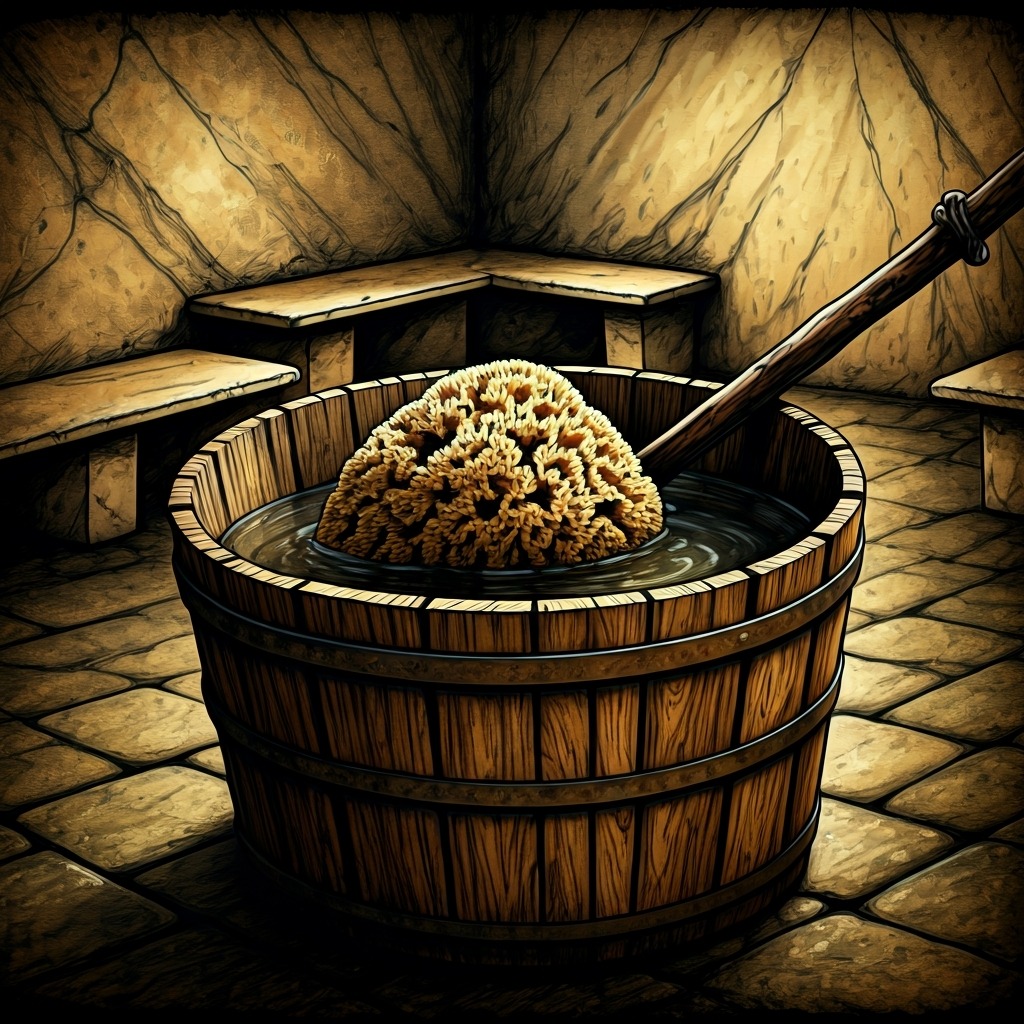
Resting in a communal container filled with highly concentrated salt water or vinegar was the tersorium—also known by its Greek name, the xylospongium.
Translating literally to “sponge on a stick,” this was the ancient Roman equivalent of toilet paper. The mechanics were brutally simple. A user would take the stick, use the natural Mediterranean sea sponge affixed to the end to wipe themselves, and then rinse it off in the shallow gutter of running water at their feet.
Then comes the detail that makes the modern mind recoil: they put it back in the bucket.
The tersorium was entirely communal. The next citizen to walk into the latrine would grab the exact same sponge. The Romans trusted that a quick soak in brine or vinegar was enough to disinfect the porous sea sponge before the next person used it.
An Illusion of Hygiene
Despite their glowing historical reputation for pristine bathhouses, advanced aqueducts, and engineering marvels, the Romans were harboring a microscopic nightmare.
Modern paleoparasitology has completely shattered the illusion of Roman cleanliness. Researchers analyzing fossilized feces from these ancient latrines have discovered that the population suffered heavily from intestinal parasites like whipworm, roundworm, and dysentery. The shared nature of the tersorium undoubtedly acted as a super-spreader for these pathogens. A splash of vinegar was absolutely no match for the fecal-oral diseases bouncing from citizen to citizen on a shared, damp sponge.
The Great Wipe Debate
History, however, is rarely as settled as it seems. Just when archaeologists thought they had the tersorium figured out, a massive wrench was thrown into the narrative.
In recent years, a fierce debate has erupted in the academic community. Scholars like Gilbert Wiplinger argue that the tersorium was not used for personal wiping at all. Instead, he suggests it was the ancient equivalent of a toilet brush, used exclusively to scrub the marble latrine seats and clean the catch-basin.
If they weren’t using the sponge, what were they using? Proponents of the toilet brush theory suggest Romans likely wiped with pessoi—small, abrasive ceramic discs—or simply used leaves, moss, or their own hands.
While the debate remains unsettled, the communal wiping sponge theory still reigns supreme in popular history. Regardless of its primary use, Seneca’s dark, indisputable historical account proves the tersorium was kept in these latrines—and that it was capable of ending a life. Behind every bizarre historical artifact lies a deeply complex human story, reminding us that the ancient world was as brutal as it was brilliant.