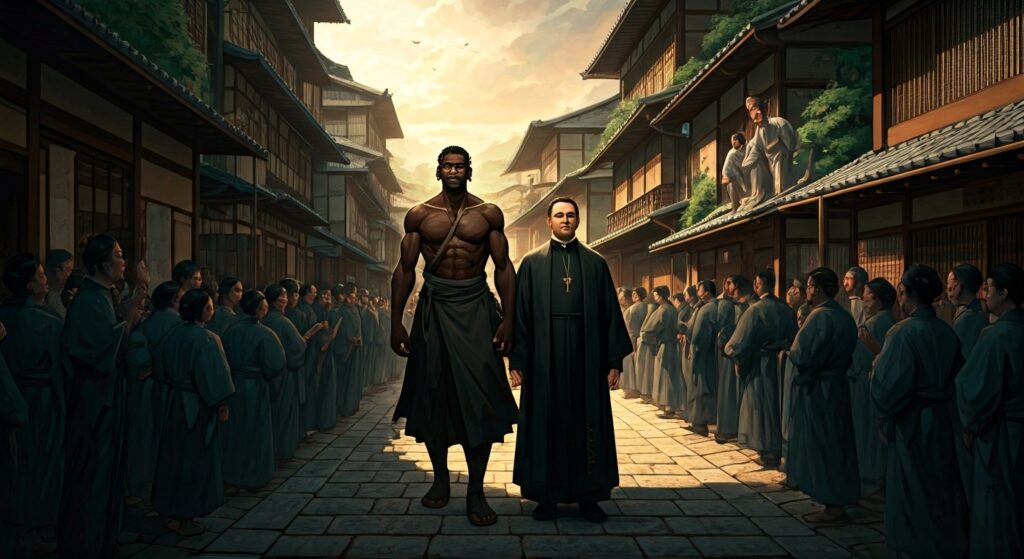
The year is 1579. The streets of Kyoto are a tapestry of rigid tradition, steeped in the exquisite, blood-soaked aesthetics of Japan’s Sengoku period. But on this particular day, the bustling capital comes to a dead, breathless halt. A procession winds through the city, led by the Italian Jesuit Alessandro Valignano. Yet, the crowds are not looking at the missionary. They are climbing over one another, trampling neighbors, and craning their necks to witness the man walking behind him.
He is an African warrior of staggering physical presence. In a nation where the average man stands barely over five feet tall, this foreigner towers above the masses at six feet, two inches. He does not merely walk through Kyoto; he eclipses it. The sheer visual spectacle of his arrival triggers a frenzy so intense that the city’s rigid order temporarily collapses.
The Warlord and the Ink
By 1581, whispers of this colossal, dark-skinned foreigner reach the ears of Oda Nobunaga. Nobunaga is no ordinary daimyo; he is a brilliant, ruthless warlord on the precipice of unifying Japan. Known for his eccentricities and appreciation of the unconventional, Nobunaga demands an immediate audience with this mysterious attendant.
The ensuing encounter is a masterclass in historical tension. Having never seen a Black man, the warlord is utterly astounded. Convinced the foreigner’s skin is coated in black ink, Nobunaga issues a sudden, commanding order: strip the man to the waist and scrub him clean.
The room holds its breath. Attendants vigorously scrub the towering stranger. But as the water runs clear and the rich, dark complexion remains unchanged, Nobunaga’s suspicion dissolves into profound awe. He realizes this striking appearance is entirely natural. In that singular moment, the warlord is captivated by the man’s immense strength and undeniable presence.
The Silk, The Sword, and The Samurai
Nobunaga does not just welcome the foreigner; he absorbs him into his inner circle, bestowing upon him the Japanese name Yasuke.
Yasuke is not kept as a mere curiosity. In a cultural shift that defies the strict hierarchy of feudal Japan, Nobunaga formally inducts Yasuke into his retinue. He grants the African warrior a private residence, a regular stipend, and—most crucially—a short ceremonial sword. With the passing of that blade, Nobunaga elevates Yasuke to the prestigious, fiercely guarded status of a samurai.
It is an unprecedented honor. Picture Yasuke: a towering warrior draped in the meticulously crafted silk and armor of a 16th-century Japanese samurai, conversing in Japanese, and riding into brutal military campaigns as the personal confidant and bodyguard to the most powerful man in the empire.
Blood in the Temple: The Honno-ji Betrayal
But in the theater of war, golden ages are notoriously brief.
The climax of Yasuke’s samurai tenure arrives with brutal suddenness in June 1582. Nobunaga is resting at the Honno-ji temple in Kyoto, accompanied only by a small, elite retinue that includes Yasuke. In the dead of night, the ultimate betrayal unfolds. Nobunaga’s trusted general, Akechi Mitsuhide, turns his massive army against his lord, ambushing the temple and setting it ablaze.
The visual of the burning temple against the night sky is terrifyingly beautiful. Inside the inferno, Yasuke fights like a demon alongside his master. But the ambush is overwhelming. Recognizing that all is lost, Nobunaga retreats to the inner chambers to commit seppuku—ritual suicide—to preserve his honor in death.
Even as the flames consume the temple and his master lies dead, Yasuke’s loyalty does not waver. He flees the burning ruins, cutting a bloody path through the chaotic streets to Nijo Castle to protect Nobunaga’s heir, Oda Nobutada. Yasuke throws himself into a valiant, desperate defense against Mitsuhide’s forces until he is finally overwhelmed, disarmed, and captured.
A Vanishing Act for the Ages
Covered in blood and ash, the African samurai is dragged before the traitor, Akechi Mitsuhide. By every rule of Sengoku-era warfare, Yasuke should be executed on the spot.
Instead, Mitsuhide spares him.
Historical accounts claim Mitsuhide dismissed Yasuke as a “non-Japanese beast who knew nothing.” However, modern historians suspect this was a brilliant, calculated piece of political theater—a merciful excuse to avoid executing a high-profile foreigner and risking the wrath of the powerful Jesuit missionaries.
Yasuke is handed over to the Jesuit church in Kyoto. And then?
He vanishes.
He completely disappears from the historical record. Did he return to his homeland? Did he travel the seas as a mercenary? Did he quietly live out his days in a hidden Japanese port town? The truth remains buried in the ashes of the 16th century. Yasuke remains a legendary symbol of diverse samurai heritage—a towering figure who walked into a foreign land, commanded the respect of a warlord, and walked out into myth.