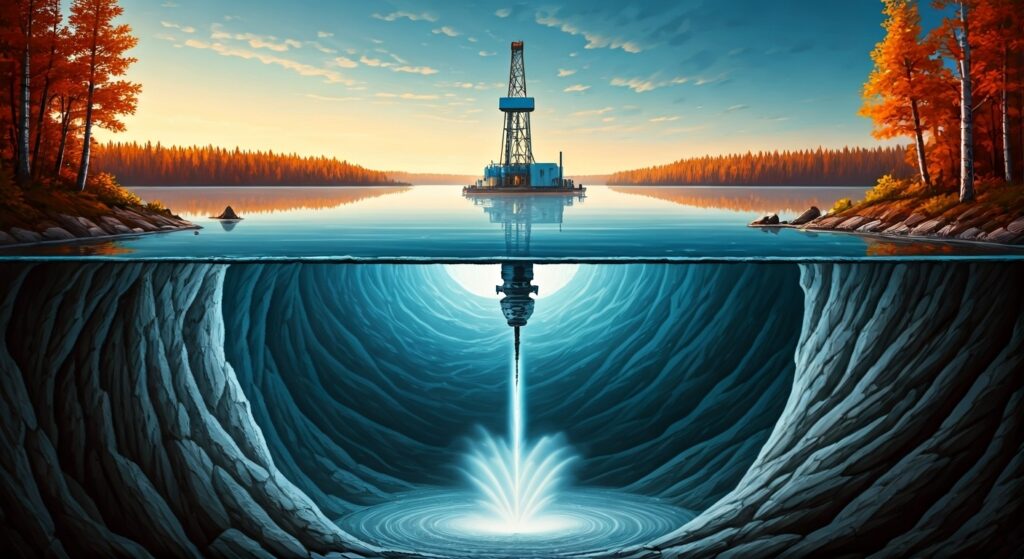
The Trap Beneath the Surface
On the crisp autumn morning of November 20, 1980, Lake Peigneur was a picture of idyllic Louisiana tranquility. Averaging a mere ten feet deep, the freshwater lake was a sleepy haven for fishermen and local wildlife. But beneath its placid surface, a catastrophic trap was waiting to be sprung.
Two massive, entirely incompatible industrial operations were sharing the exact same coordinates. Up top, a towering Texaco oil rig, operated by the Wilson Brothers Corporation, was probing the lakebed for black gold. Directly below them sat the Diamond Crystal Salt Mine, a sprawling, cavernous subterranean city carved out of highly soluble rock. Separating the heavy machinery above from the hollow caverns below was a dangerously thin layer of earth. It was a ticking time bomb, and the detonator was a simple math error.
A Pinprick of Doom
In the high-stakes world of deep-earth engineering, a single misplaced decimal or misunderstood coordinate can spell disaster. For the crew on Lake Peigneur, a critical mapping error involving coordinate reference systems meant they were drilling blind.
The Texaco drillers believed their 14-inch drill bit was aimed at a safe, solid pocket of earth. Instead, it was spinning directly toward the third level of the active salt mine. Deep underwater, the metal bit chewed through mud and rock until it suddenly punched through the mine’s ceiling.
At first, it was just a 14-inch puncture. But basic chemistry dictates a violent reaction when freshwater meets raw salt.
The Vortex Awakens
As lake water poured into the subterranean cavern, it didn’t just flood the mine—it devoured it. The freshwater rapidly dissolved the salt, expanding the 14-inch hole by the second. Down in the dark, the massive salt pillars supporting the mine’s ceiling began to melt away like sugar cubes in boiling tea.
On the surface, a bizarre ripple formed. It became a swirl, and within moments, that swirl violently accelerated into an apocalyptic vortex. The suction was unimaginably powerful. The churning maelstrom swallowed the multi-million-dollar drilling platform whole. Then it dragged down eleven barges, a tugboat, and 65 acres of the surrounding shoreline, ripping ancient trees from the nearby Live Oak Gardens and sucking them into the muddy abyss like twigs down a bathtub drain.
Gravity in Reverse
As millions of gallons of water vanished into the earth, the lakebed essentially emptied out. But the physics of the disaster were just getting started.
The Delcambre Canal, which normally flowed south to carry water from the lake into the Gulf of Mexico, was suddenly overpowered by the immense vacuum of the collapsing mine. The suction was so absolute that it forced the canal to reverse its course. Gulf saltwater rushed violently northward, pouring into the collapsing crater of the lakebed.
As the ocean water cascaded down into the cavernous sinkhole, it temporarily created a 164-foot waterfall—the tallest in Louisiana history.
The Great Escape
With a multi-million-dollar rig vanishing into a whirlpool and the earth collapsing in on itself, the stage was set for a staggering human tragedy. Yet, this is where the story shifts from a horror movie to a masterclass in survival.
Deep underground, an observant electrician noticed water pooling where it absolutely shouldn’t be. Realizing the mine’s ceiling had been breached, he immediately sounded the alarm. Thanks to a well-rehearsed emergency plan, all 55 miners working in the subterranean depths successfully evacuated through the elevator shafts, escaping just as the caverns were obliterated by the incoming flood.
Up on the surface, the seven-man drilling crew scrambled off their doomed platform and made it to shore mere moments before the rig was dragged down into the vortex. Miraculously, amidst the apocalyptic destruction, not a single human life was lost.
A Sunken Monument to Math
When the churning waters finally settled days later, the landscape of Iberia Parish was permanently altered. Lake Peigneur was no longer a 10-foot-deep freshwater puddle. It had been violently transformed into a deep, brackish lake with maximum depths reaching over 200 feet, bringing an entirely new marine ecosystem with it.
The financial fallout was as massive as the vortex itself. Texaco and Wilson Brothers paid out $32 million in out-of-court settlements to the Diamond Crystal Salt Company, and another $12.8 million to the owners of Live Oak Gardens.
Today, the lake looks peaceful again. But deep beneath the surface lies a flooded, abandoned salt mine, a graveyard of barges and drilling equipment, and a permanent, sunken monument to the terrifying consequences of getting your math wrong.