The Invisible Killer
Paris, 1816. Inside the dimly lit wards of the Necker Hospital, a young woman was fading. Her symptoms pointed to a grim fate—a diseased heart—but the exact nature of her affliction remained locked behind an impenetrable wall of flesh and social propriety.
At the time, the only way a physician could listen to a patient’s internal organs was through a crude and deeply uncomfortable method known as immediate auscultation. It required the doctor to press his ear directly against the patient’s bare chest. For Dr. René-Théophile-Hyacinthe Laennec, this was a diagnostic nightmare. His patient was young, female, and carried excess body weight. Pressing his face to her chest was not only a severe breach of 19th-century modesty, but her body fat would also muffle any faint acoustic clues.
Laennec was flying blind. The killer inside her was invisible, and the societal rules of the era demanded it remain unheard.
The Playground Epiphany
Defeated and desperate, Laennec sought fresh air in the courtyards of Paris. As he walked, his attention was drawn to a group of children playing in the dirt. They were huddled around a long wooden plank. One child scratched the far end of the wood with a pin, while another pressed his ear to the opposite side, giggling as the solid wood amplified the tiny, otherwise inaudible sound.
It was a flash of pure, unadulterated genius. If sound could travel through a solid piece of wood and become magnified, why couldn’t the same principle pierce the veil of the human body?
Driven by a sudden, frantic instinct, Laennec raced back to the hospital ward.
The Birth of the “Chest-Looker”
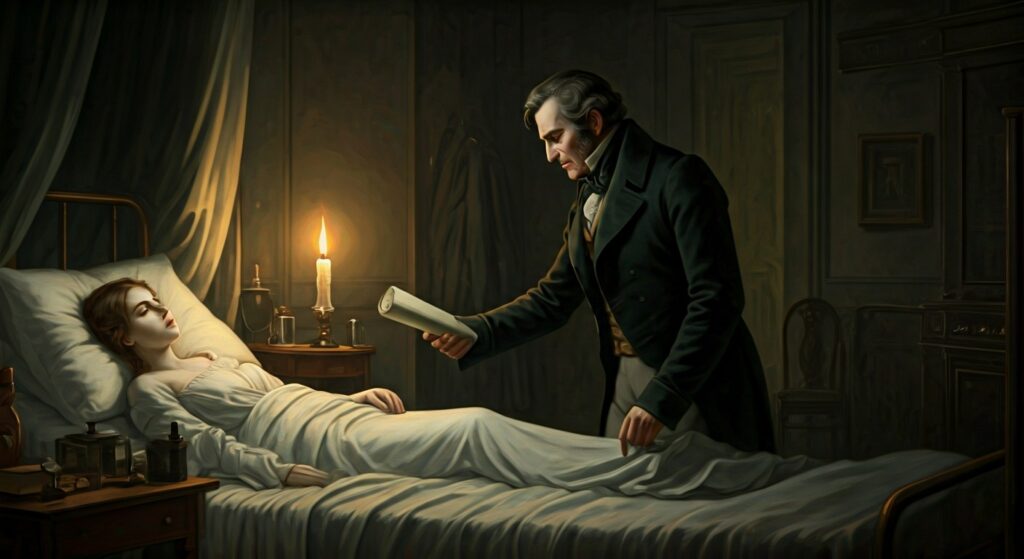
Ignoring the confused stares of his colleagues, Laennec grabbed a quire of paper—a standard bundle of twenty-four sheets—and rolled it tightly into a rigid cylinder. He approached his dying patient, gently pressed one end of his makeshift tube to her chest, and hesitantly placed his ear against the other.
What he heard next changed the course of medical history.
Through the hollow center of that simple paper roll, the young woman’s heartbeat didn’t just echo; it thundered. To his absolute astonishment, Laennec could hear the internal rhythms with a terrifying clarity he had never experienced through skin-to-ear contact. He had just unlocked a new frontier in diagnostics: mediate auscultation.
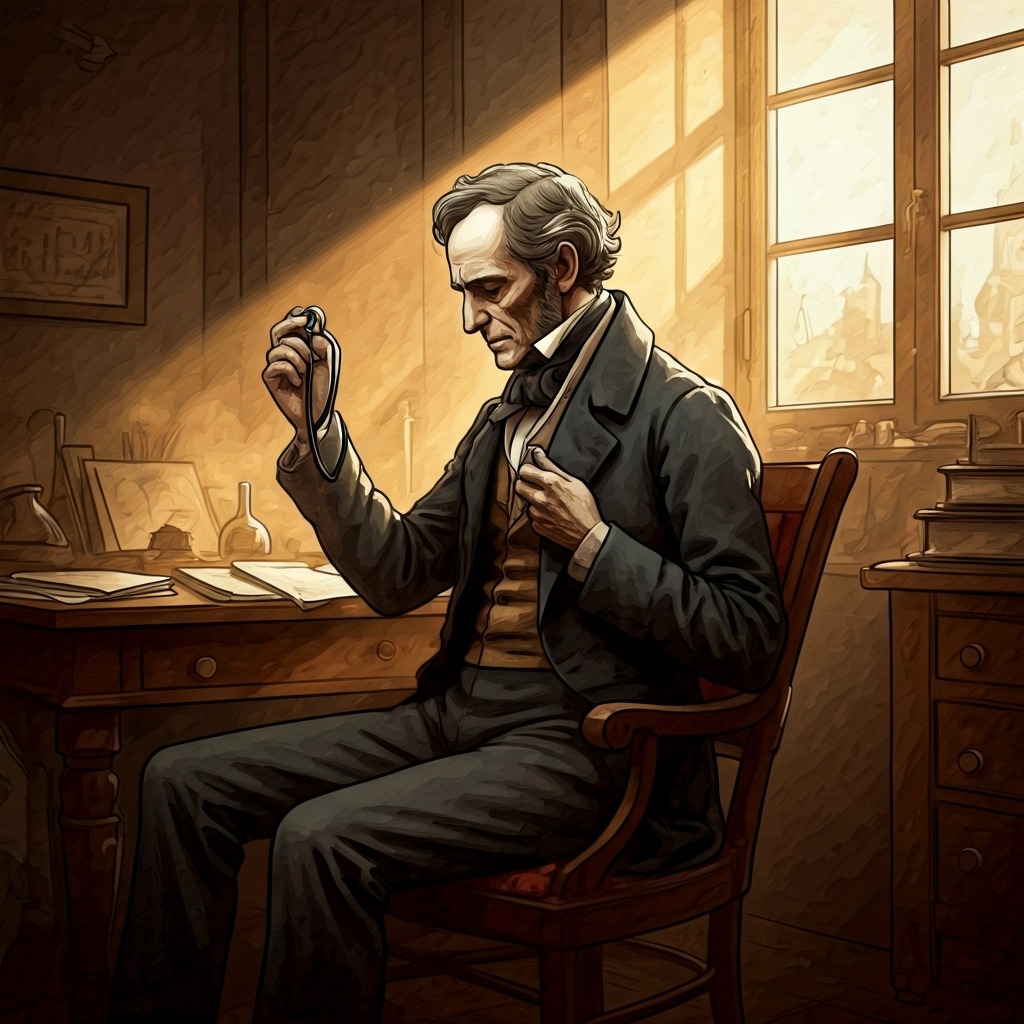
Realizing the magnitude of his discovery, Laennec spent the next three years obsessively perfecting his invention. He replaced the paper with a hollow wooden tube, elegantly crafted from cedar and ebony. Needing a name for his creation, he combined the Greek words stethos (chest) and skopein (to look). The stethoscope was born.
A Paradigm Shift and a Tragic Irony
When Laennec published his magnum opus, De l’Auscultation Médiate, in 1819, it triggered an absolute paradigm shift. Medicine transitioned overnight from relying on a patient’s subjective, often flawed recounting of symptoms to the objective observation of internal physical signs. Doctors could finally “see” inside the chest without a scalpel.
The stethoscope was an instant cultural phenomenon. It created a physical boundary that maintained social decorum, allowing physicians to examine patients with professional distance. Over the decades, Laennec’s single-ear wooden tube would evolve into the iconic, Y-shaped binaural instrument draped around the neck of every modern doctor.
But history is rarely without a cruel twist of irony.
Laennec’s brilliant invention allowed him to diagnose countless patients with tuberculosis, meticulously mapping the terrifying acoustic signature of the disease. Tragically, the man who taught the world how to listen to the lungs could not save his own. In 1826, at the young age of 45, Laennec succumbed to the very disease he had spent his life decoding.
He never lived to see his wooden tube become the ultimate symbol of the medical profession, but his legacy echoes on—beat by beat, breath by breath—in every hospital around the globe.