The Shadow of the Moai
Everyone knows about the colossal stone heads of Easter Island. But the towering Moai are merely silent guardians of a much deeper, far more baffling secret. Hidden on the isolated shores of Rapa Nui lies a mystery that has stumped linguists, archaeologists, and cryptographers for over a century.
Welcome to the ultimate historical cold case: Rongorongo.
Discovered in the mid-19th century, Rongorongo is a system of enigmatic glyphs that represents one of the most tantalizing unsolved mysteries in human history. It is quite possibly one of the only times a civilization invented writing completely from scratch, in total isolation.
There’s just one chilling problem: we can’t read a single word of it.
The Dizzying Dance of the Wood
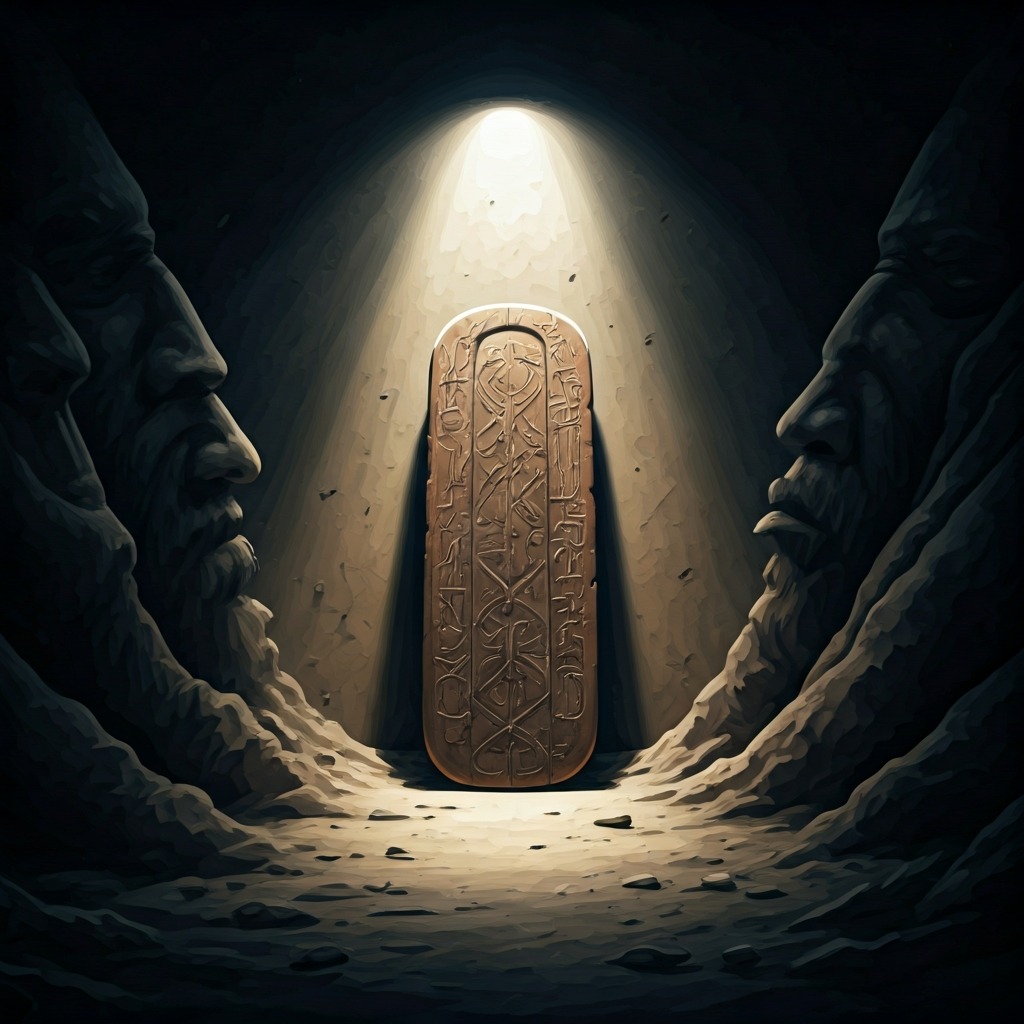
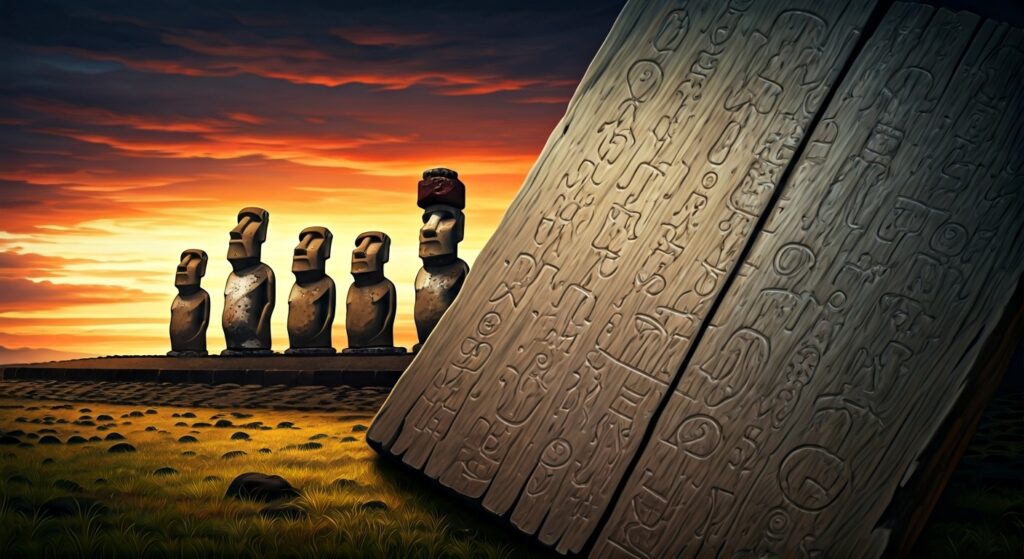
Imagine a code so intricate it makes modern encryption look like a children’s puzzle. Rongorongo consists of pictographic and abstract symbols—tiny, masterfully carved human figures, animals, plants, and geometric shapes. These glyphs were etched into wooden tablets, often crafted from native Toromiro wood or driftwood that washed ashore.
But the most mind-bending aspect of Rongorongo isn’t its appearance; it’s the mechanics of reading it. The script utilizes a dizzying directional system known as reverse boustrophedon.
You don’t simply scan a Rongorongo tablet from left to right. You start at the bottom-left corner and read to the right. When you reach the end of the line, you must physically rotate the entire wooden tablet 180 degrees to read the next line. You continue this alternating, flipping pattern all the way up the wood. It is an interactive, physical dance between the reader and the ancient text.
The Heist of a Culture
So, why does this language remain locked? Because the key to the cipher was stolen in one of the most tragic cultural heists in human history.
In the 1860s, a devastating wave of Peruvian slave raids decimated the Rapa Nui population. The raiders didn’t just steal human lives; they inadvertently wiped out an entire intellectual class. They captured or killed the island’s royal family, the priests, and the literate elite known as the tangata rongorongo—the absolute only people who held the knowledge of the script.
Subsequent epidemics of smallpox and tuberculosis ravaged the survivors. By the time missionaries noticed the tablets in 1864, the local population had entirely lost the ability to read their own ancestors’ words. Without anyone to translate them, the sacred tablets were discarded. Countless pieces of history were burned as firewood to keep warm or casually repurposed as fishing reels.
Spark of Genius or Stolen Idea?
Today, the academic world is locked in a fierce debate over the true nature of Rongorongo. Is it a fully realized writing system that perfectly represents spoken language? Or is it a proto-writing mnemonic aid—a series of visual cues used by priests to recite complex genealogies and religious chants?
Then there is the burning question of its origin. Did the Rapa Nui invent this script entirely on their own? Or was it a case of “stimulus diffusion”? Some historians argue the script was born only after the Rapa Nui witnessed Spanish written treaties in 1770. Seeing that marks on a page could hold power and meaning might have prompted them to invent their own system.
The Missing Rosetta Stone
We may never know the truth. Because of the sheer devastation wrought by the slave raids and disease, only about two dozen authentic texts survive today, scattered in museum vaults around the world.
Deciphering a lost language usually requires a bilingual key—a Rosetta Stone that translates the unknown into the known. Rongorongo has no Rosetta Stone. It is a locked door, and the key has been thrown into the depths of the Pacific Ocean.
Until a brilliant mind manages to crack the code, the wooden tablets of Rapa Nui will remain silent, fiercely guarding the thoughts, prayers, and history of a lost world.