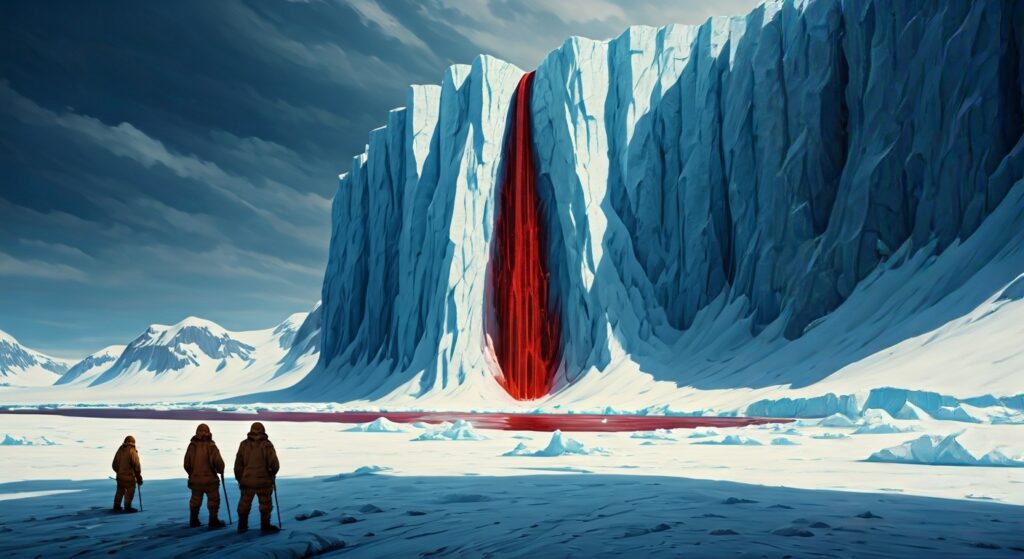
Imagine trekking through an endless, pristine white wasteland, where the temperature hovers well below freezing and the wind howls like a wounded animal. You look up at the towering face of a glacier, expecting to see nothing but ancient, blue-white ice. Instead, you are greeted by a scene ripped straight from a horror film: a five-story waterfall of what appears to be pure, unadulterated blood oozing from the ice.
Welcome to Blood Falls.
A Macabre Discovery at the End of the World
In 1911, Australian geologist Thomas Griffith Taylor was exploring the desolate, freezing expanses of East Antarctica. He was navigating the McMurdo Dry Valleys—one of the most extreme environments on Earth, a polar desert where snow rarely falls and the winds are merciless.
As Taylor charted the glacier that would eventually bear his name, he stumbled upon a sight that defied all logic. Flowing from the tongue of the ice directly onto the frozen surface of West Lake Bonney was a brilliant, starkly crimson cascade. In a world completely devoid of color, this vibrant red anomaly was jarring. It looked exactly as though the glacier was bleeding out.
Baffled, Taylor and his fellow explorers did what any early 20th-century scientists would do: they guessed. They hypothesized that the deep red coloration was caused by microscopic red algae trapped in the ice. It was a neat, logical explanation for an era that lacked modern scientific tools.
But it was completely wrong.
The Century-Old Secret Beneath the Ice
For over a century, the true nature of Blood Falls remained one of the continent’s most fiercely guarded secrets. It wasn’t until the early 2000s, armed with advanced radar and chemical analysis, that researchers finally pierced the ice to see what was really going on. What they found was far more fascinating—and terrifying—than a simple algae bloom.
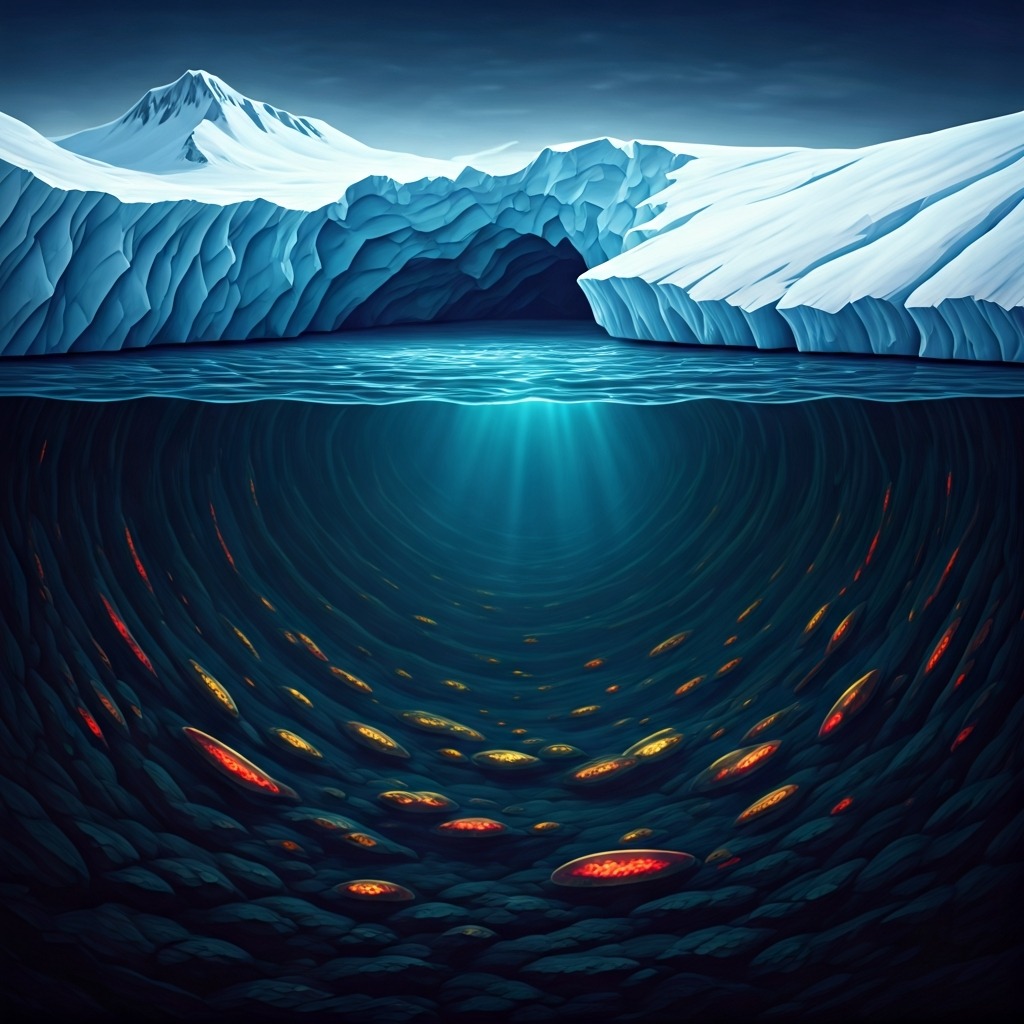
Deep beneath the Taylor Glacier lies a massive, ancient subglacial reservoir. Approximately two million years ago, a prehistoric fjord was completely sealed off by advancing glaciers. The water trapped inside this icy tomb became an isolated time capsule. Over millennia, as the glacier scraped the bedrock, the trapped water became hypersaline—about three times saltier than regular ocean water.
This extreme saltiness is the key to the water’s movement. The high salinity dramatically lowers the freezing point of the brine, allowing it to remain in a liquid state even when temperatures plunge well below freezing.
The Chemistry of a Bleeding Glacier
If it isn’t algae, and it isn’t blood, why is it so red?
The answer lies in a violent chemical reaction. The water trapped in that ancient subglacial lake is highly pressurized and completely deprived of oxygen. It is also incredibly rich in iron, scraped from the bedrock over millions of years.
When the immense pressure of the glacier occasionally forces this ancient brine through microscopic cracks in the ice, it finally makes contact with the outside world. The moment the ferrous iron dissolved in the water hits the oxygen-rich atmosphere, it oxidizes instantly. In simpler terms: it rusts.
The “blood” pouring out of the Taylor Glacier is actually a five-story waterfall of liquid rust.
An Alien World Hidden on Earth
If the story ended there, it would be a brilliant geological party trick. But Blood Falls harbors one final, mind-blowing twist.
When scientists analyzed the rusty brine, they expected it to be sterile. After all, what could possibly live in a pitch-black, freezing, oxygen-starved, hypersaline environment under crushing pressure?
Life, it turns out, is infinitely more stubborn than we give it credit for.
The subglacial lake is actually a biological marvel. It is teeming with an isolated, extremophilic microbial community that has survived cut off from the rest of the world for up to two million years. Because they are buried beneath hundreds of meters of ice, these microbes receive zero sunlight, meaning photosynthesis is impossible. Instead, they have evolved a completely unique metabolic pathway. They use sulfate as a catalyst to “breathe” and metabolize the iron-rich sediments surrounding them. They are literally eating the bedrock to survive.
This self-sustaining ecosystem isn’t just a quirky Earth fact; it’s a window into the cosmos. Astrobiologists are currently studying the microbes of Blood Falls as an Earth-based analog for alien life. If organisms can thrive in the dark, freezing, hypersaline waters beneath the Taylor Glacier, it is entirely possible that similar life could be swimming right now in the icy oceans of Jupiter’s moon Europa, or hiding beneath the polar ice caps of Mars.