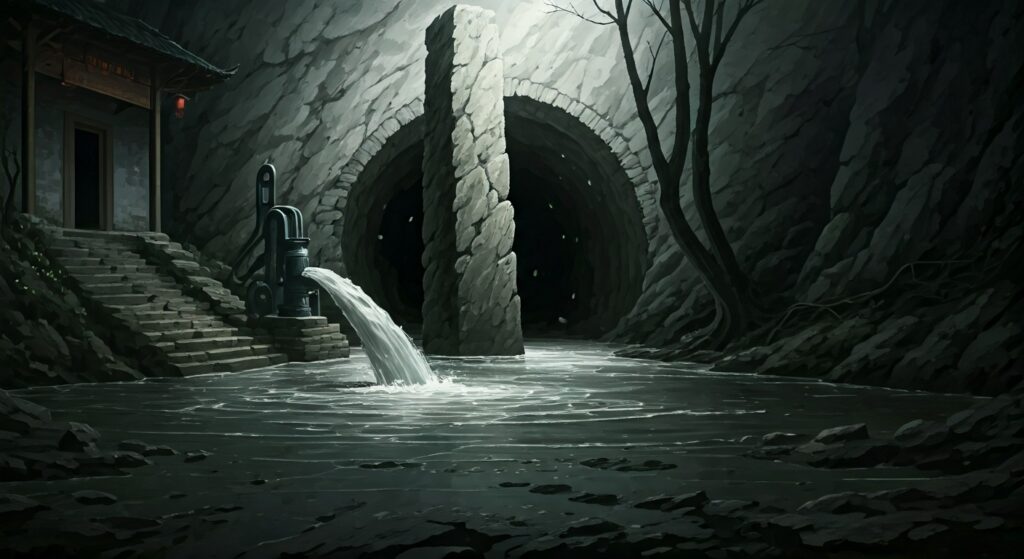
For generations, the villagers of Shiyan Beicun in China’s Zhejiang province whispered of the “bottomless ponds.” According to local lore, these murky bodies of water scattered across the landscape had no end. But in 1992, a curious farmer named Wu Anai decided to test the myth. Pooling money with his neighbors, he purchased a heavy-duty water pump, hauled it to the edge of the largest pond, and turned it on.
For seventeen days and nights, the machine roared, draining the water inch by inch. What emerged from the receding muck was not a natural lakebed, but the top of a colossal, hand-carved stone pillar. When the pond was finally dry, Wu Anai found himself staring into the abyss of a sprawling, man-made subterranean cavern.
He had not just drained a pond; he had unsealed a forgotten world. Subsequent excavations revealed a staggering network of 24 massive grottoes carved directly into the argillaceous siltstone of Phoenix Hill. The Longyou Caves had been discovered—and with them, one of the most baffling archaeological enigmas in human history.
The Missing Mountain
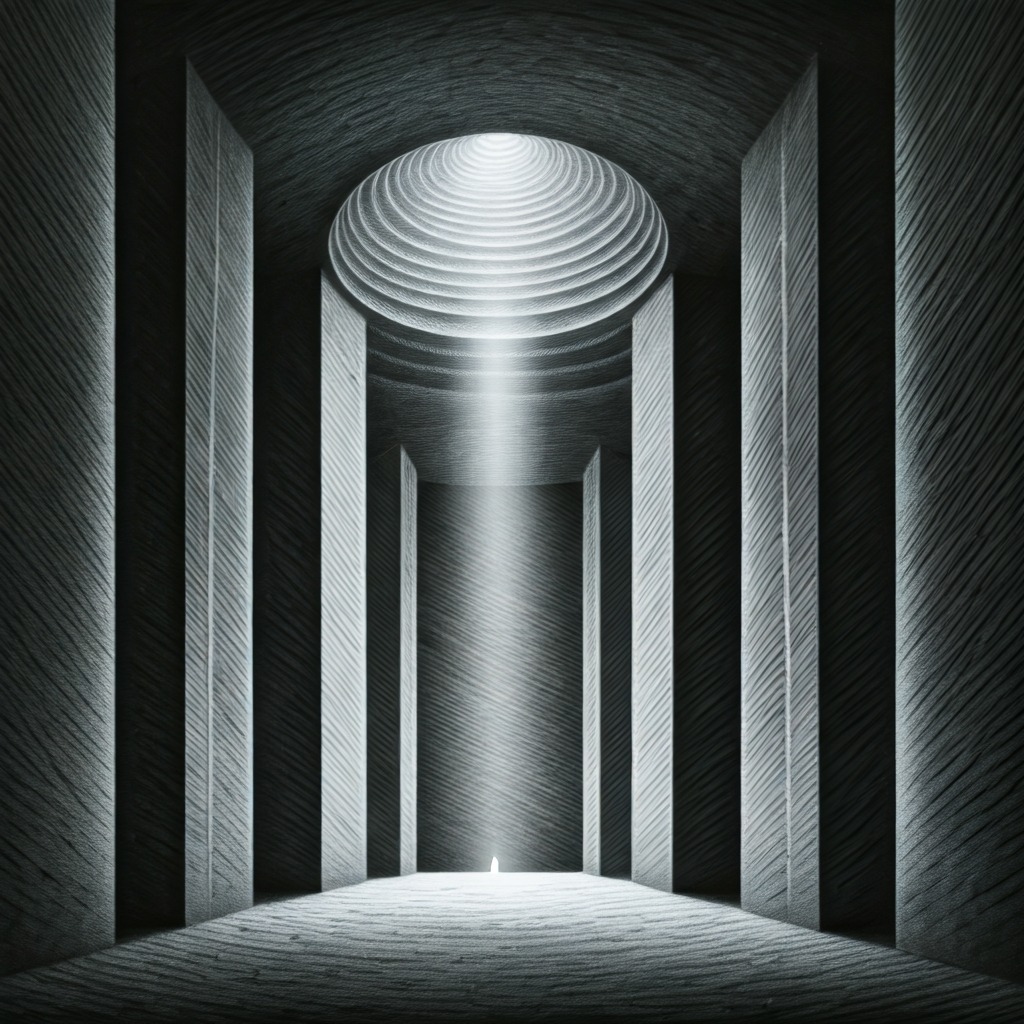
The sheer scale of the Longyou Caves defies logic. Each grotto covers an average floor area of over 1,000 square meters, with vaulted ceilings soaring up to 30 meters high. To hollow out these caverns, engineers estimate that ancient builders had to excavate nearly one million cubic meters of solid rock.
To achieve this in the ancient world, a workforce of a thousand skilled laborers would have to toil day and night, non-stop, for at least six years. Yet, this monumental effort presents an impossible logistical nightmare: where did the rock go? Not a single trace of excavated stone or rubble has ever been found in the surrounding area. A mountain’s worth of rock simply vanished.
Even more unsettling is the absolute silence of history. Ancient China is renowned for its meticulous, unbroken bureaucratic records, documenting everything from imperial decrees to local grain taxes. Yet, no historian, poet, or tax collector ever penned a single character about this colossal project. It is a masterpiece of engineering completely erased from human memory.
Carved in the Pitch Black
If the missing rubble doesn’t confound you, the structural genius will. The walls separating these massive individual caves are perilously thin—in some places, a mere 50 centimeters thick. Yet, across all 24 caves, the walls never intersect. The builders never accidentally breached a neighboring cavern, implying a highly advanced mastery of structural integrity and 3D spatial calculation.
And they achieved this impossible precision in the dark.
Curiously, archaeologists have found zero signs of soot on the ceilings, ruling out the use of traditional torches for illumination. How an ancient workforce carved a perfectly aligned, 30-meter-tall cave system without fire remains entirely unexplained.
Furthermore, the walls and ceilings of every single cave are covered in uniform, parallel chisel marks, all struck at precise 60-degree angles. This consistency transcends mere function; it was a deliberate, painstaking aesthetic choice. A few caves even feature intricate bas-relief carvings of horses, fish, and birds, hinting at a cultural or ceremonial significance that has been lost to time.
The Phantom Roster
When faced with an impossible structure, historians scramble for theories. Yet, every hypothesis about the Longyou Caves inevitably collapses under scrutiny.
The most pragmatic explanation—the “Quarry Theory”—suggests the caves were simply a source of stone. But this fails to account for the decorative 60-degree chisel marks, the carefully engineered supporting pillars, the carved stairs, and the complete absence of leftover rubble.
Another popular theory posits that the caves were a black-ops military base commissioned by King Goujian of Yue around 500 BCE. Goujian, a legendary figure who spent years plotting revenge against a rival state, could have used the subterranean network to secretly train an army off the grid. It is a thrilling narrative, but it lacks a shred of physical evidence. No weapons, armor, or human remains have ever been unearthed to suggest an army camped in the dark.
Other scholars have suggested imperial mausoleums or massive grain silos. However, the subterranean humidity would have quickly rotted any stored grain, and the complete absence of tombs or artifacts kills the mausoleum theory dead.
An Enduring Silence
Today, the Longyou Caves remain a profound, mind-bending curiosity. They challenge the very foundation of our understanding of ancient engineering capabilities and historical documentation.
For now, these grottoes stand as a silent, subterranean monument to a phantom workforce. They were built for an unknown purpose, executed with impossible precision, and erased entirely from the world—waiting patiently in the dark until a curious farmer decided to drain a pond.