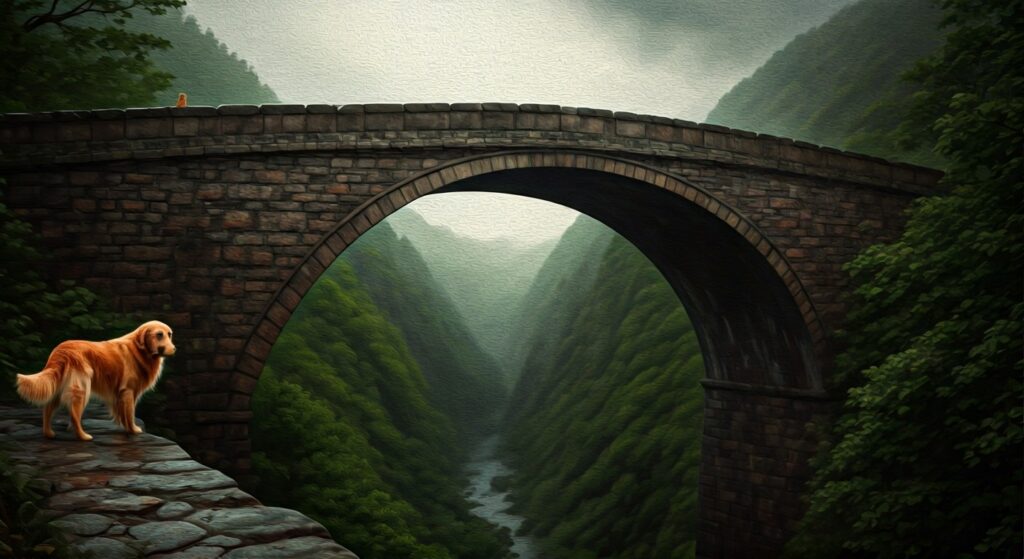
Near Dumbarton, Scotland, an elegant Victorian bridge arches gracefully over a deep, rocky gorge. To the human eye, Overtoun Bridge is a picturesque marvel of 19th-century engineering. But to the locals, it is a place of inexplicable horror. Since the 1950s, this stone crossing has harbored a dark and deadly secret: dogs that walk across it have a terrifying tendency to leap into the abyss.
Forget the dusty treaties and dry politics of the past. This is a story where Victorian masonry, local ecology, and canine biology intersect to create a deadly, invisible illusion.
The Geometry of a Nightmare
Built with heavy stone and classic 19th-century elegance, Overtoun Bridge is a Category B-listed structure. Yet, its architectural beauty is entirely overshadowed by its macabre reputation. For decades, dogs crossing this bridge have suddenly, without warning or provocation, leapt over the stone parapets.
We aren’t talking about a clumsy slip. We are talking about a deliberate, unhesitating vault into the void. An estimated 50 to 60 dogs have leapt to their deaths here, plummeting 50 feet into the rocky chasm below. Hundreds more have reportedly jumped and miraculously survived the fall.
If the sheer volume of incidents isn’t strange enough, the phenomenon is marked by a set of eerie, almost impossible commonalities. The victims are almost exclusively long-snouted breeds—think Collies, Retrievers, and Spaniels. The jumps predominantly occur on clear, dry days. And most chilling of all? The dogs almost always jump from the exact same spot: between the final two parapets on the right side of the bridge.
A “Thin Place” Pierced by Tragedy
When logic fails, human nature instinctively reaches for the supernatural. And at Overtoun Bridge, logic had seemingly packed up and left.
In Celtic mythology, the Overtoun estate is known as a “thin place”—a geographic anomaly where the veil between the physical world and the spiritual realm is terrifyingly porous. Local ghost lore leans heavily on the “White Lady of Overtoun,” the grieving spirit of Lady Overtoun who reportedly wandered the estate for decades after her husband died in 1908. Many locals believed her phantom was somehow luring the animals over the edge.
But the bridge’s sinister reputation was cemented in real, undeniable horror in 1994. In a tragic and deeply disturbing event, a local man named Kevin Moy threw his two-week-old son off the bridge to his death, claiming the child was the anti-Christ, before attempting to jump himself. For the locals, this horrific act proved that a lingering, malevolent energy infected the stone and soil of Overtoun—an energy that sensitive animals could detect.
The Science of an Invisible Funnel
Baffled by the sheer volume of incidents, scientists and animal behaviorists finally stepped in to investigate. Leading the charge was canine behaviorist Dr. David Sands.
First, Dr. Sands had to address the elephant in the room: can a dog actually commit suicide? The scientific consensus is a hard no. Dogs simply lack the cognitive ability to conceptualize self-destruction. So, if they weren’t trying to end their lives, what on earth was pulling them over the edge?
Other researchers initially looked into acoustic anomalies. Was the bridge emitting a high-frequency hum? Were nearby telephone pylons driving the dogs mad? Acoustic experts swept the area with specialized equipment, but they found absolutely no unusual frequencies.
Dr. Sands, however, realized that Overtoun Bridge was essentially a perfectly engineered sensory trap.
It starts with the Victorian architecture. The bridge features solid, 18-inch thick stone parapets. To a human, it’s a waist-high wall. But to a dog, it completely blocks their line of sight. They cannot see the 50-foot drop. To them, the stone wall simply looks like a barrier separating them from a continuation of the grassy path.
But why jump at all?
The Deadly Scent
The answer wasn’t ghosts. It was biology, local ecology, and a cruel trick of aerodynamics.
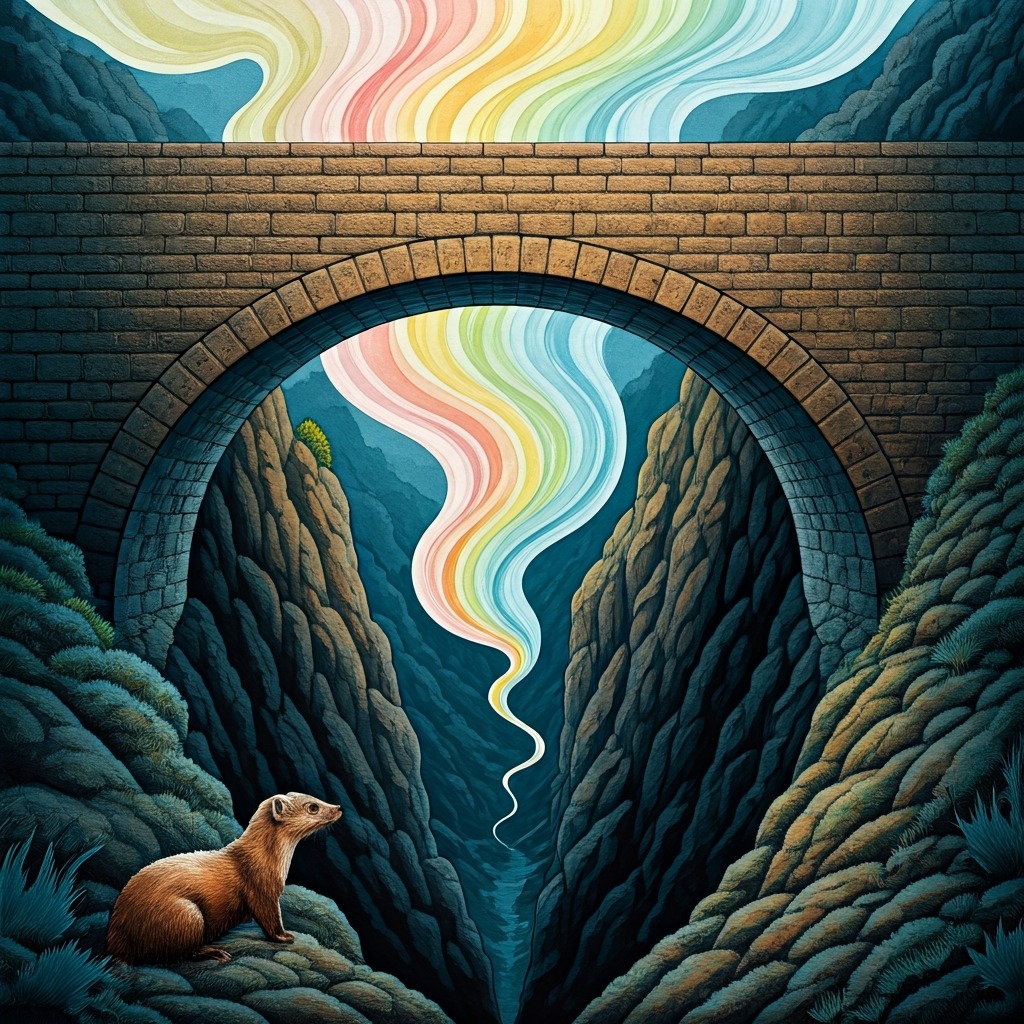
Sands discovered that the gorge beneath the bridge is heavily populated by mink, pine martens, and mice. Mink, in particular, emit a highly pungent, musky odor from their anal glands.
Because the gorge is steep and tightly enclosed, it acts as a natural chimney—an olfactory funnel. Remember how the jumps almost always happen on clear, dry days? That’s because, on those rare days when Scottish rain isn’t washing everything away, the intense, musky scent of the mink rises directly up the sides of the gorge, cresting perfectly at the level of the bridge’s parapets.
Now, combine this with the victims: long-snouted dogs. These breeds were genetically engineered by humans to have an incredibly acute sense of smell and a hair-trigger tracking instinct.
Picture it from the dog’s perspective. They are trotting along a stone bridge. Suddenly, a massive, overwhelming hit of prey scent blasts them in the face from just over the wall. Driven by pure, unadulterated hunting instinct, they don’t think. They just react. Expecting to vault over the wall and land softly on a grassy bank to catch a mink, they instead find themselves in mid-air.
Overtoun Bridge remains one of history’s most fascinating oddities. It is a mind-bending intersection where 19th-century masonry, local wildlife, weather patterns, and canine biology all perfectly aligned to create a deadly, invisible illusion. No ghosts required—just a tragic reminder of how beautifully, and sometimes terribly, the mechanics of the natural world operate.