
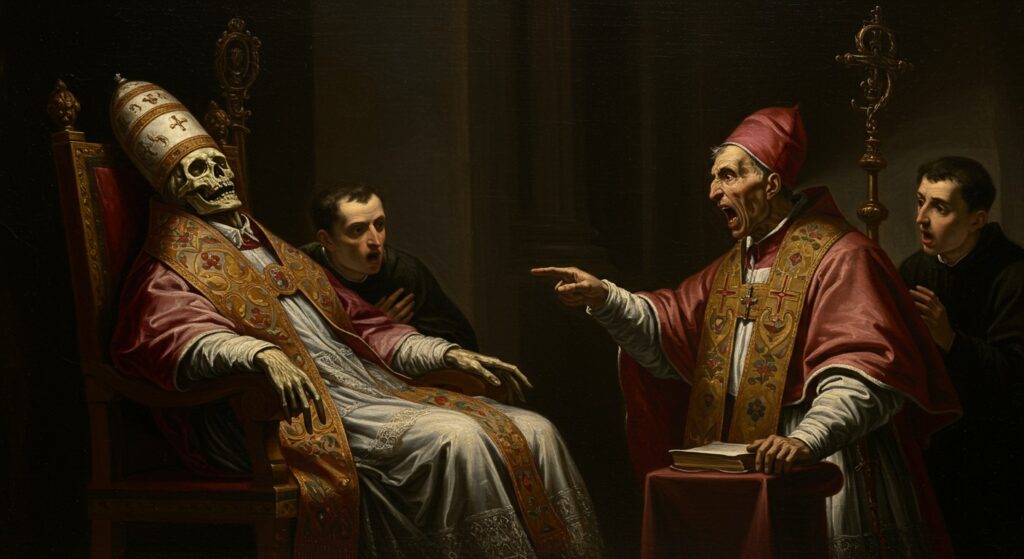
The stench of incense and rot filled the basilica. On a throne sat the accused, draped in the magnificent silk of a Roman Pontiff, the sacred tiara resting on his head. Before him, the prosecutor paced, his voice a shriek that echoed off the vaulted ceilings, hurling accusations of ambition, perjury, and illegal usurpation. But the defendant offered no reply. He did not move. He did not breathe. The man on trial was Pope Formosus, and he had been dead for seven months.
This was not an act of madness. This was the Synodus Horrenda—the Cadaver Synod—a spectacle of political terror so grotesque it has haunted the Vatican for over a thousand years. Welcome to January 897 AD, and one of the most bizarre trials in human history.
A Game of Thrones and Corpses
To understand this macabre theater, one must first understand the world that birthed it. The 9th century was the Saeculum Obscurum, the “Dark Century.” With Charlemagne’s empire shattered, Italy was a bloody chessboard of warring aristocrats. The papacy was the ultimate prize, and popes were not holy men but warlords, puppets installed and assassinated at the whim of powerful families.
Formosus had been a master player in this deadly game. Forced to crown a local strongman, Lambert of Spoleto, as Holy Roman Emperor, Formosus secretly plotted against him. He invited a rival king, Arnulf of Carinthia, to invade Italy and promptly crowned him emperor instead. It was a brilliant, treacherous move. But before the political storm could break, Formosus died of a stroke.
The Spoletan faction, robbed of their imperial legitimacy, seethed with fury. They needed to not just defeat Formosus, but to erase him. They installed their own man, Stephen VI, on the papal throne, and his first order of business was an act of unprecedented vengeance: dig up his predecessor.
The Devil’s Advocate
The decaying corpse was propped onto a throne in the Basilica of St. John Lateran. Since every defendant requires legal counsel, a terrified 18-year-old deacon was appointed to the task. He stood trembling behind the rotting body, forced to whisper answers on its behalf as Pope Stephen VI screamed his indictments.
“When you were bishop of Porto,” Stephen raged, “why did you usurp the universal Roman See in such a spirit of ambition?”
The young deacon, his voice barely audible, was forced to stammer a confession for the dead man. The trial was a sham, a piece of horrifying political stagecraft designed for one outcome.
The Logic of Desecration
Historians have often dismissed Stephen VI as a raving lunatic, a man driven mad by hatred. But this was not insanity. It was a cold, calculated, and legally ruthless maneuver. In the medieval world, oaths and ordinations were sacred, binding contracts. The Spoletans needed Formosus’s papacy declared illegitimate. If he was never a valid pope, then his crowning of their enemy, Arnulf, was legally void.
But Stephen VI had his own skin in the game. Canon law forbade a bishop from transferring from one diocese to another—a rule Formosus himself had broken. The problem? Stephen had been made a bishop by Formosus. By finding the corpse guilty and annulling all of its acts, Stephen cleverly invalidated his own prior appointment, technically making his ascension to the papacy legal. It was a brutal, medieval loophole, exploited through the desecration of a corpse.
Judgment and Damnation
Unsurprisingly, Formosus was found guilty. The punishment was swift and savage. An executioner stepped forward and hacked off the three fingers of the corpse’s right hand—the very fingers used to give blessings and consecrate the Eucharist. The body was then stripped of its sacred vestments, dressed in the rags of a commoner, and dragged through the streets of Rome.
It was first thrown into a grave for foreigners, but even that was not enough. The vengeful Stephen had it dug up again and hurled into the murky waters of the Tiber River. His memory, his legacy, and his body were to be utterly annihilated.
The Earth Trembles
Stephen VI had made a fatal miscalculation. He had forgotten the profound superstition of the Roman people. Shortly after the trial, a violent earthquake shook the city, causing the roof of the basilica to collapse. To the terrified populace, it was a sign from a furious God.
The political tide turned in an instant. A mob, inflamed with righteous anger, stormed the papal palace, seized Stephen VI, and threw him into a dungeon. In August 897, just months after his ghoulish spectacle, he was strangled to death in his cell.
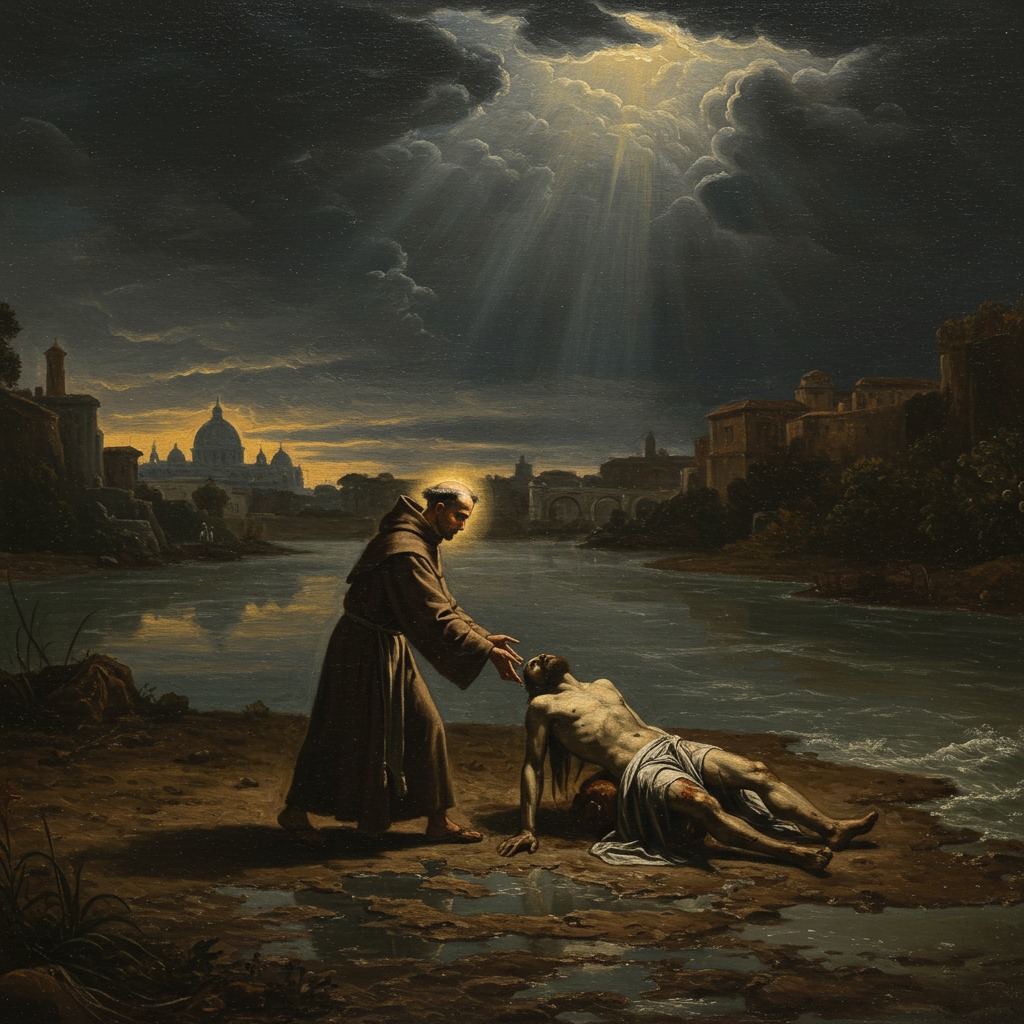
The story ends with a whisper of the miraculous. Legend claims a monk, guided by a vision, found Formosus’s battered corpse washed up on the banks of the Tiber. When the body was finally returned to St. Peter’s Basilica for a proper reburial, it was said that the statues of the saints lining the nave bowed their heads in reverence as the dead pope passed by. In the brutal calculus of power, not even the grave could offer a final sanctuary, but in the end, it was the desecrated corpse that had the last word.
Dig Deeper
- CATHOLIC ENCYCLOPEDIA: Pope Formosus — An excerpt from the Catholic Encyclopedia detailing the early life, political missions, and pontificate of Pope Formosus, the central figure of the Cadaver Synod.
- The Cadaver Synod: Putting a Dead Pope on Trial – JSTOR Daily — An article from JSTOR Daily detailing the historical events of the Cadaver Synod in 897, where Pope Stephen VI put the exhumed corpse of his predecessor, Pope Formosus, on trial.