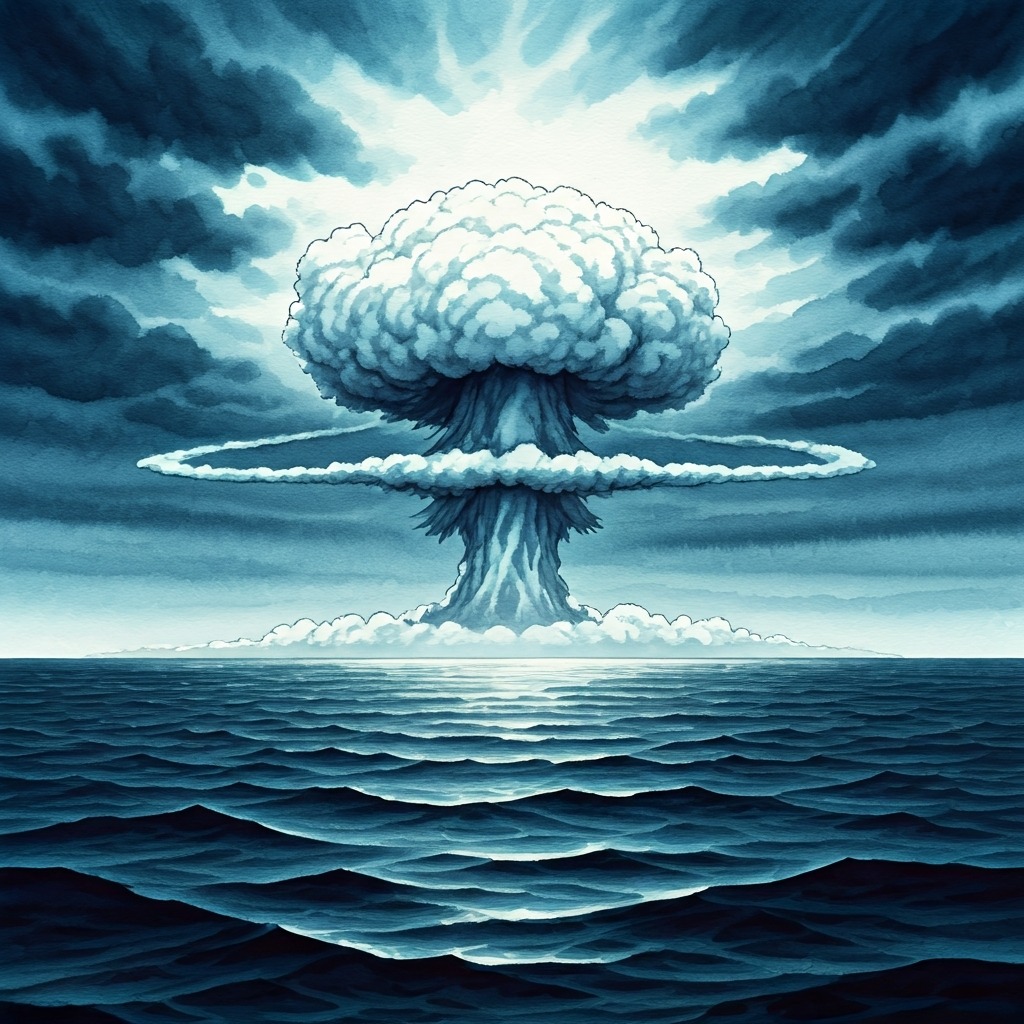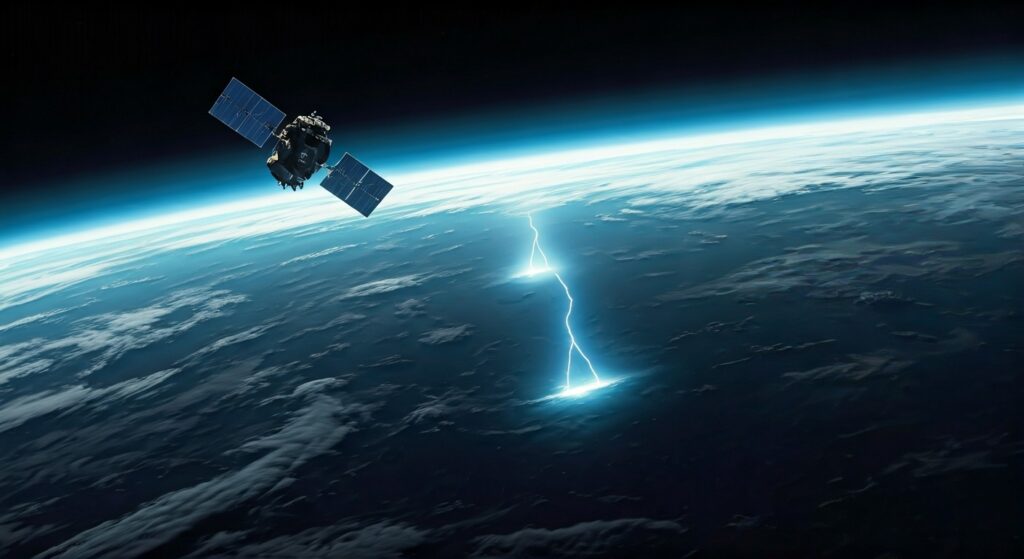
On September 22, 1979, at exactly 00:53 GMT, the freezing, desolate waters of the southern Indian Ocean were illuminated by a terrifying anomaly. High above the Earth, an aging American Vela Hotel satellite, designated 6911, was silently keeping watch. Suddenly, its optical sensors—known as ‘bhangmeters’—registered a distinct, unmistakable signature: a double flash of light.
To a layman, a flash in the middle of nowhere means nothing. To the global intelligence community, it was a blaring red siren. In the realm of nuclear physics, a double flash is the indisputable fingerprint of an atmospheric nuclear explosion.
The mechanics are chillingly precise: the first flash is the initial, blindingly intense fireball. The light briefly dims as the shockwave expands, compressing the surrounding air into an opaque envelope. A fraction of a second later, the light brightens again as the shockwave dissipates and the fireball expands. The Vela satellites were put in orbit for one specific reason: to police the 1963 Partial Test Ban Treaty by hunting for exactly this signature.
Someone, somewhere, had just detonated a nuclear bomb.
The Geopolitical Nightmare
The detection immediately triggered a high-level crisis within President Jimmy Carter’s administration. Carter had built his foreign policy on an aggressive non-proliferation agenda. If a nuclear test had just occurred, it meant a rogue nation had secretly joined the world’s deadliest club.
The suspect list was incredibly short, and the primary targets of suspicion were a diplomatic nightmare: apartheid-era South Africa and Israel.
Both nations were politically isolated, both possessed highly secretive nuclear programs, and both shared a robust, clandestine military partnership. But confirming a joint Israeli-South African nuclear test was Carter’s worst-case scenario. He had just brokered the fragile Camp David Accords between Israel and Egypt, and he was aggressively pushing for the SALT II treaty with the Soviets. Pointing the finger at Israel and South Africa would demand devastating international sanctions, potentially torpedoing Carter’s greatest diplomatic achievements overnight.
Anatomy of a Cover-Up
Faced with a diplomatic catastrophe, the Carter administration did what governments do best when cornered: they formed a committee. They convened a panel of outside scientific experts, chaired by MIT’s Jack Ruina, which became known as the Ruina Panel.
After months of deliberation, the panel released a report that essentially told the world to look the other way.
They concluded that the double flash was likely a “zoo event”—scientific shorthand for a bizarre false positive. Their official theory? A tiny micrometeoroid had struck the satellite, ejecting a piece of debris that perfectly reflected sunlight into the sensors, mimicking a nuclear blast. They argued that the satellite was two years past its design life, its electromagnetic pulse (EMP) sensors hadn’t recorded a pulse, and US Air Force WC-135 ‘sniffer’ planes failed to find conclusive radioactive fallout in the atmosphere.
The administration declared the case closed. The intelligence community, however, knew better.
The Ocean Doesn’t Lie
The broader US intelligence and scientific apparatus—including the CIA, the Defense Intelligence Agency (DIA), and the scientists at Los Alamos National Laboratory—completely rejected the Ruina Panel’s findings. They were convinced it was a nuclear test, and they had the data to prove it.
The most compelling piece of evidence came from the US Naval Research Laboratory (NRL). Analysts examining hydroacoustic data from the Navy’s SOSUS underwater listening network found a powerful acoustic signal originating near the Prince Edward Islands. The sound waves had bounced off the Antarctic ice shelf and perfectly matched the profile of a low-yield, two-to-three kiloton nuclear blast near the ocean’s surface.
The anomalies didn’t stop there. Researchers at the Arecibo Observatory in Puerto Rico detected a “traveling ionospheric disturbance” at the exact time expected if a blast had occurred in the South Atlantic or Indian Ocean.
Then came the most damning, undeniable clue: months later, reports emerged of low-level radioactive iodine-131 detected in the thyroids of sheep in parts of Australia—right in the path of the projected wind currents from the blast site. The Ruina Panel dismissed the radioactive sheep as “inconclusive,” but to nuclear forensic experts, it was the smoking gun.
The Ghost of a Mushroom Cloud
Decades later, the Vela Incident remains officially unresolved, a ghost story of the Cold War. However, the historical consensus heavily favors the theory of a clandestine nuclear test. Declassified documents, diaries, and leaks from former officials—including CIA Director Stansfield Turner—strongly suggest it was indeed a joint Israeli-South African test of a tactical nuclear weapon.
Today, historians view the Ruina Panel as a masterclass in plausible deniability. It gave the Carter administration exactly what it needed: just enough scientific doubt to avoid a geopolitical meltdown.
The Vela Incident stands as a fascinating, terrifying intersection of Cold War paranoia, nuclear forensics, and state secrecy. It is a chilling reminder that sometimes the most earth-shattering secrets aren’t hidden in locked vaults—they are hidden in plain sight, disguised as a trick of the light in the middle of a dark, lonely ocean.