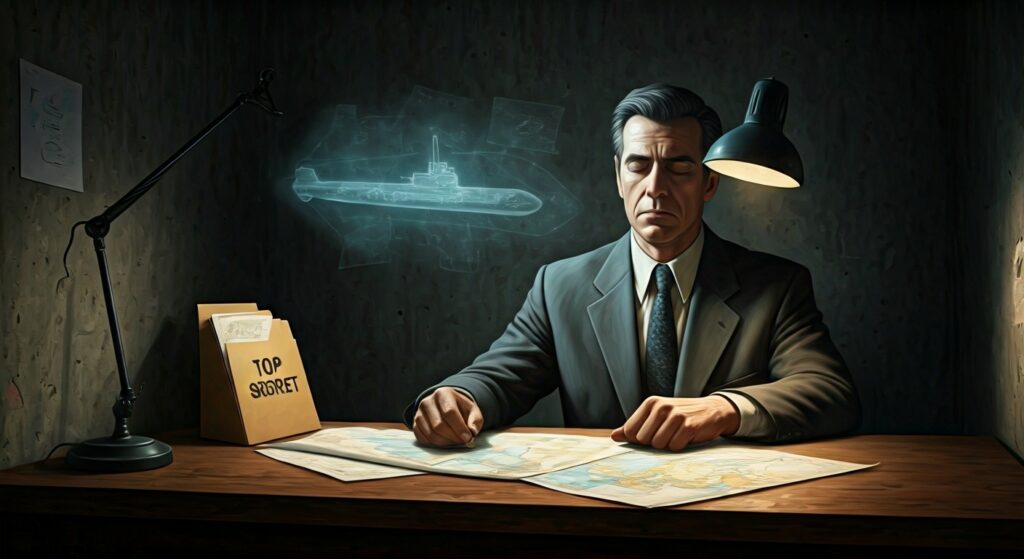
The Cold War was fought with nuclear stockpiles, double agents, and dead drops. But deep within the classified archives of the U.S. government lies a chapter so bizarre it reads like science fiction. For nearly two decades, the CIA and the Defense Intelligence Agency (DIA) funded a top-secret initiative with a singular, mind-bending goal: weaponizing clairvoyance.
Welcome to Operation Stargate.
The Terrifying “Psychic Gap”
In the late 1970s, global tension was a suffocating blanket. American intelligence agencies intercepted terrifying reports: the Soviet Union was pouring massive resources into “psychotronics” and parapsychology. Terrified of falling behind in a literal mind-control arms race, the U.S. military apparatus decided it had to close the “psychic gap.”
The CIA and DIA partnered with the Stanford Research Institute (SRI) in California, enlisting physicists Harold Puthoff and Russell Targ. Their mission was to scientifically investigate—and ultimately harness—extrasensory perception (ESP). The holy grail of this initiative was remote viewing—the purported ability to mentally perceive and describe details about a distant, unseen target, defying all known boundaries of time and space.
Operating under a string of cinematic cryptonyms like GONDOLA WISH, GRILL FLAME, CENTER LANE, and SUN STREAK, this highly classified federal initiative operated in the shadows from 1978 to 1995.
Remote Viewer No. 1 Enters the Matrix
Headquartered at Fort Meade, Maryland, the unit was incredibly small, consisting of a select cadre of military personnel and civilians who had demonstrated anomalous psychic abilities.
The protocol was rigorous and surreal. An operative would be led into a completely isolated, windowless room. They were given absolutely no context—just a set of geographic coordinates or a sealed envelope containing a target’s name. From there, they were expected to project their consciousness across the globe and sketch what they saw.
The roster of operatives was as eclectic as the mission itself. There was Ingo Swann, a visionary artist who helped coin the term “remote viewing” and developed its strict protocols; Pat Price, a former police commissioner; and Joseph McMoneagle, a decorated Army warrant officer who would become famously known as Remote Viewer No. 1.
For years, these men sat in quiet rooms in Maryland, allegedly spying on the world’s most guarded secrets using nothing but their minds.
Spying with the Mind’s Eye
If this were merely a quirky government experiment that produced nothing, it would have been shuttered in months. But Stargate operatives were tasked with hundreds of high-stakes intelligence-gathering missions, and proponents of the program point to a series of chilling, inexplicable successes.
In one heart-pounding instance, a Soviet Tu-22 bomber went down in the dense African jungle. Both American and Soviet forces scrambled to find the wreckage. According to program advocates, remote viewers pinpointed the exact location of the downed bomber before Soviet recovery teams could even get close.
In another jaw-dropping session, a viewer mentally traveled to the Severodvinsk shipyard in the Soviet Union. He accurately sketched a massive, highly classified Soviet submarine under construction, detailing its unique twin-hull design months before satellite imagery could confirm its existence.
The government relied on these psychic spies during some of the era’s most desperate hours. They were deployed during the Iran hostage crisis, utilized during the kidnapping of CIA station chief William Buckley in Lebanon, and even tasked with tracking the elusive movements of Libyan leader Muammar Gaddafi.
The 1995 Reality Check
By 1995, the geopolitical landscape had shifted. The Cold War was over, and the CIA wanted a strict audit of their psychic spy ring. They commissioned the American Institutes for Research (AIR) to conduct an independent evaluation, bringing in two heavy hitters: Ray Hyman, a skeptical psychologist, and Jessica Utts, a statistician.
Here, the narrative fractures. Hyman concluded that the program failed to produce actionable intelligence. He argued that the remote viewing data was notoriously vague, required too much subjective interpretation by analysts, and that any “hits” were retroactively fitted to match the facts—a classic case of confirmation bias.
But Utts threw a wrench into the skeptic’s narrative. She argued that the statistical results of the remote viewing trials were significantly above chance. According to her data, a genuine anomaly existed that simply could not be explained away by coincidence or experimental error. Something was happening in those isolated rooms at Fort Meade.
The $20 Million Question
Ultimately, the AIR report led to the program’s declassification and unceremonious cancellation.
Today, Operation Stargate remains one of the most captivating unsolved mysteries at the intersection of human potential and government secrecy. Skeptics look at the $20 million budget and see a monumental waste of taxpayer money, fueled by Cold War desperation and pseudoscience.
But former Stargate viewers and believers hold a different truth. They argue the program was highly successful, but was ultimately buried due to the stigma surrounding the paranormal and an intelligence community terrified of relying on phenomena they couldn’t physically explain or control.
Was it all just a desperate shot in the dark, or did a handful of operatives actually figure out how to project their minds across the globe? The declassified files are out there, waiting for you to decide.