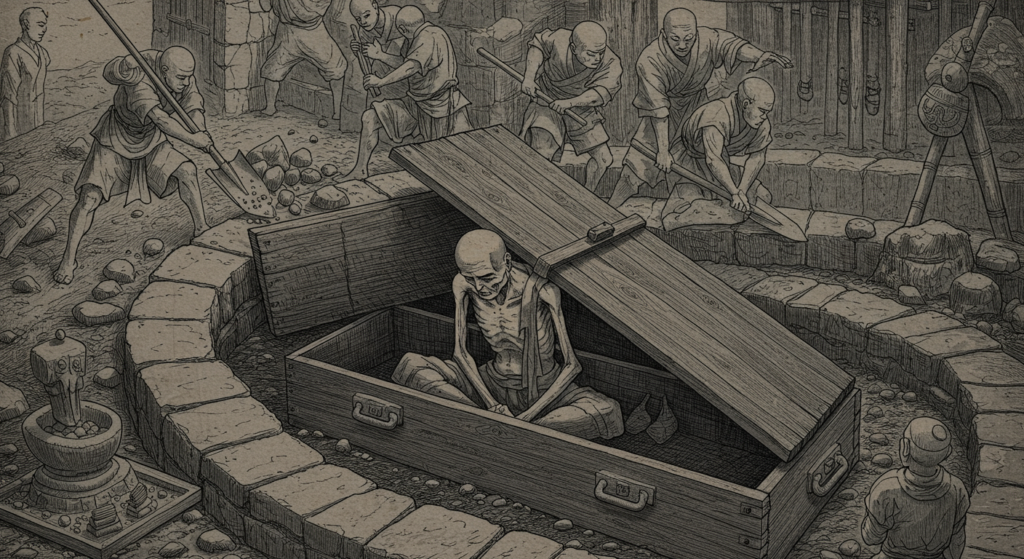
A man climbs into a pine box, barely large enough for him to sit cross-legged. The lid is hammered shut, plunging him into absolute darkness. Lowered into a stone pit three meters deep, he can hear the shovels of his disciples throwing earth and rock over him, the sound growing duller and more distant with each passing second. He is buried alive.
He is not being punished. He is not a victim. He has chosen this. In his skeletal hand, he holds a small bell. In his tomb, a bamboo tube snakes through the packed earth to the surface, a fragile straw for oxygen. Once a day, he will ring the bell, a faint, lonely signal to the world above that he still meditates in the cold, silent dark. One day, the bell will stop ringing. And his journey will truly begin.
This is not a story of suicide. This is the story of Sokushinbutsu—the almost unbelievable quest of Japan’s “Living Buddhas” to achieve enlightenment through self-mummification.
The Poison Path to Immortality
To transform a living body into an incorruptible vessel for the soul is a triumph of will over biology. The process was a grueling, 3,000-day ordeal designed to systematically strip the body of the very things that make it live, and later, make it decay. It was a slow, agonizing march toward a state between life and death.
The first 1,000 days were spent on a diet known as mokujiki, or “tree-eating.” The monk would cease consuming all grains and subsist only on what could be foraged from the freezing mountain forests: nuts, berries, roots, and pine needles. This, combined with relentless physical hardship, was designed to burn away every last ounce of body fat.
Then, for the next 1,000 days, the process turned toxic. The diet was restricted further, to little more than bark and roots. Crucially, the monk began to drink a special tea brewed from the sap of the urushi tree—the Chinese lacquer tree. The sap contains urushiol, the same highly toxic compound found in poison ivy. Drinking it induced violent vomiting and rapid fluid loss, dehydrating the body from the inside out. But it served a second, macabre purpose: the poison permeated the monk’s organs, rendering his flesh toxic to the maggots and bacteria that would feast on his corpse.
A Bell Tolls Beneath the Earth
After years of self-inflicted agony, the final stage began. Emaciated, poisoned, and barely alive, the monk was sealed in his underground tomb. His only connection to the world was the bamboo air tube and the bell in his hand. Above ground, his followers listened. For days, perhaps weeks, the faint ring would sound, a testament to the master’s enduring meditation. Then, silence.
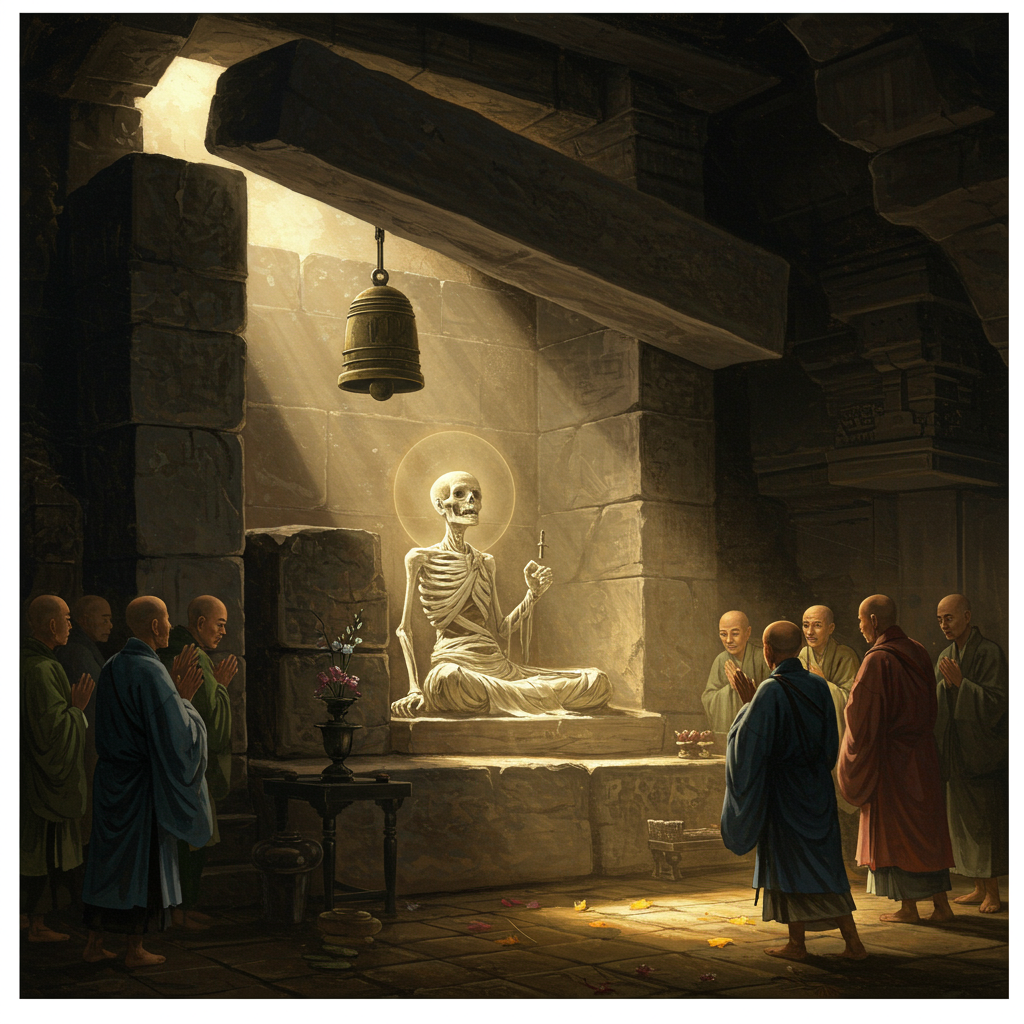
The air tube was removed. The tomb was sealed completely. For another 1,000 days, the body was left to its fate in the dark earth. At the end of this period, the tomb was opened. If the body had decayed, the monk was reburied with honor, his efforts praised. But if he was found incorrupt, perfectly preserved in his meditative pose, he had succeeded. He was declared a Sokushinbutsu, a Living Buddha. Dressed in fine robes, he was placed in a temple to be worshipped, his suffering believed to absolve the sins of mankind.
From Killer to Living God
Not all who attempted this journey were born saints. The story of Tetsumonkai is one of violent redemption. In his youth, he was a samurai who killed a man and fled into the mountains to escape justice. He became a monk at Churenji Temple, dedicating his life to asceticism with terrifying intensity. During an epidemic in Edo, he famously gouged out his own eye as an offering to end the plague. In 1829, the fugitive killer successfully completed the ritual, transforming himself into a revered living god.
At Dainichibo Temple, the monk Shinnyokai sits in eternal meditation, having entered his tomb in 1783 at the age of 96. His preservation is so remarkable that every six years, his disciples change his silk robes. The old garments are snipped into tiny pieces and sold to worshippers as powerful amulets of protection.
An Outlawed Salvation
The era of the Living Buddhas came to an abrupt end. In 1877, the Meiji government, in a fervent push to modernize Japan, outlawed the practice. The sacred act of entering nyūjō—the state of suspended meditation—was legally redefined as assisted suicide. Any disciple who sealed his master in a tomb would now be charged with murder.
The bells beneath the earth fell silent for good. But in the quiet mountain temples of Yamagata Prefecture, more than a dozen of these figures remain. They are a haunting, enduring testament to the terrifying and beautiful extremes of human faith—a belief so powerful that men would drink poison and embrace the darkness of the grave, not to die, but to live forever.