The Great Pyramid of Giza stands as the absolute pinnacle of ancient engineering, a monument that has staggered humanity for millennia. But what if it wasn’t the biggest thing they built? What if, hidden deep in the tropical forests of West Africa, a sprawling architectural marvel once existed that consumed nearly sixty times more material?
It was a structure so vast it was once recognized as the world’s largest earthwork of the pre-mechanical era. Yet today, it is a ghost. This is the story of the Walls of Benin—a lost metropolis, a mathematical masterpiece, and the victim of one of the most tragic cultural erasures in history.
A 10,000-Mile Ghost Labyrinth
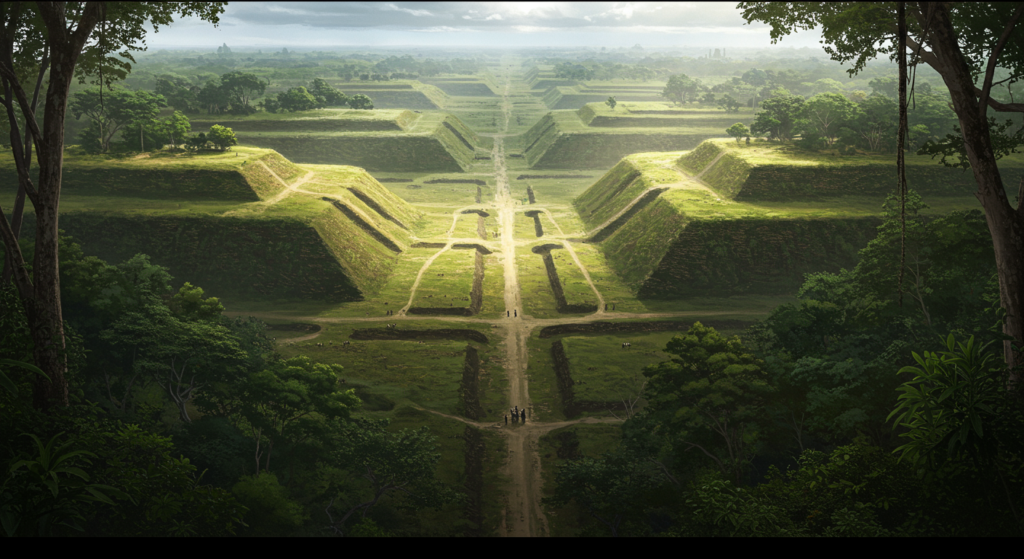
Forget everything you know about walls. This was not a single stone barrier. The Walls of Benin, known locally as Iya, were an incomprehensible, honeycomb-like network of earthworks. At its heart, a 15-kilometer wall wrapped protectively around the capital of the Edo Kingdom, Benin City. But from that center radiated a labyrinth of interconnected banks and ditches that snaked across the landscape for an estimated 16,000 kilometers—or 10,000 miles.
To put that in perspective, the entire Great Wall of China is roughly half that length. The builders of Benin moved over 150 million cubic meters of earth with their bare hands, creating a sprawling, fortified kingdom that was, for centuries, one of the wonders of the world.
The City Designed by Fractals
How do you build a 10,000-mile network without modern surveying equipment? With generations of organized labor and a level of engineering genius that is difficult to fathom. Starting around 800 CE, Edo engineers perfected a brilliant ditch-and-bank method. Laborers carved deep trenches into the red earth, piling the soil to create towering ramparts. In some places, the drop from the top of the bank to the bottom of the ditch was a terrifying 20 meters (66 feet).
But the true marvel lay in the city’s design. Centuries before European cities had basic sanitation, Benin City boasted wide, perfectly straight avenues, street lighting from palm oil lamps, and a sophisticated drainage system to handle torrential monsoon rains. The most mind-bending discovery? The city was laid out using perfect fractal geometry. Ethnomathematicians have shown how the city’s clusters of compounds were designed as perfect, repeating patterns, where smaller structures mathematically mirrored the layout of larger ones. It was a city built as a living equation.
“Larger Than Lisbon, Cleaner Than Amsterdam”
When the first European explorers stumbled out of the jungle and into Benin City in the 15th century, they were dumbfounded. The sophistication of the Edo Kingdom shattered their worldview. In 1691, the Portuguese captain Lourenço Pinto wrote in awe: “Great Benin, where the king resides, is larger than Lisbon… The houses in this city stand in good order… like good streets.”
Decades earlier, Dutch accounts compiled by Olfert Dapper compared Benin City favorably to Amsterdam, marveling at its grand palace, monumental gates, and immaculate streets. For a time, Great Benin was known as a peerless jewel of urban design. So how does a metropolis larger than Lisbon simply vanish from the map?
The Fires of 1897
The answer lies in the brutal logic of colonialism. As European powers began the “Scramble for Africa,” the glowing accounts of African grandeur were deliberately buried. To justify conquest, Africa had to be painted as a “dark continent” in need of salvation.
Tensions boiled over in 1897 when a British delegation, ignoring warnings from the Oba (King), tried to enter the city during a sacred festival and were ambushed and killed. The British Empire’s retaliation was swift, disproportionate, and absolute.
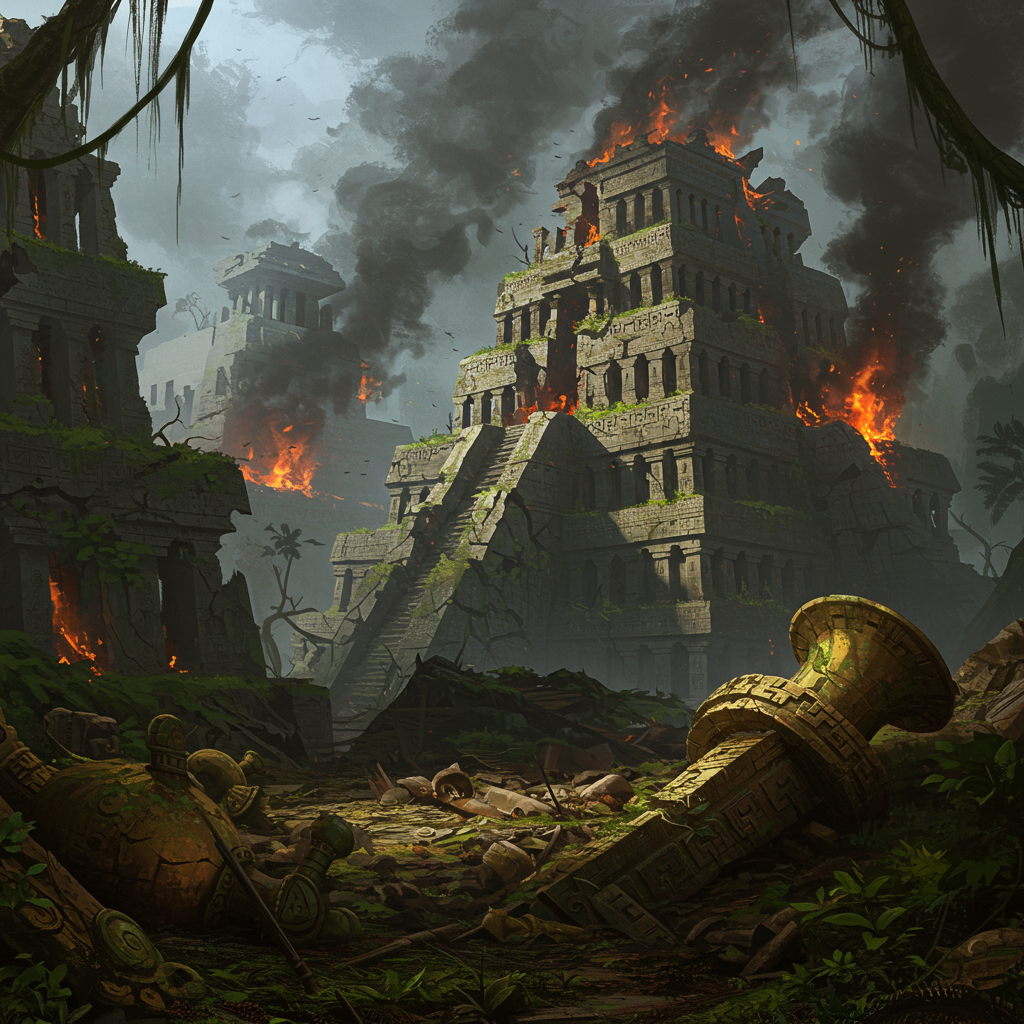
A heavily armed force of 1,200 soldiers was dispatched on a “Punitive Expedition.” They did not just conquer Benin City; they systematically erased it. They torched the fractal-designed avenues and magnificent palaces, burning the city to the ground. In the ashes, they looted thousands of the world-famous “Benin Bronzes”—exquisite sculptures that proved the Edo’s mastery of metallurgy. The art was shipped to Western museums; the great walls were left to be swallowed by the jungle.
An Empire Reclaimed from the Jungle
Today, the Walls of Benin are a faint echo. What wasn’t reclaimed by the forest has been eroded by modern urban sprawl. Yet, the story refuses to stay buried. Thanks to the tireless work of archaeologists like the late Patrick Darling, who spent years hacking through the undergrowth to survey the ruins, the true scale of this lost empire has been brought back to light.
The Walls of Benin are a haunting testament to a pre-colonial African genius that history tried to erase. They force us to look past the colonial myths and recognize a civilization that moved mountains, mastered fractals, and built a metropolis that once left the world breathless.
Dig Deeper
Explore the history, art, and science behind this lost African metropolis with these expert resources.
-
TED Talk: Ron Eglash on African Fractals
Dive into the mind-bending mathematics behind Benin City’s layout. In this classic talk, ethnomathematician Ron Eglash demonstrates how fractal geometry was intentionally used not only in the city’s design but across African art, architecture, and even hairstyling. -
World Monuments Fund: Benin City Earthworks
What remains of the great walls today? This project page from the World Monuments Fund details the current conservation status of the earthworks, outlining the threats they face from modern urban sprawl and the efforts being made to preserve their legacy. -
The Guardian: “The story of cities, part 5: Benin City”
For a comprehensive historical overview, this article provides a rich narrative of the city’s rise, its awe-inspiring descriptions by early European visitors like Olfert Dapper, and a more detailed account of its tragic destruction during the 1897 Punitive Expedition. -
UNESCO: Benin Iya / Earthworks
Read the official submission that places the Walls of Benin on the Tentative List for World Heritage status. This document from UNESCO provides a technical and historical summary of the site’s immense scale and “Outstanding Universal Value.”