We sit in the glow of our pocket-sized supercomputers, convinced we are the undisputed masters of the technological timeline. History, we assume, is a straight line of progress. But the ocean holds secrets that shatter this comfortable illusion—secrets that have kept historians and archaeologists awake at night for over a century.
Long before the world had figured out basic metallurgy, our ancestors were building literal analog computers.
Welcome to the mystery of the Antikythera Mechanism.
A Corroded Secret at the Bottom of the Sea
The story begins in 1901, entirely by accident. Greek sponge divers exploring a Roman-era shipwreck off the treacherous coast of the tiny island of Antikythera hauled up a staggering bounty of antiquities. Among the gleaming marble statues and gold coins was a crusty, calcified lump of bronze and wood. Dismissed as ancient sea-trash, it sat ignored in a museum courtyard for months.
Then, in 1902, archaeologist Valerios Stais was examining the corroded rock when he noticed something protruding from the calcification that must have made his blood run cold: a perfectly formed, mathematically precise gear wheel.
Finding a precision gear in a shipwreck from antiquity is akin to unearthing a functioning smartphone in a medieval castle. It simply shouldn’t exist.
The Clockwork of the Cosmos
Dating back to between 205 BC and 60 BC, this impossible artifact fundamentally broke our understanding of ancient engineering. For decades, researchers squinted at the calcified remains, trying to decipher its purpose.
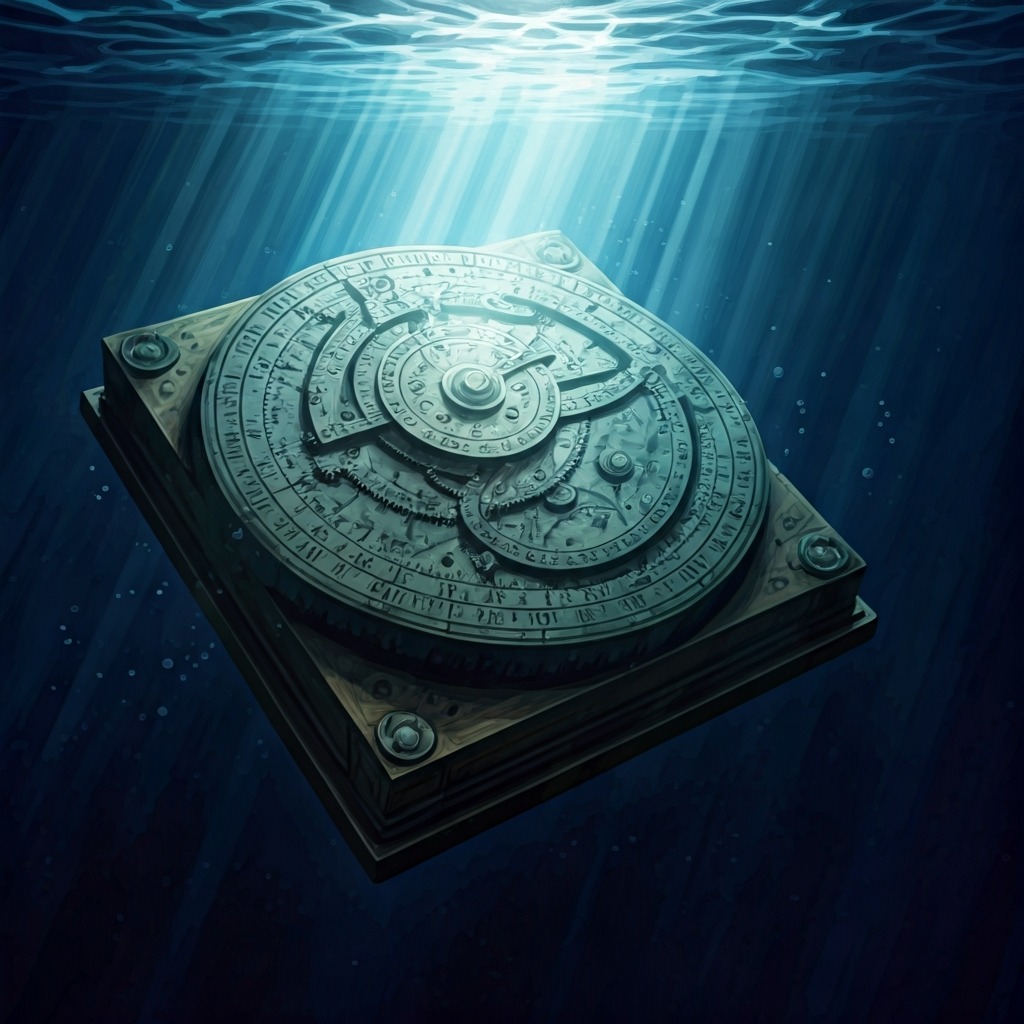
As it turns out, the Antikythera Mechanism was housed in a wooden box roughly the size of a mantel clock and operated by a hand crank. Inside lay a labyrinth of at least 30 intricately meshed bronze gears—though experts believe the original device housed many more.
Turning the crank engaged a breathtakingly complex system that calculated the precise positions of the Sun, the Moon, and the five planets known to antiquity. Its front dial displayed the Greek zodiac and the Egyptian calendar, while the back dials tracked the 19-year Metonic cycle, predicted solar and lunar eclipses, and even counted down to the Panhellenic Games.
Most terrifyingly brilliant was its ability to model the “lunar anomaly.” The ancient Greeks knew the Moon doesn’t move at a constant speed across the sky. To replicate this varying speed, the device utilized a deeply sophisticated pin-and-slot epicyclic gearing system that physically manifested the astronomical theories of Hipparchus.
The Phantom Manual Hidden in Bronze
For over a century, the true complexity of the Antikythera Mechanism remained locked away, obscured by millennia of oceanic calcification. It was the ultimate puzzle box. But in the early 21st century, researchers deployed advanced high-resolution X-ray computed tomography to peer straight through the ancient bronze.
What they found hidden inside the fragments was staggering.
Trapped within the device were thousands of microscopic text characters. It was, essentially, a user manual. The text detailed the device’s functions, its planetary cycles, and exact instructions on how to read the dials. The machine wasn’t just a physical calculator; it was a self-documented piece of high-tech engineering.
The Missing Millennium
The revelation leaves historians with a haunting question: Who built it?
Some scholars point to the school of Posidonius on the island of Rhodes, a major hub for astronomy and engineering. Others suggest a connection to Syracuse, tracing the gears back to the brilliant, chaotic legacy of Archimedes.
But the most chilling aspect of the Antikythera Mechanism isn’t its creator. It’s the fact that it is completely alone.
No other device of comparable complexity has ever been found from antiquity. It proves that ancient Greek engineers possessed a mastery of precision mechanics previously thought to have been invented during the European Renaissance, over a thousand years later.
It stands as a solitary ghost of a forgotten technological age, leaving us with one suspenseful question: If the ancient world was capable of building a mechanical computer… what else did they build that the ocean hasn’t given back to us yet?