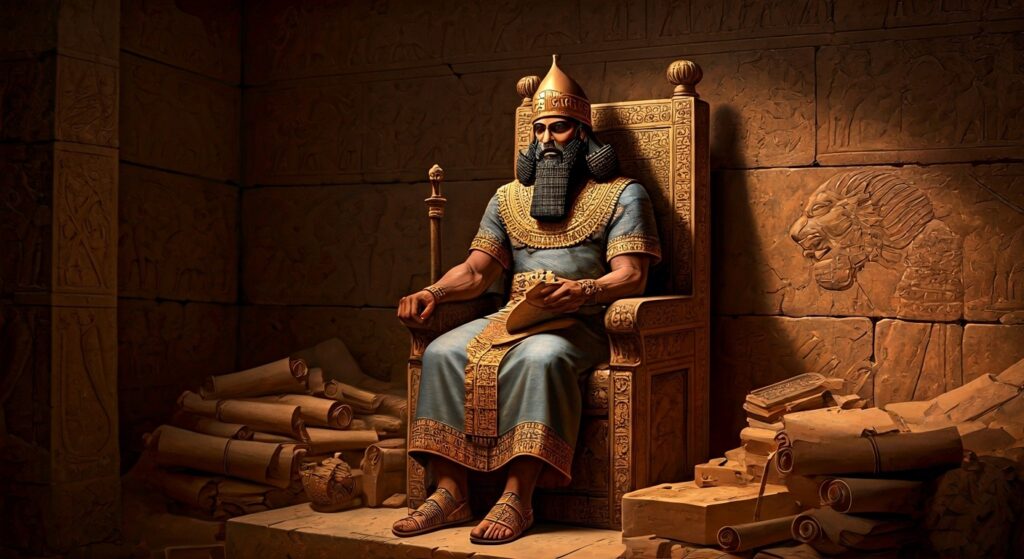
In the 7th century BC, the most terrifying man on earth had a secret obsession. King Ashurbanipal of the Neo-Assyrian Empire was a ruthless conqueror, a warlord who crushed rebellions and maintained the iron-fisted traditions of his predecessors. But beneath the armor of a brutal dictator lay the mind of a voracious scholar. He didn’t just want to conquer the physical world; he wanted to own the entirety of human knowledge.
And he was willing to kill for it.
The Scholar-King of Nineveh
Ashurbanipal ruled from the capital city of Nineveh (near modern-day Mosul, Iraq) with absolute authority. Yet, he was a walking paradox. In his royal inscriptions, he didn’t just boast of his military conquests—he bragged about his ability to read complex Sumerian and Akkadian scripts, solve advanced mathematical equations, and debate the greatest minds of his era.
To Ashurbanipal, knowledge wasn’t merely a pursuit of the mind; it was the ultimate weapon. He firmly believed that mastering the secrets of the universe was a divine right that cemented his imperial supremacy.
The Great Mesopotamian Book Heist
Ashurbanipal didn’t just want a respectable royal archive; he wanted everything. He dispatched ruthless agents across Mesopotamia, sending them deep into conquered territories—especially Babylonia—with a chilling directive: find every text of value and bring it to Nineveh.
His men scoured ancient temples, shook down scholarly families, and raided private collections to confiscate or meticulously copy their texts. The result was the Library of Ashurbanipal, widely considered the oldest surviving royal library in the world.
The scale of this collection was staggering, comprising over 30,000 clay tablets and fragments. While it contained literary and mythological masterpieces like the Enuma Elish (the Babylonian creation epic), literature was only a fraction of the hoard. The vast majority of the library was highly practical. It held the operational code of an empire: astronomical observations, medical diagnoses, early bilingual dictionaries, and omen texts used for royal divination.
Curses, Clay, and the First Librarians
The organization of this ancient archive was a marvel of early information science. Tablets were carefully stored in clay jars or on wooden shelves, categorized by subject matter. To keep track of the massive collection, scribes utilized a “colophon”—an inscription at the end of the text that functioned like a modern title page. It included the title of the work, the tablet’s sequence number, and the scribe’s name.
Most importantly, it bore a royal stamp declaring the tablet as the exclusive property of King Ashurbanipal. To ensure no one walked off with his prized texts, the colophon often included a terrifying curse, promising divine wrath and agonizing death to anyone who dared to steal from the king’s collection.
The Apocalyptic Fire That Saved History
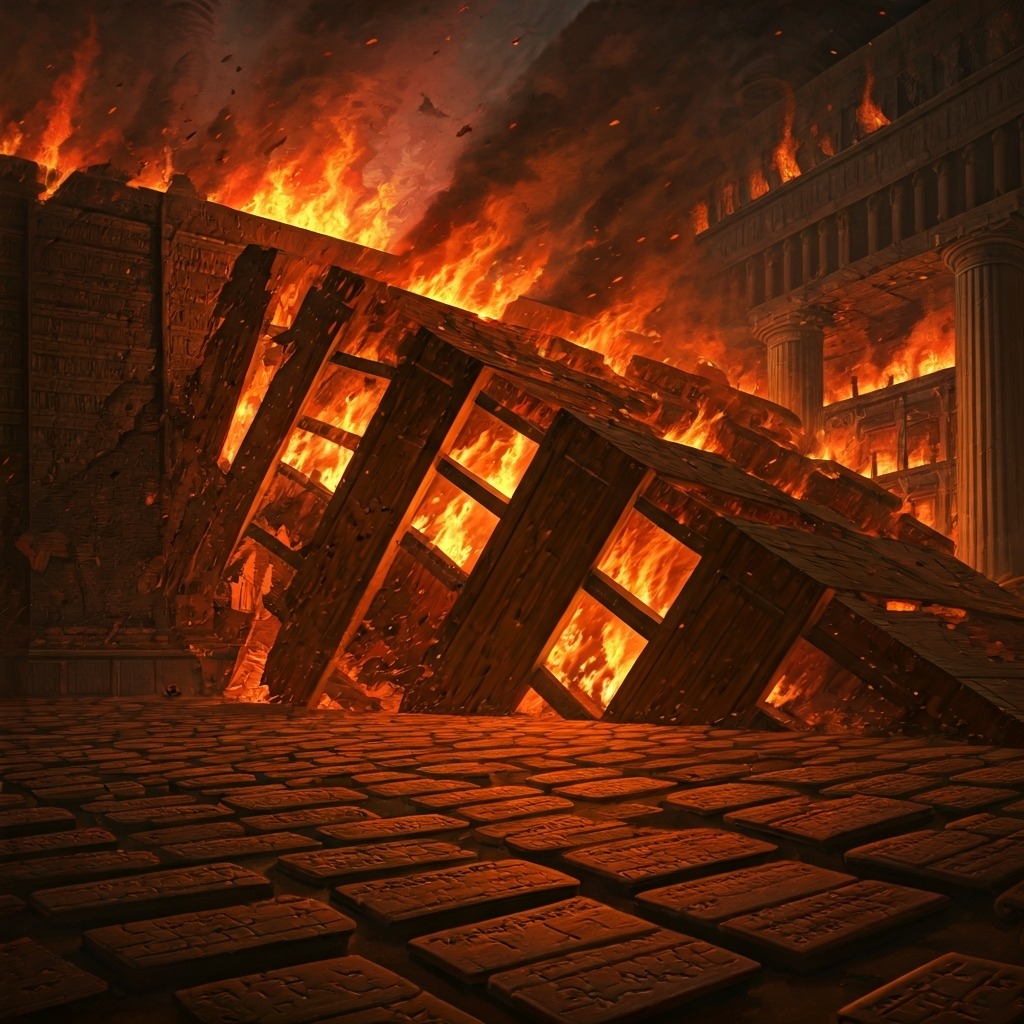
In 612 BC, a massive coalition of Babylonians, Medes, and Scythians descended upon Nineveh. They breached the walls, sacked the city, and set Ashurbanipal’s great palaces ablaze. The Neo-Assyrian Empire was violently wiped from the map.
The invaders intended the flames to erase Ashurbanipal’s legacy forever. But they unwittingly triggered one of the greatest, most beautiful ironies in human history. When you set fire to a library made of paper, it turns to ash. When you set fire to a library made of unfired clay, you bake it.
The apocalyptic heat of the burning palace acted as a colossal kiln. It hardened the clay tablets into durable ceramics, ensuring they would survive, perfectly preserved, buried beneath the ash and rubble for over two millennia. The fire that was meant to destroy Ashurbanipal’s legacy was the very thing that immortalized it.
A Shockwave Through the Victorian World
The library slept in the dark until the mid-19th century, when British archaeologist Austen Henry Layard and his brilliant Assyrian assistant, Hormuzd Rassam, began excavating the mound of Kouyunjik. They unearthed the baked tablets, shipping the vast majority to the British Museum.
But the true bombshell detonated in the 1870s. A self-taught genius named George Smith was hunched over these fragmented texts when he deciphered the standard Akkadian version of the Epic of Gilgamesh. As he translated, he realized he was reading a Mesopotamian flood narrative that predated and closely paralleled the biblical story of Noah.
The discovery sent shockwaves through the Victorian world. It fundamentally altered our understanding of biblical literature, birthed the modern academic field of Assyriology, and proved that the roots of our modern world stretch deep into the ashes of a fallen empire.