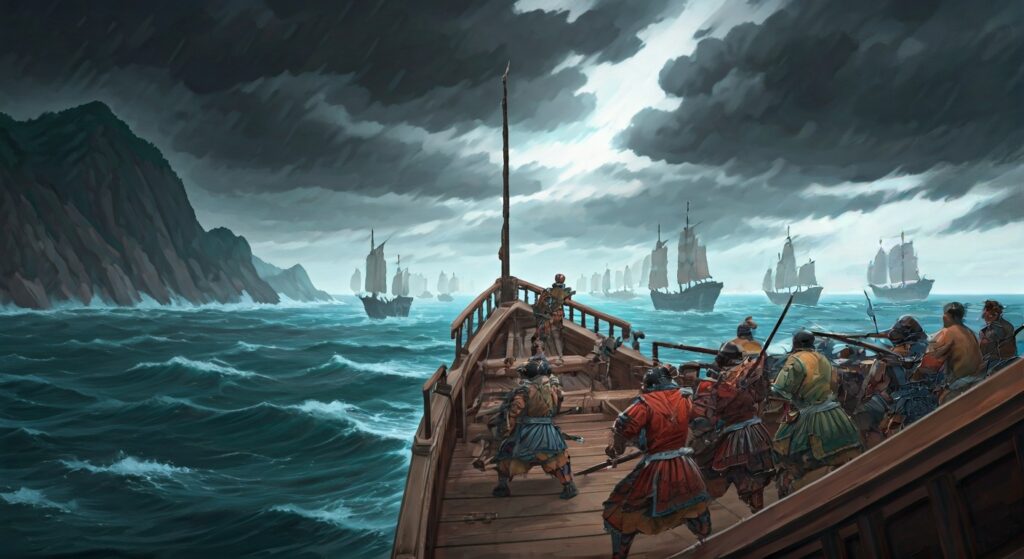
Imagine the horizon darkening with hundreds of heavily armed junks. It is the 16th century, and the coastal cities of Ming-dynasty China are bracing for the apocalypse. The invaders are the Wokou—the dreaded “Japanese pirates.” They are ruthless, wielding massive katanas and striking with the disciplined fury of masterless samurai.
But beneath the terrifying armor and the foreign battle cries lies one of the greatest plot twists in military history. The most devastating “Japanese” pirate fleet the world had ever seen wasn’t actually Japanese at all.
The Ghost Fleet of the East
For centuries, the word Wokou made blood run cold across the coasts of Korea and China. Originally translating to “dwarf pirates,” these early raiders were exactly what their name implied: impoverished Japanese fishermen, rogue merchants, and ronin (masterless samurai) operating out of rocky, isolated islands like Tsushima.
While Japan bled itself dry in endless civil wars, local feudal lords sponsored these opportunistic hit-and-run artists to fund their own military campaigns. They were brutal, but they were merely a prelude. By the 16th century, the Wokou had evolved from a ragtag nuisance into a multinational shadow empire that defied the greatest powers of Asia.
A Spectacular Case of Identity Theft
To understand the Golden Age of the Wokou, you have to look at a spectacularly disastrous piece of economic policy. In a paranoid attempt to control its population and monopolize foreign trade, the Ming Emperor implemented the Haijin—a strict “sea ban.”
Overnight, private maritime commerce was criminalized. For the coastal provinces of southeastern China, this wasn’t just a law; it was a death sentence. Desperate Chinese merchants, sailors, and fishermen couldn’t simply stop trading—their survival depended on it. Forced underground, they turned to smuggling. When the state cracked down, they armed themselves. Soon, these underground merchants evolved into massive, heavily armed syndicates.
According to the Ming Dynasty’s own historical records, during the devastating raids of the mid-16th century, up to 90 percent of the terrifying “Japanese pirates” were actually ethnic Chinese fighting for their economic survival.
The Ultimate Black-Market Syndicate
This was no chaotic band of thieves; it was a highly organized corporate empire. At the helm were brilliant Chinese pirate lords, the most notorious being Wang Zhi, who styled himself the “King of Hui.”
When the Ming military turned up the heat, Wang Zhi executed a logistical masterstroke: he relocated his base of operations to Kyushu, Japan. The local Japanese warlords welcomed him with open arms, eager for a cut of his unimaginable wealth.
From his Japanese stronghold, Wang Zhi built a black-market super-team. He recruited disenfranchised Japanese ronin from the chaotic Sengoku period, utilizing them as heavily armored shock troops. He drafted Korean smugglers for their navigational expertise. He even brought in early Portuguese explorers, who introduced advanced matchlock firearms to the pirate armadas.
At their peak, these fleets boasted hundreds of warships, built fortified island bases, and commanded forces large enough to lay siege to major Chinese cities like Nanjing. They operated completely outside the control of the Japanese shogunate and openly mocked the Ming Emperor’s authority.
The Elite Defensive Coordinator
How do you stop a heavily armed, multinational syndicate that boasts better logistics than your own navy? You bring in a tactical genius.
Enter Ming Dynasty General Qi Jiguang. Realizing that traditional Chinese military formations were being shredded by the aggressive, close-quarters combat style of the Japanese mercenaries, Qi Jiguang went to the drawing board.
He invented the “Mandarin Duck Formation”—a highly specialized, asymmetric squad tactic designed specifically to neutralize the terrifying swordsmanship of the Japanese ronin. By deploying interlocking teams of shield-bearers, spearmen, and musketeers, Qi Jiguang created a tactical meat-grinder that finally began turning the tide of the coastal wars.
The Market Always Wins
While General Qi Jiguang was winning the physical battles, the Ming government finally realized a hard truth: you cannot punch your way out of a supply chain crisis.
In 1567, the Ming Dynasty made a crucial concession—they lifted the Haijin and legalized private trade. Almost overnight, the economic incentive to be a pirate vanished. Why risk death against Qi Jiguang’s elite squads when you could simply pay a tax and trade legally?
Simultaneously, the great unifier Toyotomi Hideyoshi was bringing Japan’s chaotic Sengoku period to a close. In 1588, he issued strict anti-piracy edicts, confiscated weapons from the peasantry, and brought the rogue samurai to heel.
Just like that, the Wokou faded into the mists of history. To the Ming court, they were treasonous rebels. To the Japanese daimyo, they were lucrative business partners. But in reality, they were desperate free-traders reacting to a suffocating state monopoly, accidentally building one of the most formidable naval syndicates the world has ever seen.