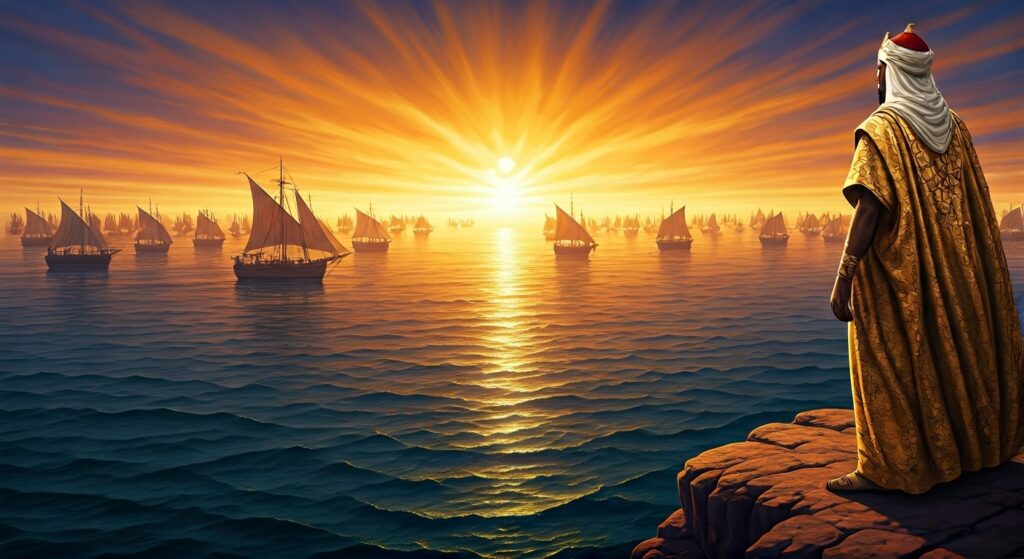
Things vanish. A set of keys. A ring. But how does an armada of two thousand ships, loaded with gold, warriors, and the absolute ruler of one of history’s greatest empires, simply disappear from the face of the earth?
Welcome back to Riveting History Daily. Today, we plunge into a 14th-century mystery that defies comprehension. Almost two centuries before Christopher Columbus dared to cross the Atlantic, the ninth ruler of the unimaginably wealthy Mali Empire, Mansa Abu Bakr II, surrendered his throne to sail into the abyss.
The Emperor Who Chased the Horizon
Everything we know about this staggering vanishing act stems from a single, legendary conversation. In 1324, Mansa Musa—Abu Bakr II’s successor, a man so wealthy his spending famously destabilized the Egyptian economy—stopped in Cairo during his pilgrimage to Mecca. While holding court with the local governor, Musa revealed the dark, strange truth of how he ascended to power.
Recorded by the Arab historian Shihab al-Umari, Musa’s account painted a portrait of a king consumed by the unknown. Abu Bakr II refused to accept that the Atlantic Ocean was infinite. He believed it had an edge, a further shore, and he possessed the boundless wealth of the Mali Empire to fund his obsession.
The River in the Sea
Abu Bakr II was a man of action. He commissioned an initial fleet of two hundred ships, packing them with men, gold, and enough provisions to last for years. His orders to the captains were absolute and terrifying: Do not return until you have reached the end of the ocean or exhausted your food.
Months bled into silence. Then, a single ship limped back to the West African coast.
Summoned before the emperor, the trembling captain recounted a nightmare. He claimed the fleet had sailed deep into the ocean until they encountered a violent ‘river in the sea’—a churning vortex modern researchers suspect was the treacherous Canary Current. The captain watched in horror as the rest of the fleet was sucked into the raging waters and swept into the void. Terrified, he turned his vessel around and fled.
The Ghost Armada
A rational monarch might have heard this tale of an ocean vortex and abandoned the sea forever. Abu Bakr II was not a rational monarch; he was a visionary driven by an insatiable hunger for discovery.
If his captains could not conquer the ocean, he would do it himself. He commissioned a staggering, unprecedented fleet of two thousand ships. One thousand were dedicated solely to his warriors and courtiers, while another thousand were loaded to the brim with provisions. In 1311, he officially abdicated his throne, naming Mansa Musa as regent.
With his empire behind him, Abu Bakr II sailed westward into the crushing swells of the Atlantic. He was never seen again.
Conquest, Catastrophe, or Cover-Up?
What happened to the ghost armada? This is where history fractures into fierce debate.
Mainstream historians view the voyage as a tragic suicide mission. The Mali Empire was an undisputed titan on land, but their nautical experience was largely confined to navigating the Niger River in canoes. Taking riverine vessels into the brutal open Atlantic is a recipe for swift annihilation.
Yet, a darker, more cynical theory lingers: Was there ever a fleet at all? Some scholars suspect Mansa Musa invented this heroic, romantic tale of abdication to legitimize his own rule and mask a bloody coup. Quietly disposing of a rival and telling the world he ‘went on a long voyage’ is a masterful, chilling political cover-up.
Conversely, a passionate fringe of scholars fiercely defends the voyage’s success. Historians like Ivan Van Sertima have argued that the Malian fleet did reach the Americas, pointing to alleged linguistic crossovers between West African and indigenous American dialects, as well as early Spanish reports of ‘guanin’—an African gold alloy. While mainstream academia largely dismisses these claims, the sheer magnitude of the possibility keeps the legend breathing.
Whether Abu Bakr II was a visionary who touched a new world, a tragic dreamer swallowed by the deep, or the phantom victim of a royal lie, his story shatters the Eurocentric narrative of the Age of Discovery. It leaves us with the haunting image of an African king who looked out at the edge of the world, and dared to chase it.