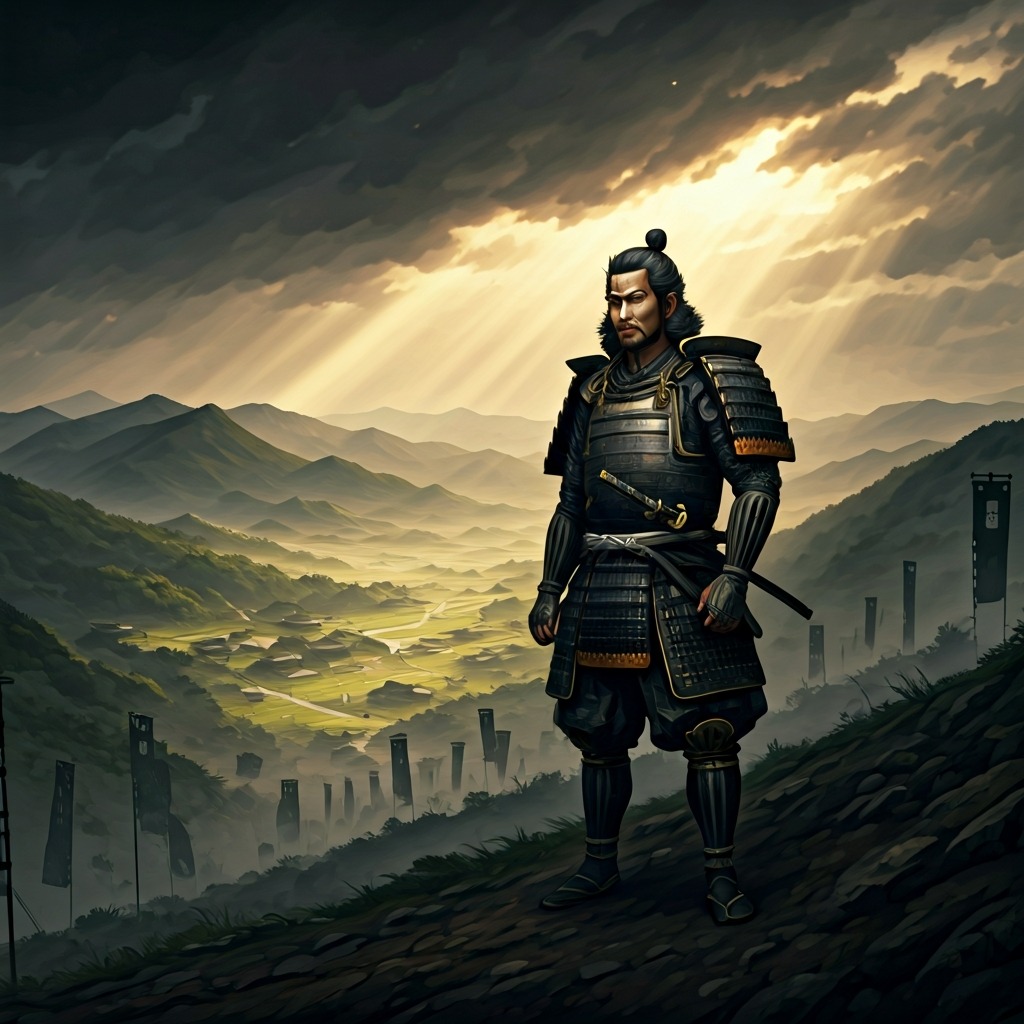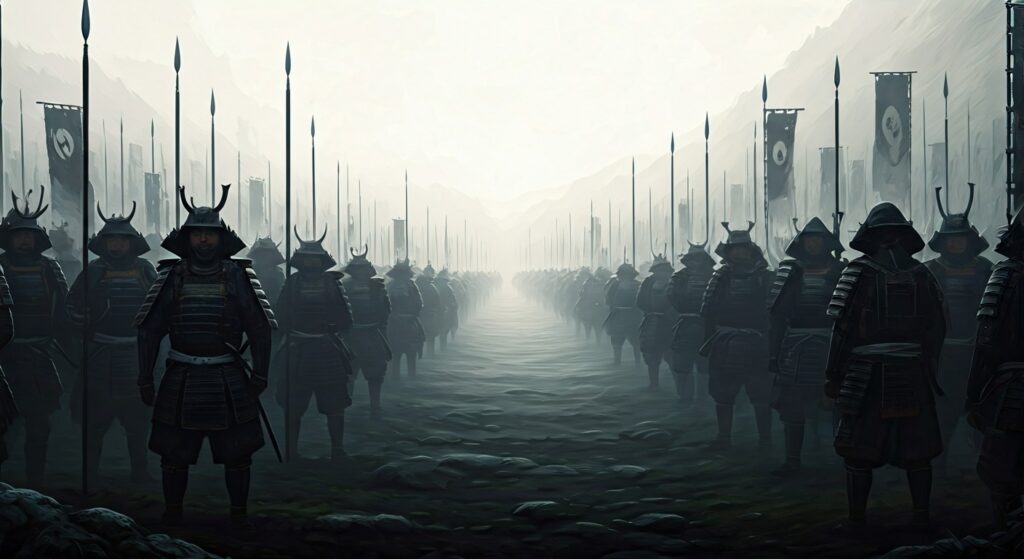
Dawn broke over the narrow valley of Sekigahara on October 21, 1600, but the sun was nowhere to be seen. A thick, suffocating fog choked the landscape, hiding the 160,000 armed men standing in the mist. They were waiting for the slaughter to begin. This was not merely a battle; it was the ultimate, winner-take-all clash that would dictate the future of Japan. The stakes were astronomical, the impending betrayals legendary, and the sheer martial insanity on display would echo through history for centuries.
The Throne of an Infant
Every great conflict requires a catalyst, and this one began with a death. When the great unifier Toyotomi Hideyoshi passed away in 1598, he left behind a massive power vacuum. His only heir was an infant named Hideyori, protected by a fragile council of regents sworn to keep the peace until the boy came of age.
But ambitious men do not wait for boys to grow up. Enter Tokugawa Ieyasu. Patient, calculating, and utterly ruthless, Ieyasu immediately began consolidating power. The realm quickly fractured into two massive coalitions. On one side stood Ieyasu’s Eastern Army. On the other was the Western Army, championed by Ishida Mitsunari. Mitsunari possessed a brilliant administrative mind and an unyielding devotion to the Toyotomi clan, making him a formidable organizer against Ieyasu’s seasoned military genius.
Demons and Dying Men
Before the first swords clashed, the psychological warfare was already at a fever pitch. Ieyasu’s roster was stacked with living legends. He commanded Honda Tadakatsu, famously known as the “Warrior who surpassed Death itself.” In over fifty battles, Tadakatsu had supposedly never sustained a single significant wound—a terrifying feat in an era of imperfect armor. Beside him rode Ii Naomasa, whose troops were dubbed the “Red Devils,” clad in blood-red armor specifically forged to strike terror into the hearts of their enemies.
But the Western Army fielded its own compelling figures, none more tragic than Otani Yoshitsugu. Otani was Mitsunari’s closest ally, yet he was suffering from advanced leprosy. Nearly blind and physically devastated, he had to be carried into battle in a palanquin. The heartbreaking reality? Otani had advised Mitsunari against starting this war, knowing the odds were stacked against them. Yet, out of pure, uncompromising loyalty, he rode into the fog, fully aware he was marching toward his doom.
The Traitor on the Mountain
For hours, the foggy valley of Sekigahara was a chaotic meat grinder of thrusting spears, deafening matchlock fire, and shattering armor. Men fought blindly, unable to see the enemy until they were inches away.
Despite Ieyasu’s star-studded vanguard, the Western Army held its ground. In fact, they possessed a massive tactical advantage. A young general named Kobayakawa Hideaki was stationed high above the valley on Mount Matsuo with a massive force of fresh troops. Whichever way Kobayakawa swung his forces, the battle would follow.
Here is where the suspense peaked: Kobayakawa had secretly promised Ieyasu he would defect and attack his own Western Army allies. But as the battle raged below, the young general froze. Paralyzed by indecision, he sat on the mountain, watching the carnage unfold.
A Gunshot That Changed History
Down in the blood-soaked valley, Ieyasu was losing his patience. His Eastern Army was bogging down, and the entire Tokugawa legacy hung by a thread. In one of the most audacious, high-risk gambles in military history, Ieyasu ordered his musketeers to aim up the mountain and fire upon Kobayakawa’s position.
He fired upon the very man he needed to save him.
The brutal tactic worked. Jolted out of his hesitation by the crack of gunfire, Kobayakawa ordered his men to charge down the mountain, crashing violently into the exposed flank of his own allies.
The betrayal shattered the Western Army. The troops who bore the brunt of this treachery were those commanded by the blind, dying Otani Yoshitsugu. Otani’s men fought like demons against the traitors until their lines finally collapsed. Knowing the end had come, Otani committed seppuku right there in his palanquin, begging his retainer to hide his severed head so it would never become a trophy for the men who betrayed him.
The Suicide Retreat
With the Western Army disintegrating, the battlefield turned into a slaughterhouse. But the Shimazu clan was not about to go down quietly.
The fierce warlord Shimazu Yoshihiro had been slighted by Mitsunari before the battle and had spent most of the day refusing to fight. Now, completely surrounded by the victorious Eastern Army, Yoshihiro had to make a choice. Surrender was out of the question. Retreating backward was impossible.
Instead, Yoshihiro ordered a Sutegamari—an “enemy-breaking retreat.” He commanded his remaining men to charge directly forward, straight through the vanguard of the Eastern Army.
To pull off this impossible escape, the Shimazu utilized a brutal rearguard tactic. Small groups of snipers would stop, sit cross-legged on the bloody ground, and calmly fire at their pursuers, fighting to the death simply to buy their lord a few more seconds. During this suicidal push, a Shimazu sniper shot the Red Devil himself, Ii Naomasa, in the arm—a wound that would eventually claim his life. Against all odds, Yoshihiro smashed through the lines and escaped.
Somewhere in that chaotic massacre of fleeing troops was a young, relatively unknown warrior fighting for the losing side. According to legend, that survivor was Miyamoto Musashi, the man who would go on to become Japan’s most legendary swordsman.
An Empire Forged in Blood
The aftermath was swift and absolute. Ishida Mitsunari was hunted down, captured, and executed in Kyoto. Tokugawa Ieyasu emerged from the fog as the undisputed master of the realm. In 1603, he officially received the title of Shogun.
That single, bloody morning in a narrow valley ended the chaotic era of warring states. It ushered in over 250 years of relative peace under the Tokugawa Shogunate, proving that while elite warriors and legendary armor are formidable, history is often decided by the man who blinks first on the side of a mountain.