In the sprawling, high-stakes chessboard of the Cold War, the apocalypse was nearly triggered by misplaced radar blips, secret missiles, and rogue submarines. But in the sweltering summer of 1976, the catalyst for World War III wasn’t a nuclear warhead. It was a 100-foot Normandy poplar tree.
The Deadliest Blind Spot on Earth
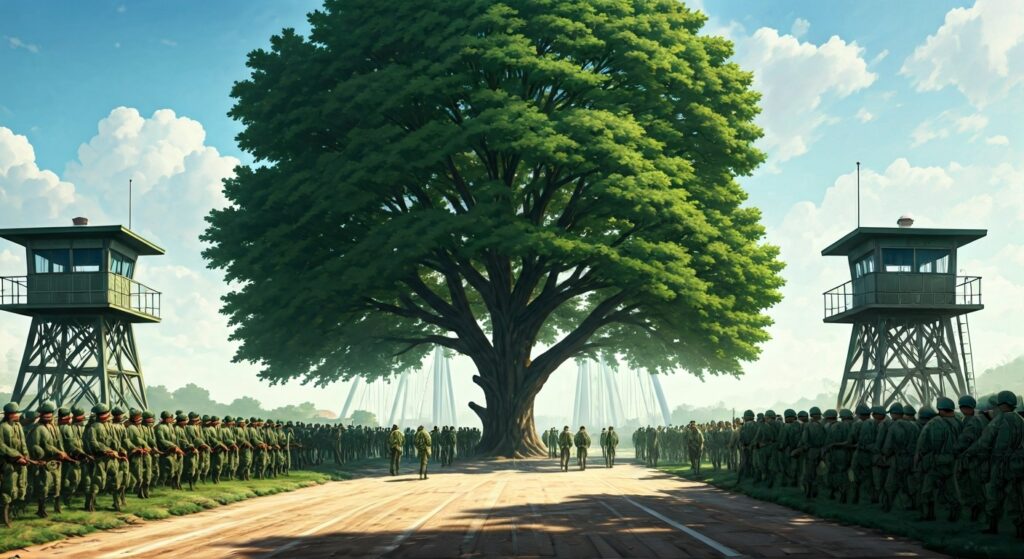
Picture the Joint Security Area (JSA) within the Korean Demilitarized Zone as a geopolitical powder keg. In the 1970s, North Korean and United Nations Command (UNC) forces still mingled in this shared space, glaring at each other across an invisible, highly contested line. Every step was calculated; every glance was a provocation.
Right in the middle of this tinderbox stood a massive poplar tree. By August 1976, its thick summer canopy had completely blocked the line of sight between UNC Checkpoint 3 and Observation Post 5. In a zone where a single misstep could trigger an artillery barrage, visibility was a matter of life and death.
The solution seemed simple: trim the tree. On August 18, 1976, a small UNC detail led by US Army Captain Arthur Bonifas and First Lieutenant Mark Barrett escorted a team of South Korean civilian workers into the JSA. Their mission was routine landscaping. It quickly became a grisly crime scene.
Blood at the Bridge of No Return
Shortly after the pruning began, a notoriously aggressive North Korean officer named Lieutenant Pak Chul marched up to the detail. Pak demanded the workers stop immediately, claiming the poplar had been personally planted and nurtured by North Korean supreme leader Kim Il Sung.
Captain Bonifas, hardened to the constant psychological warfare of the DMZ, ignored the posturing and ordered his men to continue.
Pak Chul did not hesitate. He signaled an attack, and dozens of North Korean guards swarmed the small, lightly armed UNC detail. In a flash of unprovoked brutality, the guards seized the workers’ axes and used them to bludgeon Bonifas and Barrett to death in broad daylight.
The murders sent shockwaves across the globe. The ultimate question landed squarely on the desks of US President Gerald Ford and Secretary of State Henry Kissinger: How do you avenge a brutal double murder without accidentally sparking a global nuclear holocaust?
The Lumberjack Protocol
The United States needed to project absolute, terrifying resolve. They had to prove that crossing the line would bring the full wrath of the American military down upon Pyongyang—but they had to do it without firing the first shot.
General Richard Stilwell, commander of US forces in Korea, conceived a plan so audacious it bordered on madness. He called it Operation Paul Bunyan.
The objective was highly symbolic and deceptively simple. The US military was going back into the JSA to finish the landscaping. They were going to cut the poplar tree down completely. But this time, they were bringing the apocalypse with them.
Chainsaws and Human Bombs
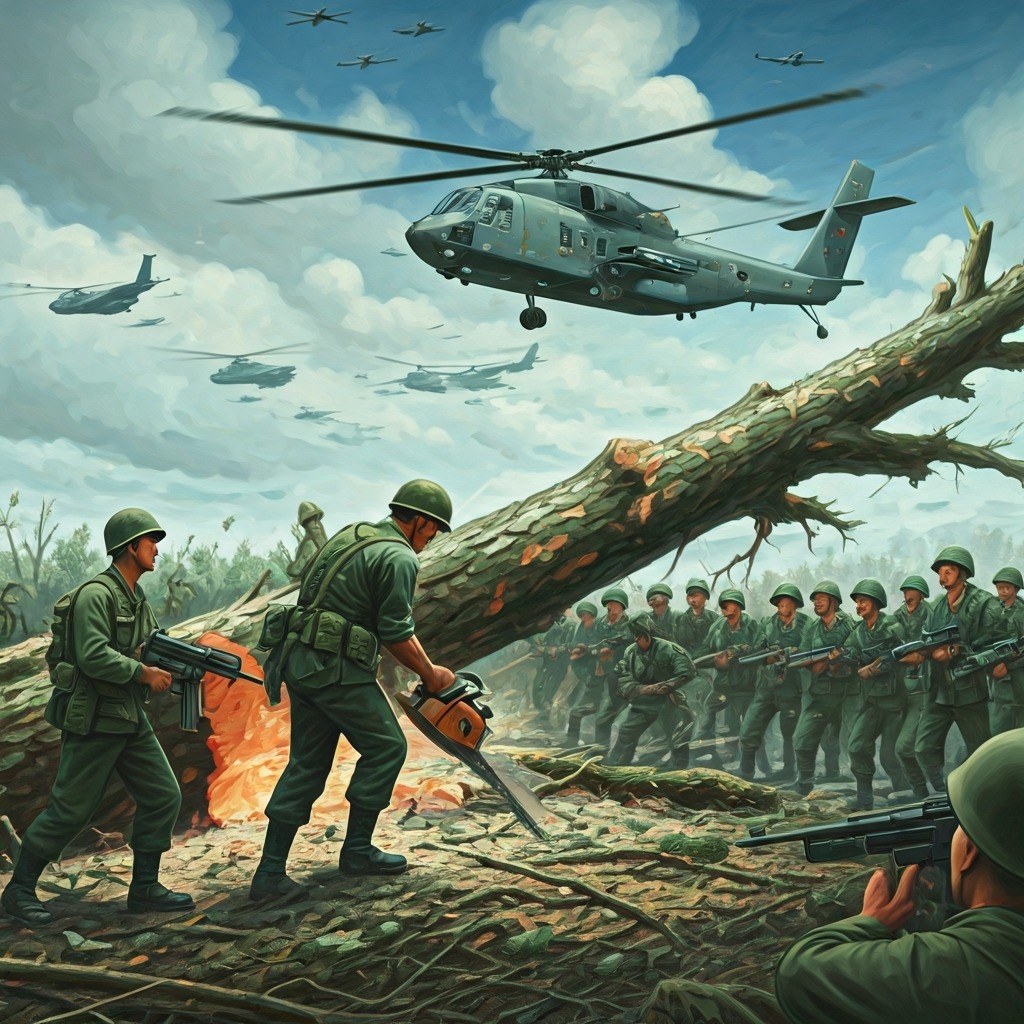
At exactly 07:00 on August 21, 1976, a convoy of 23 American and South Korean vehicles roared unannounced into the JSA. An eight-man team of military engineers jumped out, armed with chainsaws, and immediately laid into the trunk of the tree.
They were far from alone. Flanking the engineers were two 30-man security platoons from the US 2nd Infantry Division, armed with sidearms and axe handles. But the true intimidation factor came from the 64-man South Korean Special Forces unit that accompanied them.
These elite commandos were absolutely furious over the murders. Defying their own operational orders, many of these troops had strapped Claymore anti-personnel mines to their bare chests. They stood in the DMZ with the detonators in their hands, effectively turning themselves into human bombs, practically daring the North Koreans to step forward.
An Armada for a Poplar
The ground forces were merely the tip of the spear. As the chainsaws roared to life, the skies above the DMZ filled with a staggering armada.
Hovering just out of sight were 20 utility helicopters backed by AH-1 Cobra attack choppers. Above them circled US F-4 Phantom IIs and South Korean F-5 fighters. Higher still, escorted by F-111 bombers, were nuclear-capable B-52 Stratofortresses that had flown continuously from Guam. They deliberately flew high and visible, painting North Korean radar screens with the undeniable threat of total annihilation.
Offshore, the aircraft carrier USS Midway and its heavily armed task force moved into the Korea Strait. Ground artillery and Hawk missile systems locked onto North Korean positions, and 12,000 additional US troops were ordered to the peninsula.
All of this military might was mobilized to cut down a single tree.
Forty-Two Minutes to Armageddon
North Korea quickly dispatched roughly 150 heavily armed troops to the scene. The moment of truth had arrived. If a single North Korean soldier engaged, the peninsula would instantly plunge back into a devastating war.
But as the North Korean troops disembarked, they took in the scene. They saw the suicidal posture of the South Korean commandos clutching their Claymore detonators. They saw the axe handles. They looked up at a sky black with bombers and attack helicopters.
They stopped. And they watched in absolute silence.
The tree was felled in exactly 42 minutes, leaving only a 20-foot stump.
Operation Paul Bunyan was a resounding strategic success. The overwhelming show of force worked so flawlessly that, in a highly rare move, North Korean leader Kim Il Sung issued a message expressing “regret” over the deaths of the American officers. The US accepted this as a de facto apology, effectively de-escalating the crisis.
The Axe Murder Incident fundamentally changed the DMZ forever. The JSA was permanently divided by the Military Demarcation Line, ending the era of mingled forces. Eventually, the stump of the poplar tree was ripped from the earth, replaced by a quiet stone monument honoring Captain Bonifas and Lieutenant Barrett—a solemn marker of the most heavily armed landscaping job in human history.